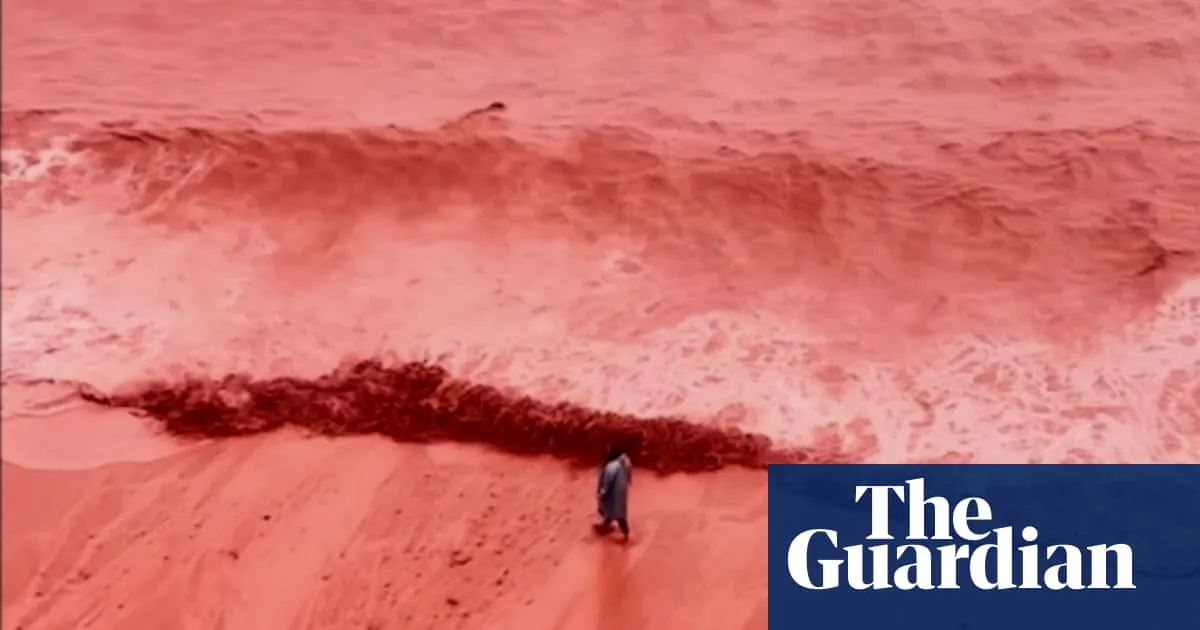
Rainfall on Iran’s Hormuz Island briefly transformed the coastline of its Red Beach into a striking natural scene this week, as red soil flowed into the sea and turned the water shades of deep red.The beach is known for its vivid red sand and cliffs, created by high concentrations of iron oxide.When rain falls, as it did on Tuesday, streams of red soil flow toward the shoreline, colouring the beach and the surrounding water and creating a sharp contrast with the blue waters of the Persian Gulf.The phenomenon regularly attracts tourists, photographers and social media attention. Beyond its visual appeal, the red soil – known locally as gelak – is exported in limited quantities and used in the production of cosmetics, pigments and some traditional products.Hormuz Island lies in the strait of Hormuz, where the Persian Gulf meets the Gulf of Oman, about 670 miles (1,080km) south of Iran’s capital, Tehran. Rainfall is relatively rare on the island, and happens mainly during the winter and early spring.
SRCThe Guardian - World News
LANGEN
LEANCenter-Left
WORDS167
ENT4
THU · 2025-12-18 · 12:56 GMTBRIEF NSR-2025-1218-3277
NSR-2025-1218-3277News Report·EN·Environmental
Rainfall creates crimson spectacle at beach on Iran’s Hormuz Island
Recent rainfall on Iran's Hormuz Island caused a striking visual phenomenon at its Red Beach, turning the coastline and surrounding waters crimson. The island's red soil, rich in iron oxide, flowed into the sea, creating a vivid contrast with the Persian Gulf's blue waters.
Associated Press in TehranThe Guardian - World NewsFiled 2025-12-18 · 12:56 GMTLean · Center-LeftRead · 1 min
The Guardian - World NewsFIG 01
Reading time
1min
Word count
167words
Sources cited
0cited
Entities identified
4entities
Quality score
100%
§ 01
Briefing Summary
AI-generatedNEWSAR · AI
Recent rainfall on Iran's Hormuz Island caused a striking visual phenomenon at its Red Beach, turning the coastline and surrounding waters crimson. The island's red soil, rich in iron oxide, flowed into the sea, creating a vivid contrast with the Persian Gulf's blue waters. This event, which occurred this week, regularly attracts tourists and photographers to the island, located in the Strait of Hormuz, about 670 miles south of Tehran. The red soil, known locally as gelak, has commercial value and is exported in limited quantities for use in cosmetics, pigments, and traditional products. Rainfall is infrequent on Hormuz Island, primarily occurring during winter and early spring.
Confidence 0.90Claims 9Entities 4
§ 02
Article analysis
Model · rule-basedFraming
Environmental
Human Interest
Tone
Measured
AI-assessed
CalmNeutralAlarmist
Factuality
0.90 / 1.00
Factual
LowHigh
Sources cited
0
No named sources
FewMany
§ 03
Key claims
9 extracted01
Hormuz Island lies in the strait of Hormuz, about 670 miles (1,080km) south of Iran’s capital, Tehran.
factual
Confidence
1.00
02
The beach is known for its vivid red sand and cliffs, created by high concentrations of iron oxide.
factual
Confidence
1.00
03
Rainfall on Iran’s Hormuz Island transformed the coastline of its Red Beach into a striking natural scene.
factual
Confidence
1.00
04
Hormuz Island lies about 670 miles (1,080km) south of Iran’s capital, Tehran.
factual
Confidence
1.00
05
The beach is known for its vivid red sand and cliffs, created by high concentrations of iron oxide.
factual
Confidence
1.00
06
Rainfall on Iran’s Hormuz Island transformed the coastline of its Red Beach into a striking natural scene.
factual
Confidence
1.00
07
Rainfall is relatively rare on the island, and happens mainly during the winter and early spring.
factual
Confidence
0.90
08
The red soil – known locally as gelak – is exported in limited quantities.
factual
Confidence
0.90
09
The red soil – known locally as gelak – is exported in limited quantities.
factual
Confidence
0.90
§ 04
Full report
1 min read · 167 words§ 05
Entities
4 identifiedKey playerOppositionContextPositiveNeutralNegative
§ 06
Keywords & salience
8 termsred beach
0.90
hormuz island
0.80
rainfall
0.70
red soil
0.70
iron oxide
0.60
persian gulf
0.50
natural phenomenon
0.50
gelak
0.40
§ 07
Topic connections
Interactive graph No topic relationship data available yet. This graph will appear once topic relationships have been computed.