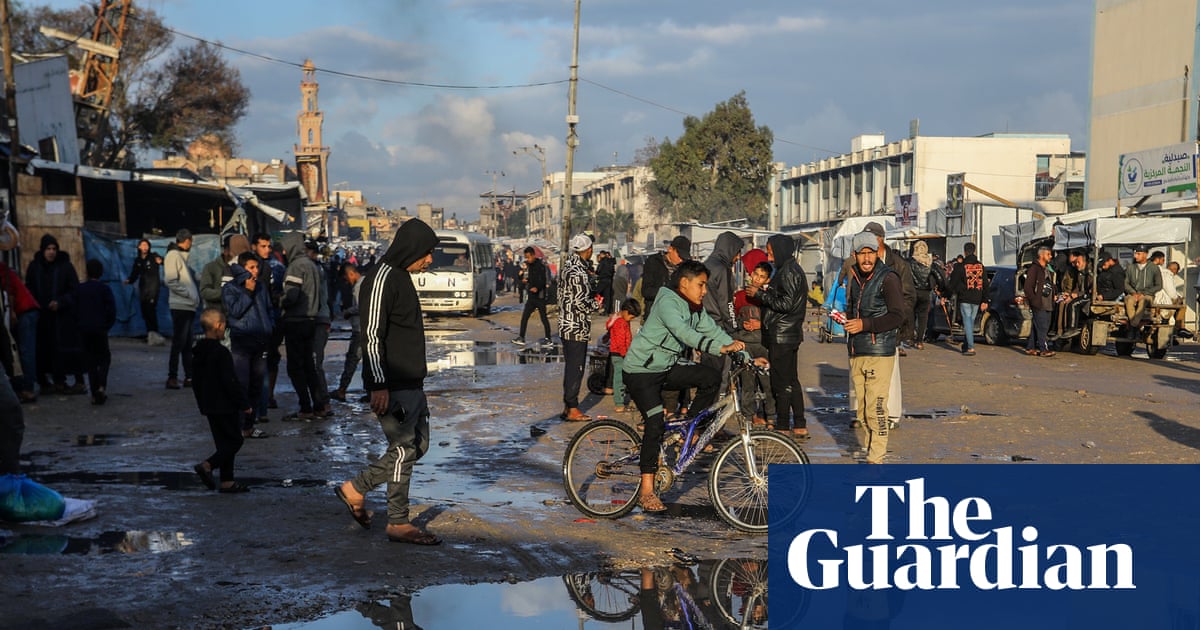
The famine in Gaza has ended as a result of increased humanitarian aid deliveries into the territory, the UN said on Friday, though it warned that levels of hunger and the humanitarian situation remained critical.Almost one in eight people in Gaza still faced food shortages, the UN said, adding that persistent hunger had been made worse by winter flooding and the colder weather. Most people in Gaza live in tents or other substandard accommodation as Israel destroyed much of the housing and civilian infrastructure during its two-year war.Israel has partly eased restrictions on the entry of aid since an October ceasefire between Israel and Hamas, but delivery was still limited and inconsistent, the UN said.“No areas are classified in famine,” said the Integrated Food Security Phase Classification (IPC) initiative, used by the UN to monitor food crises. The IPC first declared a famine in parts of Gaza in August after Israeli restrictions of food aid into the territory led to mass starvation, with at least 450 people starving to death, according to the Gaza ministry of health.The monitor said that despite the end of the famine classification, the situation in Gaza still remained dire, with “the entire Gaza Strip classified in emergency”. According to the IPC’s five-phase classification system, the emergency stage is just a step below famine and occurs when households have “very high acute malnutrition and excess mortality” due to lack of food.Before the ceasefire, Israel maintained a severe blockade on the entry of aid into Gaza, described as “systematic obstruction by Israel” by the UN under-secretary general for humanitarian affairs, Tom Fletcher, in August.After the US-mediated ceasefire took effect in October, Israel began to allow more aid from the UN and its partners to enter.“Following the ceasefire … the latest IPC analysis indicates notable improvements in food security and nutrition compared to the August 2025 analysis, which detected famine,” the IPC said.Aid workers have said that the deal remains fragile, however, with Israel carrying out near-daily strikes in the territory and both sides trading accusations of ceasefire violations.About 1.6 million people were expected to face “crisis” levels of hunger in the next four months, the IPC said, warning that if the ceasefire broke down, the strip could slip back into famine.Israel has vehemently denied the accusations that there is famine in Gaza and that it is restricting the entry of aid. Israel’s foreign ministry spokesperson, Oren Marmorstein, said in a post on X on Friday that in the face of “overwhelming and unequivocal evidence, even the IPC had to admit that there is no famine in Gaza”.Cogat, the Israeli body in charge of humanitarian affairs in Gaza, said the IPC report “portrays a distorted, biased, and unfounded picture of the humanitarian situation in the Gaza Strip”.The humanitarian community and the UN have widely acknowledged famine in Gaza, and the IPC is considered the global authority on food crises.Oxfam said hunger in Gaza remained at an “appalling” level and accused Israel of blocking humanitarian groups from bringing aid into the territory. “Oxfam alone has $2.5m worth of aid including 4,000 food parcels, sitting in warehouses just across the border. Israeli authorities refuse it all,” Nicolas Vercken, the campaigns and advocacy director at Oxfam France, said in a statement.Hundreds of thousands of people are still enduring torrential rains and the cold in frayed tents. Pictures of flooded encampments at the start of winter have circulated on social media. The threat of disease outbreaks remains high as hygiene conditions are subpar in the crowded tent settlements.On Wednesday, a 29-day-old baby died of hypothermia, according to Gaza’s ministry of health. “Children are losing their lives because they lack the most basic items for survival,” said Bilal Abu Saada, the nursing team supervisor at Nasser hospital, which received the baby before it died.The ceasefire remains fragile, with negotiators still unable to bridge the differences necessary to move to the second phase of the deal – meant to lead to a permanent peace.The US special envoy to the Middle East, Steve Witkoff, is due to meet senior Qatari, Egyptian and Turkish officials in Miami on Friday to discuss how to move to the second part of the ceasefire deal, Israeli media reported.Under the second phase, Israel is supposed to withdraw from the 53% of Gaza it still controls, while a transitional authority will replace Hamas as the governing power, and an international stabilisation force is to be deployed in the territory.The Qatari prime minister, Sheikh Mohammed bin Abdulrahman bin Jassim al-Thani, warned on Thursday that delays in moving to the second phase of the deal, as well as ceasefire violations, “endanger the entire process”.
SRCThe Guardian - World News
LANGEN
LEANCenter-Left
WORDS771
ENT4
FRI · 2025-12-19 · 17:58 GMTBRIEF NSR-2025-1219-3516
NSR-2025-1219-3516News Report·EN·Human Rights
Gaza no longer in famine but hunger levels remain critical, UN says
The UN announced on Friday that the famine in Gaza has ended due to increased humanitarian aid deliveries, though critical hunger levels persist. While no areas are currently classified as experiencing famine, the entire Gaza Strip is still considered an emergency situation, with a large portion of the population facing crisis levels of hunger.
William Christou in BeirutThe Guardian - World NewsFiled 2025-12-19 · 17:58 GMTLean · Center-LeftRead · 4 min
The Guardian - World NewsFIG 01
Reading time
4min
Word count
771words
Sources cited
5cited
Entities identified
4entities
Quality score
100%
§ 01
Briefing Summary
AI-generatedNEWSAR · AI
The UN announced on Friday that the famine in Gaza has ended due to increased humanitarian aid deliveries, though critical hunger levels persist. While no areas are currently classified as experiencing famine, the entire Gaza Strip is still considered an emergency situation, with a large portion of the population facing crisis levels of hunger. The Integrated Food Security Phase Classification (IPC) noted improvements in food security since August 2025, following an October ceasefire between Israel and Hamas that led to eased restrictions on aid entry. However, the UN warns that the situation remains fragile, with potential for renewed famine if the ceasefire breaks down, especially as 1.6 million people are expected to face crisis levels of hunger in the coming months. Despite the improved situation, one in eight people in Gaza still face food shortages, exacerbated by winter flooding and inadequate housing.
Confidence 0.90Sources 5Claims 5Entities 4
§ 02
Article analysis
Model · rule-basedFraming
Human Rights
Conflict
Tone
Measured
AI-assessed
CalmNeutralAlarmist
Factuality
0.70 / 1.00
Factual
LowHigh
Sources cited
5
Well sourced
FewMany
§ 03
Key claims
5 extracted01
No areas are classified in famine.
factualIntegrated Food Security Phase Classification (IPC)
Confidence
1.00
02
Almost one in eight people in Gaza still faced food shortages.
statisticUN
Confidence
0.90
03
The famine in Gaza has ended due to increased humanitarian aid deliveries.
factualUN
Confidence
0.90
04
Israel has partly eased restrictions on the entry of aid since an October ceasefire.
factualUN
Confidence
0.80
05
About 1.6 million people were expected to face “crisis” levels of hunger in the next four months.
predictionIPC
Confidence
0.70
§ 04
Full report
4 min read · 771 words§ 05
Entities
4 identifiedKey playerOppositionContextPositiveNeutralNegative
§ 06
Keywords & salience
9 termsgaza
1.00
famine
0.90
humanitarian aid
0.80
food security
0.70
hunger
0.70
food shortages
0.60
ipc
0.50
ceasefire
0.50
emergency
0.40
§ 07
Topic connections
Interactive graph Network visualization showing 51 related topics
View Full Graph Person Organization Location Event|Click node to navigate|Edge numbers = shared articles