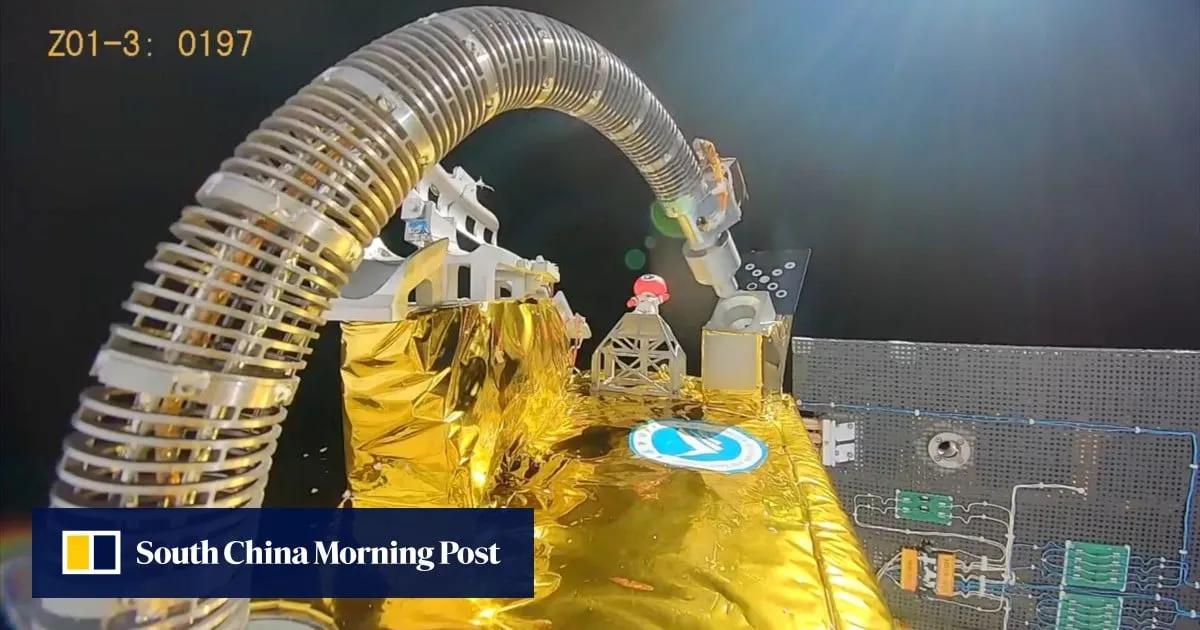
A Chinese commercial satellite has completed a refuelling test in low Earth orbit using a flexible “octopus tentacle” robotic arm, advancing efforts to extend spacecraft lifespans and develop in-orbit servicing abilities.The Hukeda-2, or Yuxing-3 06, demonstration satellite used its flexible arm to carry out compliance control and refuelling tests after blasting off from Jiuquan in China’s northwestern Gansu province last week, state broadcaster CCTV reported on Tuesday.The arm can curl, twist and wrap around objects to work in tight, complex spaces, with a nozzle-like tip at one end designed to line up and connect with a target port.It is made of a series of linked spring-like tubes with motors that pull on cables, bending its joints to guide the tip into place, according to the Tsinghua Shenzhen International Graduate School, which led the arm’s design and development.It is unclear if the Hukeda-2 docked with another satellite.To refuel another satellite, the Hukeda-2 would have to dock precisely with a port as both satellites hurtled around Earth at about 27,000km/h (16,800mph), a major challenge that the developers likened to “threading a needle in space”.
SRCSouth China Morning Post
LANGEN
LEANCenter-Right
WORDS182
ENT7
THU · 2026-03-26 · 01:31 GMTBRIEF NSR-2026-0326-36032
NSR-2026-0326-36032News Report·EN·Technology
Chinese satellite performs landmark refuelling test in low Earth orbit
A Chinese commercial satellite, Hukeda-2, successfully completed a refuelling test in low Earth orbit, demonstrating advancements in in-orbit servicing capabilities. Launched from Jiuquan, the satellite utilized a flexible robotic arm, designed by Tsinghua Shenzhen International Graduate School, to perform compliance control and refuelling procedures.
Ling XinSouth China Morning PostFiled 2026-03-26 · 01:31 GMTLean · Center-RightRead · 1 min
South China Morning PostFIG 01
Reading time
1min
Word count
182words
Sources cited
2cited
Entities identified
7entities
Quality score
100%
§ 01
Briefing Summary
AI-generatedNEWSAR · AI
A Chinese commercial satellite, Hukeda-2, successfully completed a refuelling test in low Earth orbit, demonstrating advancements in in-orbit servicing capabilities. Launched from Jiuquan, the satellite utilized a flexible robotic arm, designed by Tsinghua Shenzhen International Graduate School, to perform compliance control and refuelling procedures. The arm, described as having "octopus tentacle" capabilities, is engineered to navigate complex spaces and precisely connect with a target port for fuel transfer. While it is unclear if Hukeda-2 docked with another satellite, the test represents a significant step towards extending spacecraft lifespans through in-orbit refuelling, a challenging process requiring precise docking at high speeds. The successful demonstration highlights China's progress in developing technology for servicing satellites in space.
Confidence 0.90Sources 2Claims 5Entities 7
§ 02
Article analysis
Model · rule-basedFraming
Technology
National Security
Tone
Measured
AI-assessed
CalmNeutralAlarmist
Factuality
0.80 / 1.00
Factual
LowHigh
Sources cited
2
Limited
FewMany
§ 03
Key claims
5 extracted01
Both satellites hurtle around Earth at about 27,000km/h (16,800mph).
statistic
Confidence
1.00
02
To refuel another satellite, the Hukeda-2 would have to dock precisely with a port.
factual
Confidence
1.00
03
The arm can curl, twist and wrap around objects to work in tight, complex spaces.
factualTsinghua Shenzhen International Graduate School
Confidence
1.00
04
The Hukeda-2 used its flexible arm to carry out compliance control and refuelling tests.
factualCCTV
Confidence
1.00
05
A Chinese commercial satellite has completed a refuelling test in low Earth orbit.
factual
Confidence
1.00
§ 04
Full report
1 min read · 182 words§ 05
Entities
7 identifiedKey playerOppositionContextPositiveNeutralNegative
Organizations3
§ 06
Keywords & salience
9 termssatellite refuelling
1.00
low earth orbit
0.80
robotic arm
0.70
in-orbit servicing
0.70
hukeda-2
0.60
spacecraft lifespan
0.60
docking
0.50
compliance control
0.50
space technology
0.40
§ 07
Topic connections
Interactive graph Network visualization showing 51 related topics
View Full Graph Person Organization Location Event|Click node to navigate|Edge numbers = shared articles