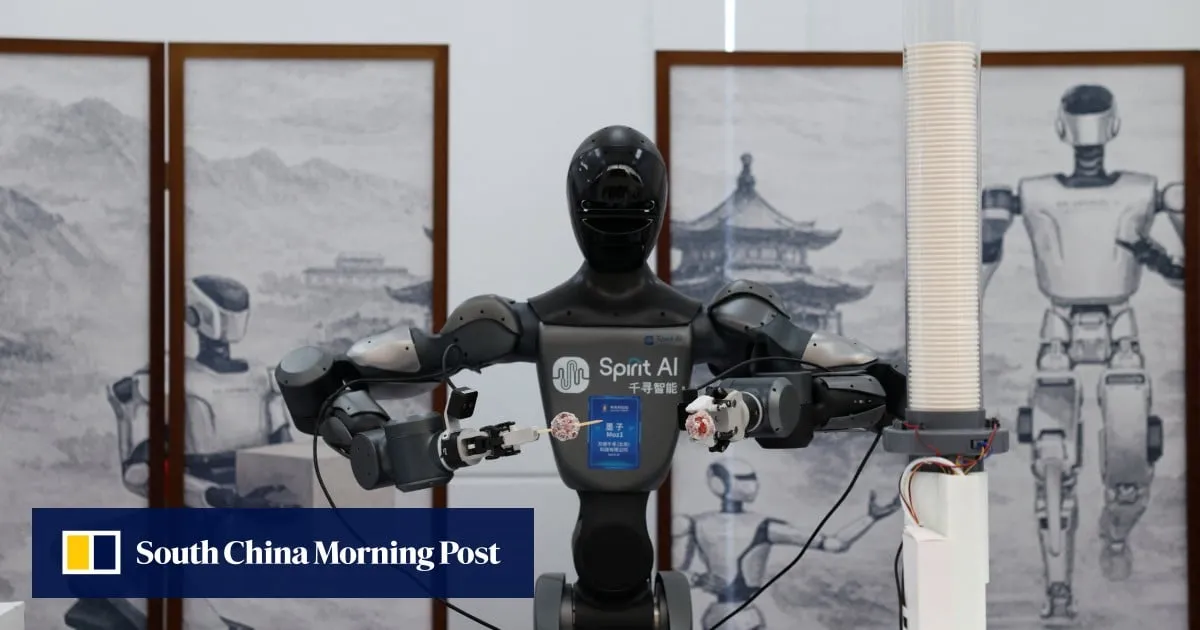
A “ChatGPT moment” for China’s humanoid robots – the tipping point at which the technology becomes widely usable – remains years away as persistent challenges in adapting to new tasks and training efficiency continue to hold back the industry, leading experts said on Wednesday at the Boao Forum for Asia in Hainan.Despite rapid advances in recent years, humanoid robots were still far from large-scale deployment, with both hardware and software limitations yet to be fully resolved, panellists said during a discussion on the sector’s future.“The core issue is that robotics data is extremely high-dimensional, while text data [used to train large language models] is essentially one-dimensional,” said Shao Hao, chief scientist at the robotics lab of Chinese smartphone maker Vivo.“Looking back, deep learning began gaining momentum around 2012, but the breakthrough moment didn’t arrive until around 2019. The key difference maker was data.”A Kuavo-5W humanoid robot by Leju Robotics passes freshly made coffee to a journalist during a demonstration at the 2026 Zhongguancun Forum, a major annual technology conference in Beijing on March 25. Photo: ReutersIn the robotics industry, references to OpenAI’s “ChatGPT” have become shorthand for the point at which a technology overcomes key technical bottlenecks and achieves mass adoption.By massively expanding the volume of training data – including large amounts of human-labelled inputs – OpenAI developed models capable of generalising across previously unseen tasks, underpinning ChatGPT’s launch in late 2022.
SRCSouth China Morning Post
LANGEN
LEANCenter-Right
WORDS232
ENT11
THU · 2026-03-26 · 01:15 GMTBRIEF NSR-2026-0326-36035
NSR-2026-0326-36035News Report·EN·Technology
Why China’s humanoid robots are still waiting for their ‘ChatGPT moment’
Experts at the Boao Forum for Asia in Hainan stated that China's humanoid robot industry is still years away from achieving a "ChatGPT moment" due to challenges in adapting to new tasks and training efficiency. Despite recent advancements, large-scale deployment is hindered by unresolved hardware and software limitations.
Vincent ChowSouth China Morning PostFiled 2026-03-26 · 01:15 GMTLean · Center-RightRead · 1 min
South China Morning PostFIG 01
Reading time
1min
Word count
232words
Sources cited
1cited
Entities identified
11entities
Quality score
100%
§ 01
Briefing Summary
AI-generatedNEWSAR · AI
Experts at the Boao Forum for Asia in Hainan stated that China's humanoid robot industry is still years away from achieving a "ChatGPT moment" due to challenges in adapting to new tasks and training efficiency. Despite recent advancements, large-scale deployment is hindered by unresolved hardware and software limitations. A key issue is the high-dimensional nature of robotics data compared to the one-dimensional text data used for training large language models like ChatGPT. The robotics industry needs to overcome technical bottlenecks and achieve mass adoption through expanded training data, similar to how OpenAI's ChatGPT achieved its breakthrough. The lack of sufficient data is preventing Chinese humanoid robots from generalizing across unseen tasks.
Confidence 0.90Sources 1Claims 5Entities 11
§ 02
Article analysis
Model · rule-basedFraming
Technology
Economic Impact
Tone
Measured
AI-assessed
CalmNeutralAlarmist
Factuality
0.70 / 1.00
Factual
LowHigh
Sources cited
1
Limited
FewMany
§ 03
Key claims
5 extracted01
Robotics data is extremely high-dimensional, while text data [used to train large language models] is essentially one-dimensional.
quoteShao Hao, chief scientist at the robotics lab of Chinese smartphone maker Vivo
Confidence
1.00
02
OpenAI developed models capable of generalising across previously unseen tasks by massively expanding the volume of training data.
factual
Confidence
0.90
03
Humanoid robots were still far from large-scale deployment, with both hardware and software limitations yet to be fully resolved.
factualpanellists
Confidence
0.90
04
Persistent challenges in adapting to new tasks and training efficiency continue to hold back the industry.
factualleading experts
Confidence
0.90
05
A “ChatGPT moment” for China’s humanoid robots remains years away.
predictionleading experts
Confidence
0.80
§ 04
Full report
1 min read · 232 words§ 05
Entities
11 identifiedKey playerOppositionContextPositiveNeutralNegative
Organizations5
§ 06
Keywords & salience
9 termshumanoid robots
1.00
chatgpt moment
0.90
robotics data
0.80
large language models
0.70
training data
0.70
mass adoption
0.60
deep learning
0.50
technical bottlenecks
0.50
china
0.40
§ 07
Topic connections
Interactive graph Network visualization showing 51 related topics
View Full Graph Person Organization Location Event|Click node to navigate|Edge numbers = shared articles