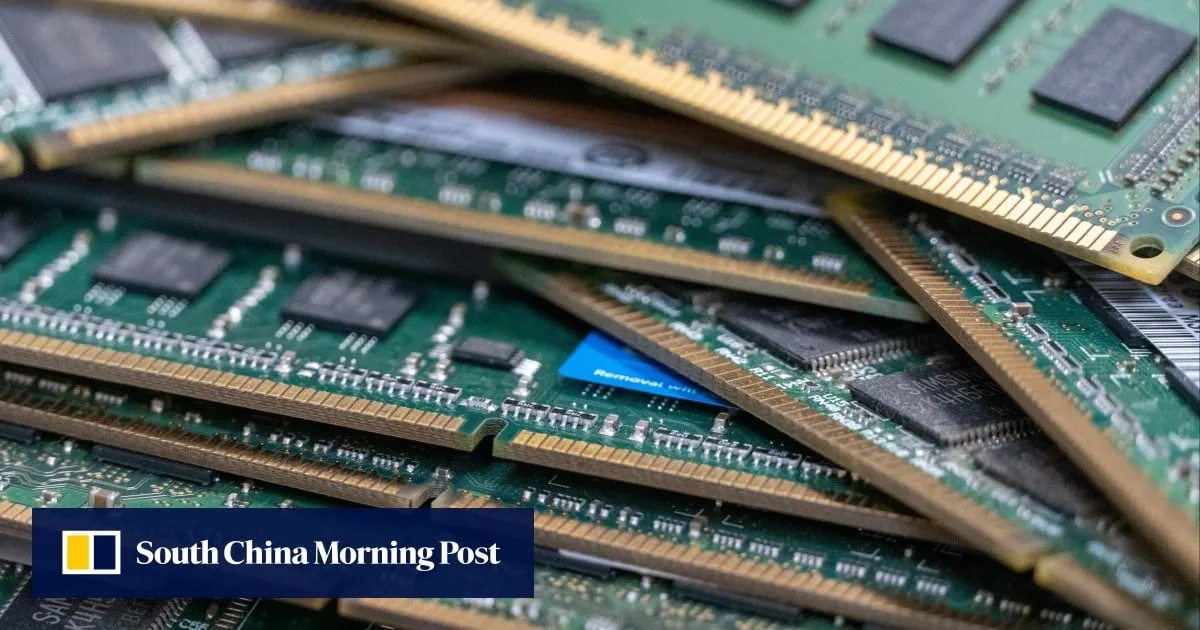
A new artificial intelligence algorithm developed by Google that could reduce demand for memory chips triggered a slump in global memory stocks, but analysts said it presented an opportunity for investors to “buy the dip”.Shares in memory giants including Samsung and SK Hynix fell after Google said in a blog post on Tuesday that the algorithm, called TurboQuant, reduced the memory demands of key-value (KV) caches – a crucial component of how AI models are served to users – by six times through “extreme compression” of information. Investors panicked that the efficiency gains would dampen demand for memory chips.The corresponding research paper for TurboQuant was published in April.The immediate market pullback extended to major Chinese memory firms GigaDevice Semiconductor and Montage Technology, whose shares in Shanghai fell by 5.89 and 3.53 per cent, respectively, on Thursday.However, analysts said that TurboQuant was instead a boon for memory and the AI industry overall. By increasing the amount of throughput possible with each chip, TurboQuant meant that inference costs would fall, said Shawn Kim, Morgan Stanley’s head of Asia technology research, in a research note on Thursday.The diverging views underscore huge demand-side uncertainties surrounding the future of the unprecedented AI infrastructure buildout under way, amid continued concerns over an AI bubble that has driven up the valuations of memory and semiconductor companies worldwide.Rather than reducing demand for memory chips, however, TurboQuant could have the opposite effect because of the so-called Jevons Paradox, where efficiency gains increase total demand as services become cheaper to access, spawning more users and use cases, Kim said. The concept is named for 19th-century economist William Stanley Jevons.
SRCSouth China Morning Post
LANGEN
LEANCenter-Right
WORDS269
ENT10
THU · 2026-03-26 · 13:24 GMTBRIEF NSR-2026-0326-37248
NSR-2026-0326-37248News Report·EN·Economic Impact
Google’s TurboQuant AI advance dents memory-chip stocks, but analysts say ‘buy the dip’
Google's new AI algorithm, TurboQuant, which significantly reduces memory demands for AI models, caused a temporary dip in memory chip stocks globally, including Samsung, SK Hynix, GigaDevice Semiconductor, and Montage Technology. TurboQuant achieves this by compressing information in key-value caches, a critical component for serving AI models, by six times.
Vincent ChowSouth China Morning PostFiled 2026-03-26 · 13:24 GMTLean · Center-RightRead · 2 min
South China Morning PostFIG 01
Reading time
2min
Word count
269words
Sources cited
1cited
Entities identified
10entities
Quality score
100%
§ 01
Briefing Summary
AI-generatedNEWSAR · AI
Google's new AI algorithm, TurboQuant, which significantly reduces memory demands for AI models, caused a temporary dip in memory chip stocks globally, including Samsung, SK Hynix, GigaDevice Semiconductor, and Montage Technology. TurboQuant achieves this by compressing information in key-value caches, a critical component for serving AI models, by six times. While investors initially worried about decreased demand for memory chips, analysts suggest the technology could actually boost demand due to the Jevons Paradox. This paradox states that increased efficiency can lead to greater overall consumption as services become more accessible and affordable. Analysts are advising investors to capitalize on the stock dip, viewing TurboQuant as beneficial for both the memory and AI industries. The research paper for TurboQuant was published in April.
Confidence 0.90Sources 1Claims 5Entities 10
§ 02
Article analysis
Model · rule-basedFraming
Economic Impact
Technology
Tone
Measured
AI-assessed
CalmNeutralAlarmist
Factuality
0.70 / 1.00
Factual
LowHigh
Sources cited
1
Limited
FewMany
§ 03
Key claims
5 extracted01
GigaDevice Semiconductor and Montage Technology shares in Shanghai fell by 5.89 and 3.53 per cent, respectively, on Thursday.
statistic
Confidence
1.00
02
Shares in memory giants including Samsung and SK Hynix fell after Google's announcement.
factual
Confidence
1.00
03
Google’s TurboQuant algorithm reduced the memory demands of key-value caches by six times.
factualGoogle
Confidence
0.90
04
TurboQuant meant that inference costs would fall.
quoteShawn Kim, Morgan Stanley
Confidence
0.80
05
TurboQuant could have the opposite effect because of the so-called Jevons Paradox.
predictionShawn Kim, Morgan Stanley
Confidence
0.60
§ 04
Full report
2 min read · 269 words§ 05
Entities
10 identifiedKey playerOppositionContextPositiveNeutralNegative
Organizations6
Locations1
Events1
§ 06
Keywords & salience
10 termsturboquant
1.00
artificial intelligence
0.90
memory chips
0.80
demand
0.70
google
0.70
efficiency gains
0.60
memory stocks
0.60
jevons paradox
0.50
ai models
0.50
investors
0.50
§ 07
Topic connections
Interactive graph Network visualization showing 51 related topics
View Full Graph Person Organization Location Event|Click node to navigate|Edge numbers = shared articles