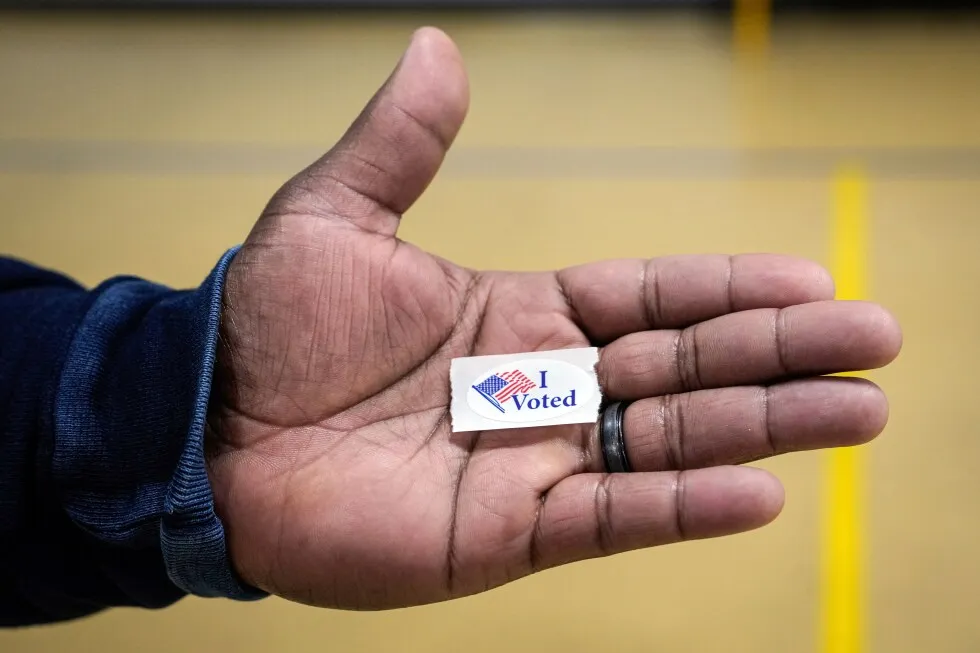
Sasha Dix holds his, “I voted,” sticker after voting at T.C. Roberson High School on Election Day, Nov. 5, 2024, in Asheville, N.C. (AP Photo/Kathy Kmonicek, File) Updated [hour]:[minute] [AMPM] [timezone], [monthFull] [day], [year] RALEIGH, N.C. (AP) — North Carolina’s photo voter identification law was upheld on Thursday, as a federal judge set aside arguments by civil rights groups that Republicans enacted the requirement with discriminatory intent against Black and Latino voters.The decision by U.S. District Judge Loretta Biggs is a huge legal victory for Republican legislative leaders who passed the law in late 2018 — weeks after voters approved a constitutional amendment backing the idea.North Carolina state Senate leader Phil Berger said in a news release that with Biggs’ decision, “we can put to rest any doubt that our state’s Voter I.D. law is constitutional.”Biggs had presided in spring 2024 over a non-jury trial in a lawsuit filed by the state NAACP and local chapters, which argued that the ID requirement violated the U.S. Constitution and the federal Voting Rights Act. At trial, the NAACP alleged Republican legislators passed the voter ID law to entrench their political power by discouraging people historically aligned with Democrats from voting. But lawyers for Republican lawmakers helping defend the law with state attorneys argued that Republicans wouldn’t have passed one of the most permissive voter ID laws among states that have them if they wanted to entrench themselves in state politics. They argued that the law is race-neutral and contains many more categories of qualifying ID than was allowed under a previously approved 2013 voter ID law that was struck down years ago. The lawyers also said the General Assembly had legitimate state interests in building voter confidence in elections and preventing voter fraud. Still, nationwide voter identity fraud is rare. State NAACP President Deborah Dicks Maxwell called Thursday’s decision “deeply disappointing and ignores the real and documented barriers” that voter ID laws have on certain voters. No decision has been made on whether to appeal the ruling. Even with the federal litigation, the 2018 voter ID law has been carried out since the 2023 municipal elections, after the state Supreme Court upheld the law in a separate lawsuit. Those elections have included the March 3 primary — nearly all of its results were certified on Wednesday. In her 134-page decision and order, Biggs, who was nominated to the court by President Barack Obama, said evidence in the trial record did suggest the burden to obtain IDs fell more on Black and Hispanic voters. As a result, a disparate number of racial minority voters would be among thousands who will not possess the required ID on Election Day, and ultimately “for many their vote will not count when the election is certified.”Biggs said the state’s history of race-based discrimination and voter suppression favors a finding that the law was enacted with discriminatory intent. But she wrote that previous rulings — including one from an federal appeals court panel earlier in the case — requires “this Court to assign less weight to the historical background” and “almost impenetrable deference to the presumption” that lawmakers approved the law in good faith. Biggs had previously issued in 2019 a preliminary injunction blocking enforcement of the 2018 law, saying it was tainted because the 2013 voter ID law was struck down on similar grounds of racial bias. But the 4th U.S. Circuit Court of Appeals reversed her decision, writing that she had put too much emphasis on the past conduct of the General Assembly when evaluating the 2018 law.So based on the “preliminary injunction record, the limited evidence presented at trial, and the arguments of counsel,” the court “concludes that it is compelled by controlling case law” to side with legislative leaders and the state elections board, Biggs wrote Thursday.North Carolina law offers free ID cards for voting at county election offices statewide and at the Division of Motor Vehicles. People lacking photo ID for the polls should have their votes count if they fill out an exception form or bring in their ID to election officials before the final tallies. In the separate state court lawsuit, the 2018 law was struck down initially. But when the state Supreme Court flipped from a Democratic to a Republican majority, the justices agreed to revisit the matter and proceeded to uphold the law.Thirty-six states have laws requesting or requiring identification at the polls, 23 of which seek photo ID, according to the National Conference of State Legislatures.
SRCAssociated Press (AP)
LANGEN
LEANCenter
WORDS748
ENT9
THU · 2026-03-26 · 20:23 GMTBRIEF NSR-2026-0326-38012
NSR-2026-0326-38012News Report·EN·Legal & Judicial
North Carolina’s photo voter ID mandate can continue as a judge upholds the law
A federal judge in North Carolina upheld the state's photo voter identification law on Thursday, dismissing claims by civil rights groups, including the NAACP, that it was enacted with discriminatory intent against Black and Latino voters. U.S.
By
GARY D. ROBERTSONAssociated Press (AP)Filed 2026-03-26 · 20:23 GMTLean · CenterRead · 3 min
Associated Press (AP)FIG 01
Reading time
3min
Word count
748words
Sources cited
4cited
Entities identified
9entities
Quality score
100%
§ 01
Briefing Summary
AI-generatedNEWSAR · AI
A federal judge in North Carolina upheld the state's photo voter identification law on Thursday, dismissing claims by civil rights groups, including the NAACP, that it was enacted with discriminatory intent against Black and Latino voters. U.S. District Judge Loretta Biggs' decision is a victory for Republican legislators who passed the law in 2018. The NAACP argued the law violated the U.S. Constitution and the Voting Rights Act, aiming to entrench Republican power by discouraging Democratic-leaning voters. Republican lawmakers defended the law as race-neutral, citing its broad range of acceptable IDs and the state's interest in voter confidence and fraud prevention. Despite the ruling, the NAACP expressed disappointment and is considering an appeal. The voter ID law has been in effect since the 2023 municipal elections, following a state Supreme Court ruling in a separate lawsuit.
Confidence 0.90Sources 4Claims 5Entities 9
§ 02
Article analysis
Model · rule-basedFraming
Legal & Judicial
Political Strategy
Tone
Measured
AI-assessed
CalmNeutralAlarmist
Factuality
0.80 / 1.00
Factual
LowHigh
Sources cited
4
Well sourced
FewMany
§ 03
Key claims
5 extracted01
The 2018 voter ID law has been carried out since the 2023 municipal elections.
factualArticle
Confidence
1.00
02
The NAACP alleged Republican legislators passed the voter ID law to entrench their political power.
quoteNAACP
Confidence
1.00
03
Republicans enacted the requirement with discriminatory intent against Black and Latino voters, according to civil rights groups.
quotecivil rights groups
Confidence
1.00
04
North Carolina’s photo voter identification law was upheld on Thursday by a federal judge.
factualArticle
Confidence
1.00
05
Nationwide voter identity fraud is rare.
factualArticle
Confidence
0.90
§ 04
Full report
3 min read · 748 words§ 05
Entities
9 identifiedKey playerOppositionContextPositiveNeutralNegative
People3
Organizations4
Locations1
§ 06
Keywords & salience
9 termsvoter id law
1.00
north carolina
0.90
voting rights
0.80
election law
0.70
discriminatory intent
0.60
legal challenge
0.60
u.s. constitution
0.50
voter fraud
0.50
naacp
0.40
§ 07
Topic connections
Interactive graph Network visualization showing 51 related topics
View Full Graph Person Organization Location Event|Click node to navigate|Edge numbers = shared articles