China’s military canine robots have evolved into intelligent “wolf packs” with specialised roles and a shared “brain” to coordinate complex tasks in urban warfare, according to state media.Compared with earlier models deployed and tested by the People’s Liberation Army, these “robot wolves” have achieved a transformational leap from a “single-soldier support system to a coordinated swarm combat platform”, state broadcaster CCTV said in a documentary series episode that aired on Thursday.The series Unmanned Competition, which debuted this week, features the latest developments in China’s unmanned weapon systems. It highlights the PLA’s new sea, air and land drones, as well as the artificial intelligence (AI) capabilities of its anti-drone weapons, including smart laser platforms.In a simulated urban clearing operation, the wolf pack operates through a shared sensing network, which acts like a collective brain allowing for autonomous collaboration and joint decision-making within the group, according to the report. The pack can also integrate with drones for coordinated air-ground operations.Like real wolves, members of the robot pack have different roles. The Shadow variant is tasked with reconnaissance and real-time situational awareness, while the Bloody handles target neutralisation and the Polar variant is for support and logistical backing. The Bloody can be equipped with an array of weapons, including micro-missiles, grenade launchers and 191 automatic rifles, according to the report.The robots can be controlled through terminal consoles, by voice and with a tactical glove or control stick mounted on the rifle. Compared with their predecessors, they feature more flexible joints, a top speed of up to 15km/h (9mph), a heavier payload capacity of 25kg (55lbs), improved endurance in extreme environments and greater adaptability to diverse terrain, according to CCTV.
SRCSouth China Morning Post
LANGEN
LEANCenter-Right
WORDS276
ENT6
FRI · 2026-03-27 · 10:01 GMTBRIEF NSR-2026-0327-38806
NSR-2026-0327-38806News Report·EN·National Security
Rise of the ‘wolf pack’: China’s canine robots evolve to think as one for urban combat
China's military has developed advanced canine robots, dubbed "wolf packs," designed for coordinated urban combat. These robots, highlighted in a state media documentary, feature specialized roles and a shared AI "brain" enabling autonomous collaboration and joint decision-making.
Liu ZhenSouth China Morning PostFiled 2026-03-27 · 10:01 GMTLean · Center-RightRead · 2 min
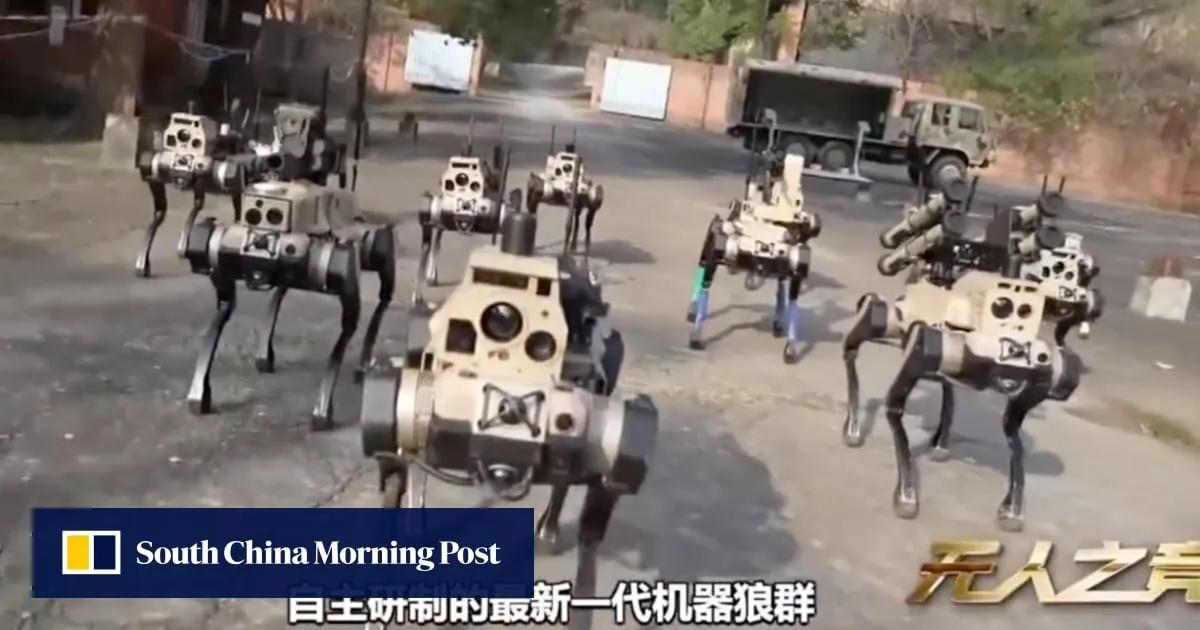
South China Morning PostFIG 01
Reading time
2min
Word count
276words
Sources cited
1cited
Entities identified
6entities
Quality score
100%
§ 01
Briefing Summary
AI-generatedNEWSAR · AI
China's military has developed advanced canine robots, dubbed "wolf packs," designed for coordinated urban combat. These robots, highlighted in a state media documentary, feature specialized roles and a shared AI "brain" enabling autonomous collaboration and joint decision-making. The wolf pack can integrate with drones for air-ground operations. Individual robots are equipped for reconnaissance, target neutralization, and logistical support, with some carrying weapons like micro-missiles and automatic rifles. The robots can be controlled via various methods, including voice commands and tactical gloves. These new models exhibit improved speed, payload capacity, environmental endurance, and terrain adaptability compared to previous versions.
Confidence 0.90Sources 1Claims 5Entities 6
§ 02
Article analysis
Model · rule-basedFraming
National Security
Technology
Tone
Mixed Tone
AI-assessed
CalmNeutralAlarmist
Factuality
0.70 / 1.00
Factual
LowHigh
Sources cited
1
Limited
FewMany
§ 03
Key claims
5 extracted01
The robots feature a top speed of up to 15km/h (9mph) and a heavier payload capacity of 25kg (55lbs).
factualCCTV
Confidence
0.90
02
The Bloody can be equipped with an array of weapons, including micro-missiles, grenade launchers and 191 automatic rifles.
factualCCTV
Confidence
0.90
03
These “robot wolves” have achieved a transformational leap from a “single-soldier support system to a coordinated swarm combat platform”.
quoteCCTV
Confidence
0.90
04
China’s military canine robots have evolved into intelligent “wolf packs”.
factualCCTV
Confidence
0.80
05
The wolf pack operates through a shared sensing network, which acts like a collective brain.
factualCCTV
Confidence
0.70
§ 04
Full report
2 min read · 276 words§ 05
Entities
6 identifiedKey playerOppositionContextPositiveNeutralNegative
Organizations5
Locations1
§ 06
Keywords & salience
10 termscanine robots
1.00
wolf pack
0.90
urban warfare
0.80
people's liberation army
0.70
artificial intelligence
0.60
unmanned systems
0.60
military technology
0.50
coordinated swarm
0.50
drones
0.40
china
0.40
§ 07
Topic connections
Interactive graph Network visualization showing 51 related topics
View Full Graph Person Organization Location Event|Click node to navigate|Edge numbers = shared articles