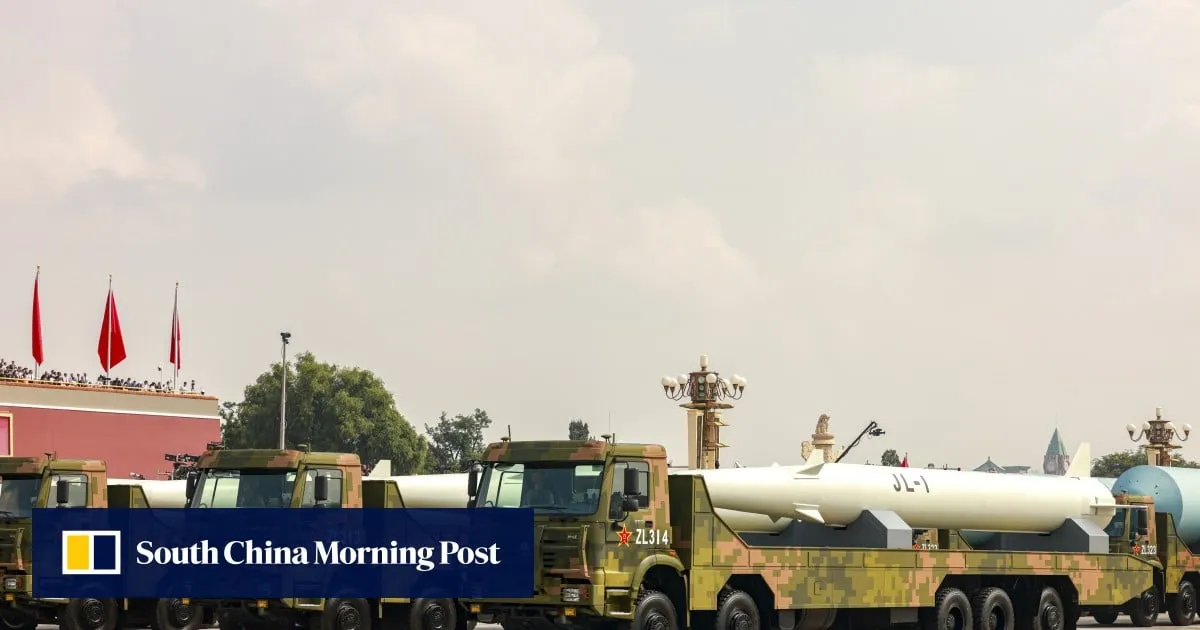
China’s new air-based nuclear missile will boost the country’s ability to survive a first strike and retaliate, reinforcing confidence in its no-first-use policy, according to a state-linked military magazine.The Jinglei-1 nuclear-capable air-launched ballistic missile (ALBM) made its debut at the World War II Victory Day parade in Beijing last September.It can be carried by the PLA Air Force’s H-6N strategic bombers, completing the People’s Liberation Army’s “nuclear triad” – the ability to deliver nuclear weapons from air, land and sea platforms.05:50China showcases new military hardware in massive Victory Day paradeChina showcases new military hardware in massive Victory Day paradeAccording to an article in Shipborne Weapons this month, the combination of the H-6N and JL-1 ensures survivability for second-strike capability, thanks to the bomber’s mobility.The bomber fleet can scramble swiftly upon early warning of an attack, dodging destruction on the ground and safeguarding its ability to strike back.This combination “gives China greater confidence in adhering to its no-first-use nuclear policy, because there’s no worry that they [H-6N plus JL-1] will be completely destroyed, and therefore [it] does not need to conduct a pre-emptive nuclear strike,” the article said.The magazine is managed by state-owned China-state-shipbuilding-corporation" class="entity-link entity-organization" data-entity-id="15044" data-entity-type="organization">China State Shipbuilding Corporation.China’s no-first-use policy commits it to never striking first with nuclear weapons in any conflict, restricting its arsenal to retaliation against a nuclear attack.
SRCSouth China Morning Post
LANGEN
LEANCenter-Right
WORDS219
ENT8
FRI · 2026-03-27 · 14:00 GMTBRIEF NSR-2026-0327-39229
NSR-2026-0327-39229News Report·EN·National Security
What the debut of a new air-based missile means for China’s nuclear strategy
China's new Jinglei-1 (JL-1) air-launched ballistic missile (ALBM), which debuted in September at a Beijing parade, strengthens its nuclear capabilities. Carried by H-6N strategic bombers, the JL-1 completes China's "nuclear triad," enabling nuclear weapon delivery from air, land, and sea.
Amber WangSouth China Morning PostFiled 2026-03-27 · 14:00 GMTLean · Center-RightRead · 1 min
South China Morning PostFIG 01
Reading time
1min
Word count
219words
Sources cited
1cited
Entities identified
8entities
Quality score
100%
§ 01
Briefing Summary
AI-generatedNEWSAR · AI
China's new Jinglei-1 (JL-1) air-launched ballistic missile (ALBM), which debuted in September at a Beijing parade, strengthens its nuclear capabilities. Carried by H-6N strategic bombers, the JL-1 completes China's "nuclear triad," enabling nuclear weapon delivery from air, land, and sea. According to a state-linked military magazine, the H-6N and JL-1 combination enhances China's second-strike capability due to the bomber's mobility, allowing it to survive a first strike. This survivability reinforces China's confidence in its no-first-use nuclear policy, eliminating the need for a pre-emptive strike. The magazine, managed by China State Shipbuilding Corporation, suggests the new missile system provides greater assurance against complete destruction in a first strike.
Confidence 0.90Sources 1Claims 5Entities 8
§ 02
Article analysis
Model · rule-basedFraming
National Security
Political Strategy
Tone
Measured
AI-assessed
CalmNeutralAlarmist
Factuality
0.70 / 1.00
Factual
LowHigh
Sources cited
1
Limited
FewMany
§ 03
Key claims
5 extracted01
China’s no-first-use policy commits it to never striking first with nuclear weapons in any conflict.
factual
Confidence
1.00
02
It can be carried by the PLA Air Force’s H-6N strategic bombers, completing the People’s Liberation Army’s “nuclear triad”.
factual
Confidence
1.00
03
The Jinglei-1 nuclear-capable air-launched ballistic missile (ALBM) made its debut at the World War II Victory Day parade in Beijing last September.
factual
Confidence
1.00
04
China’s new air-based nuclear missile will boost the country’s ability to survive a first strike and retaliate.
quotestate-linked military magazine
Confidence
0.80
05
The combination of the H-6N and JL-1 ensures survivability for second-strike capability, thanks to the bomber’s mobility.
quoteShipborne Weapons
Confidence
0.70
§ 04
Full report
1 min read · 219 words§ 05
Entities
8 identifiedKey playerOppositionContextPositiveNeutralNegative
Organizations5
§ 06
Keywords & salience
8 termsnuclear strategy
0.90
no-first-use policy
0.80
air-launched ballistic missile
0.70
second-strike capability
0.70
strategic bombers
0.60
nuclear triad
0.60
nuclear weapons
0.50
military hardware
0.40
§ 07
Topic connections
Interactive graph Network visualization showing 51 related topics
View Full Graph Person Organization Location Event|Click node to navigate|Edge numbers = shared articles