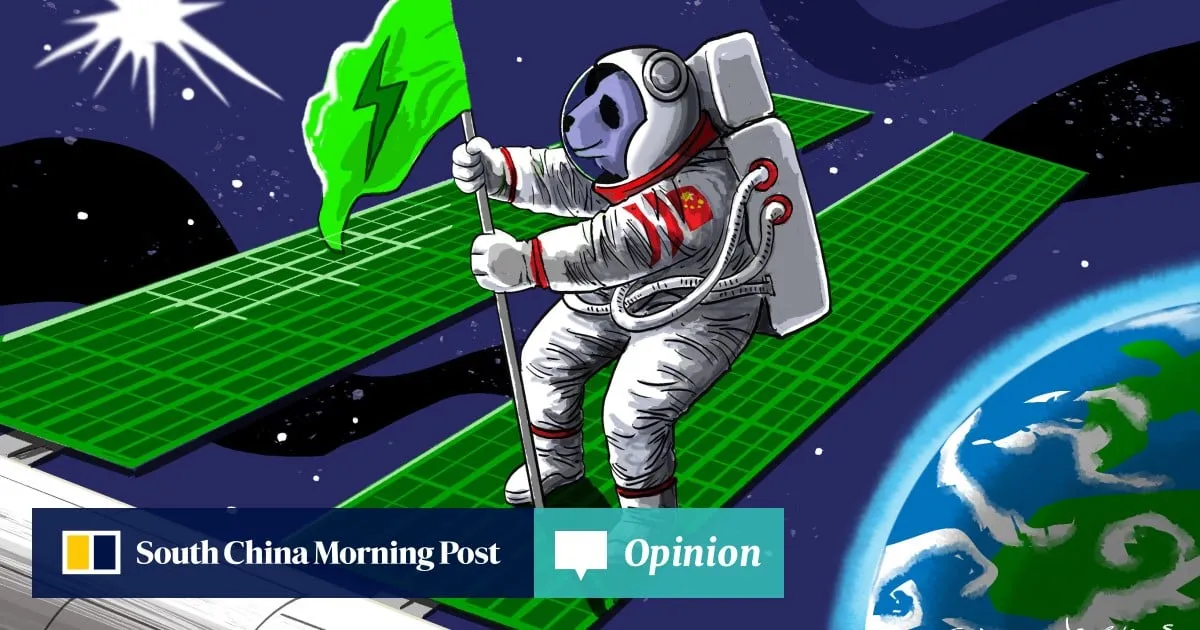
Amid turmoil in the Middle East, including the effective closure of the Strait of Hormuz, through which roughly a quarter of the world’s seaborne oil passes, Beijing is pressing ahead with its Zhuri (sun-chasing) project to build solar power stations in space.Chinese Academy of Engineering academician and senior rocket scientist Long Lehao likened this space-based solar power programme to putting the Three Gorges Dam into geostationary orbit, underscoring its extraordinary scale and ambition. China plans to conduct a megawatt-level in-orbit test by around 2030.Space-based solar power refers to orbital systems that collect solar energy via satellites equipped with enormous solar panels, convert it into microwaves or laser beams and send it wirelessly to ground-based rectennas, which then feed electricity into the grid.The appeal is obvious: unlike terrestrial solar, it operates continuously – unaffected by weather, seasons or nightfall.The concept is not new. Science fiction author Isaac Asimov popularised the idea in his 1941 short story Reason, while aerospace engineer Peter Glaser published the first technical design for an orbital solar power system in 1968.In the 1970s, the National Aeronautics and Space Administration (Nasa) confirmed its feasibility before concluding that engineering complexity and launch costs made it economically unviable. But that is now changing. Advances in robotics, wireless power transmission and sharply falling launch costs are narrowing the gap between concept and reality. Major space powers are taking notice.
SRCSouth China Morning Post
LANGEN
LEANCenter-Right
WORDS228
ENT10
FRI · 2026-03-27 · 21:30 GMTBRIEF NSR-2026-0327-39963
NSR-2026-0327-39963News Report·EN·Technology
Why China’s space-based solar power is the next frontier of green energy
China is advancing its "Zhuri" project to develop space-based solar power stations, aiming for a megawatt-level in-orbit test by approximately 2030. This initiative involves satellites with large solar panels collecting solar energy, converting it into microwaves or lasers, and wirelessly transmitting it to ground-based rectennas for electricity distribution.
Genevieve Donnellon-MaySouth China Morning PostFiled 2026-03-27 · 21:30 GMTLean · Center-RightRead · 1 min
South China Morning PostFIG 01
Reading time
1min
Word count
228words
Sources cited
3cited
Entities identified
10entities
Quality score
100%
§ 01
Briefing Summary
AI-generatedNEWSAR · AI
China is advancing its "Zhuri" project to develop space-based solar power stations, aiming for a megawatt-level in-orbit test by approximately 2030. This initiative involves satellites with large solar panels collecting solar energy, converting it into microwaves or lasers, and wirelessly transmitting it to ground-based rectennas for electricity distribution. Unlike terrestrial solar, space-based solar power operates continuously, unaffected by weather or time of day. The concept, popularized decades ago, is gaining renewed interest due to technological advancements in robotics, wireless power transmission, and reduced launch costs. While NASA previously deemed it economically unviable, these advancements are making space-based solar power a more realistic prospect for major space powers.
Confidence 0.90Sources 3Claims 5Entities 10
§ 02
Article analysis
Model · rule-basedFraming
Technology
Environmental
Tone
Measured
AI-assessed
CalmNeutralAlarmist
Factuality
0.70 / 1.00
Factual
LowHigh
Sources cited
3
Well sourced
FewMany
§ 03
Key claims
5 extracted01
Long Lehao likened this space-based solar power programme to putting the Three Gorges Dam into geostationary orbit.
quoteLong Lehao
Confidence
1.00
02
In the 1970s, NASA confirmed its feasibility before concluding that engineering complexity and launch costs made it economically unviable.
factual
Confidence
0.90
03
Beijing is pressing ahead with its Zhuri project to build solar power stations in space.
factual
Confidence
0.90
04
China plans to conduct a megawatt-level in-orbit test by around 2030.
factual
Confidence
0.80
05
Advances in robotics, wireless power transmission and sharply falling launch costs are narrowing the gap between concept and reality.
factual
Confidence
0.70
§ 04
Full report
1 min read · 228 words§ 05
Entities
10 identifiedKey playerOppositionContextPositiveNeutralNegative
Organizations2
§ 06
Keywords & salience
8 termsspace-based solar power
1.00
solar energy
0.80
renewable energy
0.70
wireless power transmission
0.60
china
0.50
geostationary orbit
0.50
orbital systems
0.40
launch costs
0.40
§ 07
Topic connections
Interactive graph Network visualization showing 51 related topics
View Full Graph Person Organization Location Event|Click node to navigate|Edge numbers = shared articles