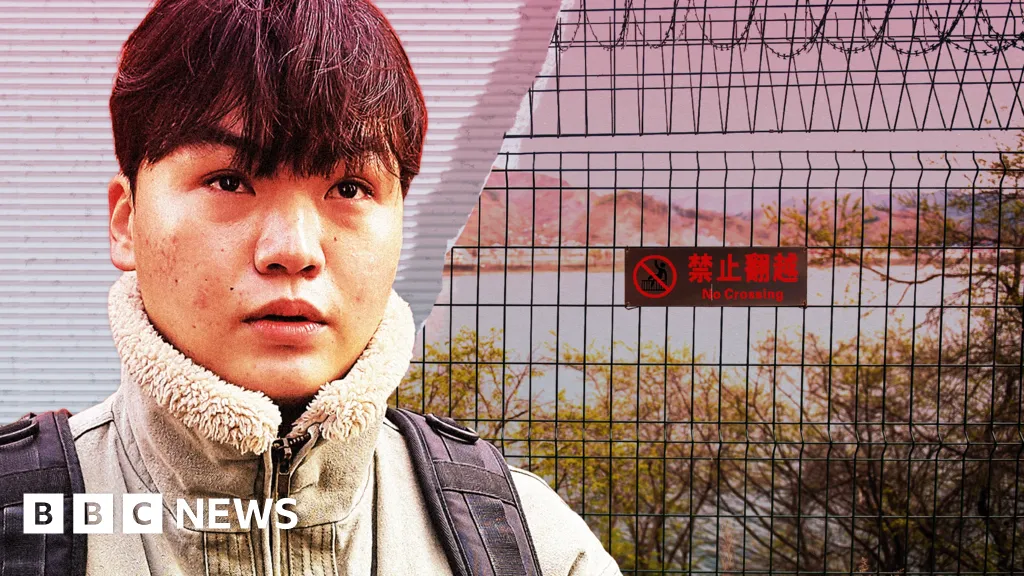
5 hours agoLaura Bicker,China correspondentandJulie Yoonnyung LeeHandout/Getty ImagesWhen Geumseong's phone rang on Christmas Eve 2020, he answered nervously.The previous year he'd made the perilous journey to escape from North to South Korea, using an international underground network of safe houses and brokers.Eventually his mother's voice came from the speaker: "Geumseong, Geumseong, can you see me?"Eunhee could hardly get her words out through sobs as her teenage son clasped his hand to his mouth."Mum, I'm doing well and I'm not sick," Geumseong quickly reassured her. The relief at seeing his mother's face was overwhelming."So much time has passed," she replied. "I can hardly recognise you."Watch: Geumseong, then 15, speaks to his mother for the first time after their escape from North KoreaGeumseong proudly announced he was now taller than his mother. He lifted his hair, showing his teenage acne to make her laugh.Then he picked up the phone and took her on a tour around his new home in the South Korean capital, Seoul."The house has three floors, it's really big!" exclaimed Geumseong. "It even has a piano." "Wow!" his mum responded.Until he was 15, Geumseong lived with his mother in a North Korean village near the Chinese border. He is guarded about the details of their lives and will only say it was extremely tough."When she did difficult work, I helped her. Sometimes when she was overwhelmed and exhausted, we cried together," he said. "That is how we lived."It was a life the pair risked everything to escape.HandoutGeumseong (right) was welcomed by his foster father to his new home in Seoul in 2019. The text reads: "Welcome home, Geumseong!"The last time Geumseong saw his mother was in June 2019, on the banks of the Yalu River which separates China from North Korea.It's a heavily fortified border. There are high fences on both sides that are often electrified, with guard posts every few hundred metres.It was only once they had made it safely across the river together in neighbouring China that his mother revealed the sacrifice she had made.Eunhee would be sold as a bride to a Chinese man, like tens of thousands of North Korean women desperate to escape their country have been since the 1990s.In return, the broker who arranged the match would help Geumseong travel 4,000km (2,500 miles) to the Chinese border with Thailand, through endless checkpoints, surveillance and security.Over the decades, around 30,000 North Koreans have made the risky journey across the border and through China to South Korea in search of a better life.If they are caught they face torture, forced labour in prison camps, sexual assault, and in some cases execution on their return, according to rights groups. For the North Korean regime, those who escape are considered enemies of the state.Geumsong was horrified to discover he would be separated from his mother. But they had to part quickly before they were spotted by the North Korean and Chinese border guards on patrol.After an arduous, nearly two month long journey hiking through Thailand, Geumseong eventually made it to Seoul.Getty ImagesEunhee and her son last saw each other on the banks of the Yalu River, seen here through a Chinese border fence in 2017It has been six years since Geumseong and his mother were separated. And now Eunhee needs her son's help.She's in a Chinese prison after attempting to leave China to join Geumseong in Seoul. Her son fears she will be sent back to North Korea - where he believes she could die in jail.UN human rights experts have cited reports of two women being executed after repatriation in October 2023. As many as 1,000 people may have been forcibly returned from China to North Korea since then, according to rights groups.Geumseong has been trying everything he can think of to help his mother, including pleading with the Chinese government."I just want to ask them to please give her one more chance to live a normal life," he said.In response to a question from the BBC, the foreign ministry in Beijing said China was a country "ruled by law"."Illegal immigrants are not refugees. China has always maintained a responsible attitude, adhering to domestic and international law, and handling these matters appropriately in the spirit of humanitarianism," the statement added.Geumseong has tried and failed to see his mother in prison in China - but he is undeterred.HandoutGeumseong was granted South Korean citizenship after arriving in the capital Seoul"I had no way of knowing whether you were alive or dead," Eunhee had told her son on the phone, back in December 2020.She knew the journey through Thailand could be tough. "I kept worrying - what if something happened to you?"Geumseong's escape to South Korea had been difficult and dangerous and, at one point, he collapsed with what was believed to be tuberculosis."I was so dizzy I couldn't even stand up," he told his mum. "When we finally crossed into Thailand some people carried me on their backs."The government in Seoul views North Korean refugees as citizens under the South Korean constitution and offers them a home.After spending three months in Hanawon, a dedicated settlement support centre in the capital, Geumseong, then 15, was placed with a foster family and started school."Do you know how much I thought about you?" Eunhee asked her son. "My heart finally feels at ease now." HandoutGeumseong, pictured here at an Amnesty International protest, has been fighting to stop the repatriation of his mother from ChinaAfter parting ways with her son in 2019, Eunhee settled in north-eastern China with the man to whom she had been sold. He turned out to be a kind partner, but Eunhee missed her son deeply, and longed to be reunited with him.She made many attempts to find Geumseong - including appearing on a Chinese podcast that was popular with North Korean refugees - where she described her son who had fled to South Korea.Miles away in Seoul, a friend of Geumseong's happened to be listening - and as soon as she heard the description knew it was him.Several phone calls later, Geumseong had his mother's WeChat number.They started speaking regularly. Eunhee would worry about whether her son was eating or sleeping enough, and tease him about how long his hair was growing.Then in December 2024, Eunhee made a big decision. After five years apart, she was going to try to leave China to be with her son in South Korea.Terrified of what might happen if she was caught, Geumseong begged his mother to be careful and tried to dissuade her from her plan.For a month and a half, he heard nothing.Then he got a call with news he had feared.On 2 January 2025 Eunhee had been caught in southern China near the border with Myanmar. She was eventually moved to a prison in north-eastern China with other North Korean refugees.HandoutSix years after fleeing North Korea, Geumseong learned his mother may be repatriated from China - which he fears is a death sentenceFar fewer North Korean refugees make it to South Korea these days than did in the past.After the Covid pandemic, North Korea and China reinforced their shared 1,420km (880 mile) border with double-layered high fences and extra surveillance.In 2025, 223 defectors arrived in the South - but before 2020 around 1,000 were making the journey each year.Numbers were once even greater - after a devastating famine in the mid-1990s triggered what rights groups described as a silent exodus over a more porous border with China.Like Eunhee, many of the women who arrive in China today are sold as black-market brides.Some marry by choice to send money back to their families or to plot an eventual escape. Others are lured by false promises of employment and have no idea that when they cross the border they will be forced to marry.Once married, North Korean women often feel isolated and many report living in fear that one day they will be sent back.The market for North Korean black-market brides stems from a severe gender imbalance in China, where there are an estimated 34 million more men than women. It's a result of the country's previous one-child policy which led to sex-selective abortions and in some cases female infanticide, because of a preference for boys.Handout"I can't sit still. I don't have time. Please help me," Geumseong writes in a letter urging South Korea's foreign minister to help his motherOver the last two years, the BBC has exchanged messages through an intermediary with four North Korean women living in China. We cannot verify their accounts, but they are similar to the hundreds of interviews done by human rights groups over the past two decades.The women described living in rural areas along the border, with no legal status or documentation, entirely dependent on the whims of their husbands.One told the BBC she was 16 when she was sold to her Chinese husband who was nearly twice her age. He kept her in a barn next to the house and raped her, before finally announcing her as his fiancée to his family. She has been in China for 15 years and has two children.The Chinese authorities know where many of these women live and check on them regularly.From time to time, police warn their husbands to keep their wives in check and ensure they don't try to flee the province or the country. Women say authorities collect samples of their saliva, fingerprints and photos for facial recognition.Beijing wants to avoid a mass migration of North Koreans into China - but seems content to monitor the lives of the brides, as long as they don't cause much trouble.All four women said in their messages to the BBC they were doing their best to make a life for themselves in China. "I am almost happy," one wrote.HandoutGeumseong recently travelled to China to try to see his mother in prison - but he was unsuccessfulThe women who make it to China live in a "cruel paradox", says Lina Yoon from Human Rights Watch."They are never legal, never safe - stuck somewhere between being tolerated and controlled."The detention of Geumseong's mother, a woman who gave up her own freedom so her son could reach safety, shows you what happens to those who try to break free of this system."But Geumseong would choose that life all over again for his mum, rather than have her returned to North Korea."I just want her to be allowed to stay in China and live a normal life beside her husband like before," he said."I am simply begging China not to send her back to North Korea."AFP via Getty ImagesGeumseong is desperate for his mother to not be sent back to North Korea, visible here from ChinaMore weekend picks
SRCBBC News - World
LANGEN
LEANCenter
WORDS1 778
ENT8
FRI · 2026-03-27 · 22:05 GMTBRIEF NSR-2026-0327-40033
NSR-2026-0327-40033News Report·EN·Human Interest
I escaped North Korea with my mum. Now I'm terrified she might be sent back
Geumseong, a North Korean defector, escaped to South Korea in 2019 with the help of brokers. His mother, Eunhee, sacrificed herself by being sold as a bride in China to pay for his passage.
BBC News - WorldFiled 2026-03-27 · 22:05 GMTLean · CenterRead · 8 min
BBC News - WorldFIG 01
Reading time
8min
Word count
1 778words
Sources cited
2cited
Entities identified
8entities
Quality score
100%
§ 01
Briefing Summary
AI-generatedNEWSAR · AI
Geumseong, a North Korean defector, escaped to South Korea in 2019 with the help of brokers. His mother, Eunhee, sacrificed herself by being sold as a bride in China to pay for his passage. The pair last saw each other on the Yalu River border between North Korea and China. Geumseong eventually settled in Seoul, and in 2020, he spoke to his mother for the first time since their separation, learning of her situation. Tens of thousands of North Korean women have been sold as brides in China since the 1990s as a means of escaping North Korea.
Confidence 0.90Sources 2Claims 5Entities 8
§ 02
Article analysis
Model · rule-basedFraming
Human Interest
Human Rights
Tone
Mixed Tone
AI-assessed
CalmNeutralAlarmist
Factuality
0.80 / 1.00
Factual
LowHigh
Sources cited
2
Limited
FewMany
§ 03
Key claims
5 extracted01
For the North Korean regime, those who escape are considered enemies of the state.
factual
Confidence
1.00
02
Around 30,000 North Koreans have made the risky journey to South Korea.
statistic
Confidence
1.00
03
Eunhee was sold as a bride to a Chinese man to help Geumseong escape.
factual
Confidence
1.00
04
Geumseong escaped from North to South Korea using an international underground network.
factual
Confidence
1.00
05
If caught, North Koreans face torture, forced labour, sexual assault, and execution.
factualrights groups
Confidence
0.90
§ 04
Full report
8 min read · 1 778 words§ 05
Entities
8 identifiedKey playerOppositionContextPositiveNeutralNegative
§ 06
Keywords & salience
9 termsnorth korea
1.00
escape
0.90
human trafficking
0.80
refugee
0.70
south korea
0.70
chinese border
0.60
brokers
0.50
safe houses
0.50
yalu river
0.50
§ 07
Topic connections
Interactive graph Network visualization showing 51 related topics
View Full Graph Person Organization Location Event|Click node to navigate|Edge numbers = shared articles