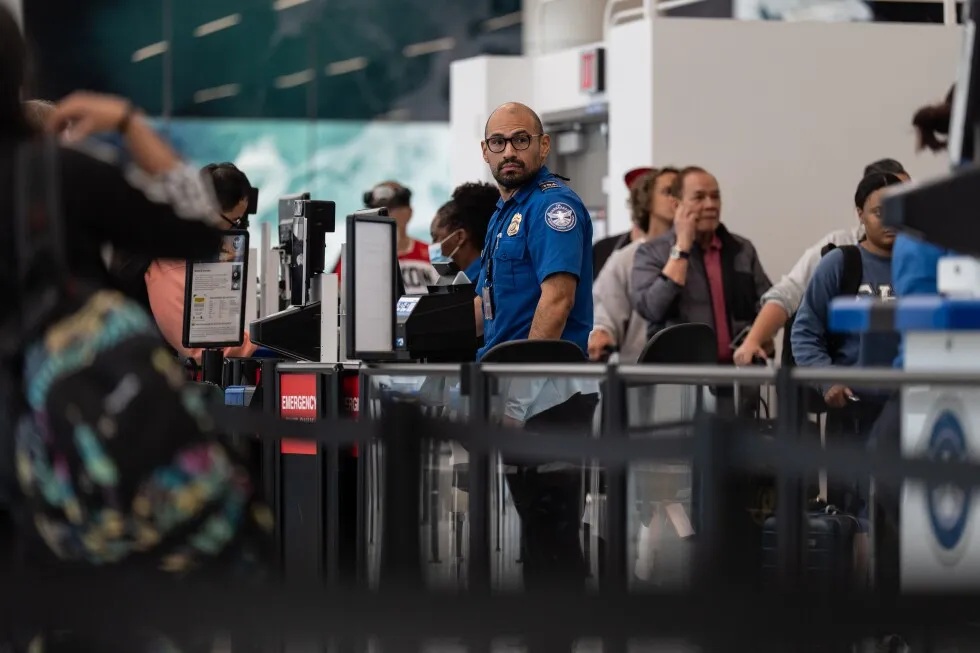
Bills to pay FAA and TSA workers during shutdowns get introduced but keep stalling in Congress 1 of 5 | A TSA agent works at Los Angeles International Airport in Los Angeles, Friday, March 27, 2026. (AP Photo/Jae C. Hong) 2 of 5 | Travelers are screened at a security checkpoint at George Bush Intercontinental Airport Friday, March 27, 2026, in Houston. (AP Photo/David J. Phillip) 3 of 5 | Speaker of the House Mike Johnson, R-La., speaks while House Majority Whip Tom Emmer R-Minn., right, and House Republican Conference Chair Lisa McClain, R-Mich., left, listen during a news conference on Capitol Hill, Friday, March 27, 2026, in Washington. (AP Photo/Mariam Zuhaib) 4 of 5 | Travelers wait in long security checkpoint lines at George Bush Intercontinental Airport Friday, March 27, 2026, in Houston. (AP Photo/David J. Phillip) 5 of 5 | Travelers wait in long security checkpoint lines at George Bush Intercontinental Airport Friday, March 27, 2026, in Houston. (AP Photo/David J. Phillip) 1 of 5 A TSA agent works at Los Angeles International Airport in Los Angeles, Friday, March 27, 2026. (AP Photo/Jae C. Hong) Add AP News on Google Add AP News as your preferred source to see more of our stories on Google. 2 of 5 Travelers are screened at a security checkpoint at George Bush Intercontinental Airport Friday, March 27, 2026, in Houston. (AP Photo/David J. Phillip) Add AP News on Google Add AP News as your preferred source to see more of our stories on Google. 3 of 5 Speaker of the House Mike Johnson, R-La., speaks while House Majority Whip Tom Emmer R-Minn., right, and House Republican Conference Chair Lisa McClain, R-Mich., left, listen during a news conference on Capitol Hill, Friday, March 27, 2026, in Washington. (AP Photo/Mariam Zuhaib) Add AP News on Google Add AP News as your preferred source to see more of our stories on Google. 4 of 5 Travelers wait in long security checkpoint lines at George Bush Intercontinental Airport Friday, March 27, 2026, in Houston. (AP Photo/David J. Phillip) Add AP News on Google Add AP News as your preferred source to see more of our stories on Google. 5 of 5 Travelers wait in long security checkpoint lines at George Bush Intercontinental Airport Friday, March 27, 2026, in Houston. (AP Photo/David J. Phillip) Add AP News on Google Add AP News as your preferred source to see more of our stories on Google. Updated [hour]:[minute] [AMPM] [timezone], [monthFull] [day], [year] The Aviation Funding Solvency Act. The Keep America Flying Act. The Keep Air Travel Safe Act. The Aviation Funding Stability Act.Again and again, members of Congress have dusted off the same idea: ensuring the federal employees who control air traffic and screen passengers and bags at U.S. airports get paid during government shutdowns. Bills to make it happen keep getting introduced in one form or another, sometimes with Democrats and Republicans as co-sponsors. Yet session after session, the result has been the same — agencies receive their annual appropriations, public outrage over long security lines and flight delays fades, legislation languishes and workers have no guarantees their paychecks won’t stop coming again. “Once the crisis is over, people assume that the good times are back,” said Eric Chaffee, a Case Western Reserve law professor whose research includes risk management in the aviation industry. “It’s easy to pass the next big bill when you’re still in the throes of the financial crisis, but once the shutdown is done, people have a relatively short memory of the problems that it created.” Since 2019, after a partial shutdown that spanned the holiday travel season, lawmakers have drafted, revised and reintroduced multiple proposals to pay aviation workers who would have to keep reporting for duty in the event of another budget impasse. The Aviation Funding Stability Act of 2019 — and 2021 and 2025 — and the bipartisan Aviation Funding Solvency Act introduced after a government shutdown last fall would protect the pay of air traffic controllers. The Keep Air Travel Safe Act, filed in October, extended the protection to Transportation Security Administration agents. The Keep America Flying Act, also from October, would cover both TSA personnel and certain Federal Aviation Administration employees. Broader proposals, like the Shutdown Fairness Act introduced in January, would maintain the pay of essential federal workers across the U.S. government. Those bills have stalled as well. “Congress cares about headlines, and as a result of that, it means they don’t always make changes that would be really beneficial,” Chaffee said. Political gridlockShutdowns that disrupt air travel have continued along with the push for aviation-specific pay protections. The 35-day shutdown that arose over funding for a wall along the U.S.-Mexico border during President Donald Trump’s first term resulted in delays at East Coast airports and prolonged wait times at some airports as air traffic controllers and TSA agents went unpaid.Last fall’s 43-day shutdown broke the record for the longest funding lapse and revived concerns over the consequences of requiring air traffic controllers to work without pay. The FAA, citing risks to aviation safety, took the extraordinary step of ordering U.S. airlines to cut flights at 40 of the nation’s busiest airports as unscheduled absences deepened existing staffing shortages at air traffic control facilities.TSA officers who worked through that shutdown also found themselves working through a short one that started on Jan. 31 and yet another when funding for only the Department of Homeland Security lapsed on Feb. 14. Thousands began missing shifts each day as the stalemate entered its second month. Carlos Rodriguez, a TSA agent and local union leader in New York, said many workers had not recovered financially from last year’s shutdown when this one hit.“Part of the American dream that I was sold was that working for the government was honorable and stable,” Rodriguez, a second generation Dominican American, said. “But this is not honorable or stable.”On Friday, the 42nd day of the DHS shutdown, Trump signed an emergency order instructing Homeland Security to pay TSA agents immediately. The action came after House Republicans defeated a Senate deal that would have funded the TSA, the U.S. Coast Guard and the Federal Emergency Management Agency but not Immigration and Customs Enforcement and Border Patrol. The House later in the night passed its own bill to fund the entire Homeland Security department through May 22, but senators had already left town. Johnny Jones, secretary-treasurer of the TSA division of the American Federation of Government Employees, said union members resent having their livelihoods used as tools and talking points in a game of political brinkmanship. To them, the machinations of Congress feel like “let’s checkmate the queen with the TSA pawn here, and then we’ll smash them over whenever we feel like it,” Jones said. “We’re on the chess board.” Public pressure buildsLabor unions, airline leaders and airport executives have issued open letters, taken out newspaper ads and made direct appeals to urge lawmakers to act on at least one of the existing bipartisan proposals for paying government workers who are essential to the aviation and travel industries. “Congress has the power to end this dysfunction once and for all, and must use any legislative vehicle to accomplish this goal,” the Modern Skies Coalition said in a joint statement this week. The broad coalition of more than 60 organizations pointed to the Aviation Funding Solvency Act, Aviation Funding Stability Act and Keep America Flying Act as potential options.The president and CEO of Airlines for America, a trade group representing major U.S. airlines, made a similar case in a Washington Times op-ed this week, writing that Congress “must get to the table immediately” and pass legislation that would prevent more scenes of frustrated passengers, overflowing airport terminals and donation drives for public servants.“Right now, lawmakers are sitting on their hands doing nothing with three viable, bipartisan bills that could prevent this mess,” wrote Chris Sununu, a former New Hampshire governor hired to lead the trade group last year.The American Federation of Government Employees joined more than 30 unions this week in urging Congress to pass the Shutdown Fairness Act, warning that funding lapses undermined employee morale, recruitment and retention.Breaking the cycleSome TSA workers have reported sleeping in their cars or thinking about selling them to make rent. Union leaders have described workers not being able to fill their refrigerators or gas tanks. Caleb Harmon-Marshall, a former TSA officer who runs a travel newsletter called Gate Access, said the officers he’s spoken with are eager to receive all of their back pay quickly because they are struggling to pay their bills and accumulating debt. But without greater certainty, more officers may miss shifts or decide to quit, he said. If the president’s emergency order only funds a single pay period, “that’s not enough to bring them back,” Harmon-Marshall said. “It has to be an extended pay for them to come back or want to stay there.” Previous legislation with bipartisan backing struggled to make it across the finish line. The Aviation Funding Act of 2019 that was introduced by Sen. Jerry Moran, a Kansas Republican, had 13 co-sponsors, eight of them Democrats. It never made it out of committee. A House version introduced by Oregon Democrat Peter DeFazio eventually had 303 co-sponsors and cleared the House Transportation and Infrastructure Committee but never received a floor vote. The current political environment in the U.S. may consign the legislation in Congress now to the same fate, Chaffee said. “We live in a society currently where things are very polarized,” he said. “Whether or not any of these bills get passed, it will need to have political momentum behind it, meaning it will need to be something that the public really wants to see happen.” Yamat is a national business reporter for The Associated Press. Based in Las Vegas, she covers airlines, travel and tourism.
SRCAssociated Press (AP)
LANGEN
LEANCenter
WORDS1 644
ENT12
SAT · 2026-03-28 · 15:23 GMTBRIEF NSR-2026-0328-41046
NSR-2026-0328-41046News Report·EN·Political Strategy
Bills to pay FAA and TSA workers during shutdowns get introduced but keep stalling in Congress
In March 2026, bills designed to ensure that FAA and TSA workers are paid during government shutdowns have been introduced in Congress. These bills, including the "Aviation Funding Solvency Act" and the "Keep America Flyin'," aim to prevent disruptions to air travel and security caused by unpaid federal employees.
By
RIO YAMAT, AP Airlines and Travel WriterAssociated Press (AP)Filed 2026-03-28 · 15:23 GMTLean · CenterRead · 7 min
Associated Press (AP)FIG 01
Reading time
7min
Word count
1 644words
Sources cited
0cited
Entities identified
12entities
Quality score
100%
§ 01
Briefing Summary
AI-generatedNEWSAR · AI
In March 2026, bills designed to ensure that FAA and TSA workers are paid during government shutdowns have been introduced in Congress. These bills, including the "Aviation Funding Solvency Act" and the "Keep America Flyin'," aim to prevent disruptions to air travel and security caused by unpaid federal employees. Despite their introduction, these bills are currently stalled in Congress. The holdup comes as travelers experience long security lines at airports in Houston and Los Angeles. The legislation seeks to address the financial insecurity faced by essential aviation personnel during periods of government shutdown, but its future remains uncertain.
Confidence 0.90Claims 5Entities 12
§ 02
Article analysis
Model · rule-basedFraming
Political Strategy
Economic Impact
Tone
Measured
AI-assessed
CalmNeutralAlarmist
Factuality
0.80 / 1.00
Factual
LowHigh
Sources cited
0
No named sources
FewMany
§ 03
Key claims
5 extracted01
Agencies receive their annual appropriations.
factual
Confidence
1.00
02
Some bills have had both Democratic and Republican co-sponsors.
factual
Confidence
1.00
03
The bills have stalled in Congress despite being introduced repeatedly.
factual
Confidence
1.00
04
These bills aim to ensure federal employees who control air traffic and screen passengers get paid during shutdowns.
factual
Confidence
1.00
05
Bills to pay FAA and TSA workers during shutdowns have been introduced in Congress.
factual
Confidence
1.00
§ 04
Full report
7 min read · 1 644 words§ 05
Entities
12 identifiedKey playerOppositionContextPositiveNeutralNegative
People3
Organizations2
Locations6
Events1
§ 06
Keywords & salience
8 termsgovernment shutdowns
0.90
faa workers
0.80
tsa workers
0.80
congress
0.70
bills
0.60
keep america flyin
0.50
aviation funding solvency act
0.50
airport security
0.40
§ 07
Topic connections
Interactive graph Network visualization showing 16 related topics
View Full Graph Person Organization Location Event|Click node to navigate|Edge numbers = shared articles