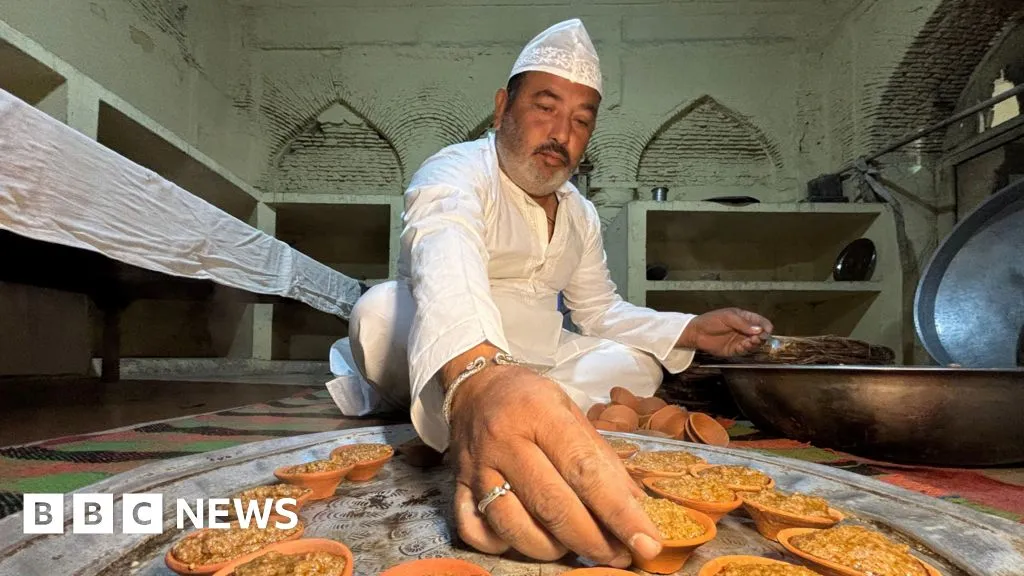
35 minutes agoAmanBBC Hindi, LucknowAman/BBCThe royal kitchen of the former Awadh kingdom has been serving meals for almost 200 yearsIn northern India's Uttar Pradesh state, a team of workers is carefully restoring a centuries-old royal kitchen that once fed the rulers of the former princely state of Awadh.Tucked within the sprawling complex of Chota Imambara - a mausoleum and congregation hall - this kitchen in Lucknow is a reminder of a different kind of royal legacy. Built in 1837 by former Awadh ruler Muhammad Ali Shah, the site once served not just the elite, but the public too.At its peak, the meals here were prepared for both the royal household and ordinary people, especially during religious gatherings and special occasions.India no longer has royals and Awadh, once a princely state ruled by semi-autonomous Muslim nawabs, now exists only as a historical region in central Uttar Pradesh.Yet some traditions have outlived the kingdoms that created them.Nearly 200 years on, the kitchen is not just a relic but is still in use. It continues to serve food to thousands during the holy months of Ramadan and Muharram, continuing a practice of community service.ASIOver the years, the structure of the royal kitchen has gone into disrepairAccording to historians, in 1839, Muhammad Ali Shah gave 3.6m rupees - considered a vast sum in those days - to the India-company" class="entity-link entity-organization" data-entity-id="3242" data-entity-type="organization">East India Company, then a British trading enterprise, on the condition that it would be responsible for maintaining the monuments built by the Awadh nawabs, while the kitchen would continue to run on the interest earned from the fund. After India became independent 1947, this money was transferred into a local bank. Today, the kitchen is managed by the Hussainabad Trust - a state government-monitored body - which continues to use the interest to fund and manage the kitchen's operations.That legacy lives on in the meals still served here, prepared to the same standards laid down generations ago. But step beyond the food and the building tells a different story.The intricate patterns and iconic brick walls that once defined the kitchen have fallen into disrepair - plaster peeling from cracked walls and sections of the floor beginning to cave in.It was this worrying decline that prompted a group of local residents to approach the Archaeological Survey of India (ASI), says Aftab Hussain, a superintending archaeologist.The ASI began restoration work last October and hopes to complete the project by the end of March. But the project is not just about saving a crumbling structure. What makes this restoration stand out is its focus on returning the kitchen to exactly how it once was - from recreating its original lime-based mortar (a traditional binding material used to hold bricks together) to preserving intricate wall carvings, says archaeologist Hussain."We are using slaked lime as the base. It is soaked for a month and then mixed with the pulp of wood apples, black gram, natural gum found in India - called gond -jaggery and red brick dust," Hussain says.The workers have carefully recreated this indigenous mortar, once widely used in the Mughal era, but now largely replaced by cement in modern construction.He adds that 'lakhauri' bricks - thin, burnt clay bricks typical of Awadhi architecture - are also being used to maintain the structure's original form.Aman/BBCLabourers work with a special mortar to restore the kitchen to its original gloryAman/BBCThe mortar used during construction in the Mughal era predates cement For members of the Awadh royal lineage, the restoration is deeply personal.Yasir Abbas, a descendant of the former rulers, says the work is crucial not only to preserve a historic structure but also to "uphold the centuries‑old tradition and culture" that the kitchen represents."We are duty‑bound to carry out the will of the king who introduced this practice of serving food," he added.Historian Roshan Taqui says the king was determined to ensure the kitchen kept running without interruption.To handle the scale of cooking, he built two identical kitchens on either side of the Chota Imambara - a design that also reflects Awadhi architecture's heavy emphasis on symmetry, he adds. The concept of twin kitchens is proving useful to this day."During this Ramadan, while restoration was underway in one of the kitchens, cooking continued in the other," Taqui says. For many locals, the kitchens mean more than just a place where meals are cooked. Syed Haider Raza, 80, holds the place especially close to his heart, having visited the kitchen for decades."I have been coming to the Chhota Imambara since childhood to receive tabarrukh - or the royal offering - during Muharram, and sehri (early meal before dawn) and iftar (evening meal to break their fast) during Ramadan," he said."As children, we would see huge vessels in which food was being cooked. Everyone ate to their fill, and the food never fell short."Aman/BBCThe head chef and his team cook kebabs in the dilapidated kitchen complexEvery Ramadan, the kitchen feeds the poor, widows and others unable to provide for themselves. Around 700 coupons are distributed daily, and cooked food is sent to 16 nearby mosques to serve both to the needy and the faithful. The meals - simple but filling - include meat curries, flatbreads, kebabs, fruits and sweets, reflecting Lucknow's rich culinary tradition.During Muharram, the menu changes. For the first nine days, it is simple and largely vegetarian - sweet flatbread, lentils and potato curry among the staples. For the remainder of the 40-day mourning period, richer meat curries and kebabs are added.According to kitchen in‑charge Murtaza Hussain Raju, the menu - even the portion sizes - is recorded in the former ruler's will. "It lays out not just the types of dishes to be prepared, but also their weight and quality. These standards are still followed strictly," says historian Taqui. For Lucknow's residents, this continuity feels quietly familiar. The restoration is not just about repairing a building, but sustaining a tradition that has endured for generations.Raza, who has been coming to the kitchen for decades, describes it best."The spirit of the place is still the same", he says. "It feels as if the food is still being sent by Muhammad Ali Shah."
SRCBBC News - World
LANGEN
LEANCenter
WORDS1 021
ENT11
SAT · 2026-03-28 · 23:25 GMTBRIEF NSR-2026-0329-41369
NSR-2026-0329-41369News Report·EN·Human Interest
India restoring a centuries-old royal kitchen that never stopped serving food
In Lucknow, Uttar Pradesh, India, a centuries-old royal kitchen is undergoing restoration. Built in 1837 by Awadh ruler Muhammad Ali Shah, the kitchen historically served both royalty and the public, particularly during religious events.
BBC News - WorldFiled 2026-03-28 · 23:25 GMTLean · CenterRead · 5 min
BBC News - WorldFIG 01
Reading time
5min
Word count
1 021words
Sources cited
1cited
Entities identified
11entities
Quality score
100%
§ 01
Briefing Summary
AI-generatedNEWSAR · AI
In Lucknow, Uttar Pradesh, India, a centuries-old royal kitchen is undergoing restoration. Built in 1837 by Awadh ruler Muhammad Ali Shah, the kitchen historically served both royalty and the public, particularly during religious events. Remarkably, the kitchen has remained in continuous operation for nearly 200 years, providing food during Ramadan and Muharram. Funded initially by an endowment to the East India Company and now managed by the Hussainabad Trust, the kitchen's structure had deteriorated. The Archaeological Survey of India (ASI) began restoration work in October to preserve this unique legacy of community service.
Confidence 0.90Sources 1Claims 5Entities 11
§ 02
Article analysis
Model · rule-basedFraming
Human Interest
Social Justice
Tone
Measured
AI-assessed
CalmNeutralAlarmist
Factuality
0.80 / 1.00
Factual
LowHigh
Sources cited
1
Limited
FewMany
§ 03
Key claims
5 extracted01
The kitchen is managed by the Hussainabad Trust, a state government-monitored body.
factualBBC Hindi
Confidence
1.00
02
The ASI began restoration work last October and hopes to complete the project by the end of March.
factualAftab Hussain, a superintending archaeologist
Confidence
1.00
03
The kitchen was built in 1837 by former Awadh ruler Muhammad Ali Shah.
factualBBC Hindi
Confidence
1.00
04
The royal kitchen of the former Awadh kingdom has been serving meals for almost 200 years.
factualBBC Hindi
Confidence
1.00
05
In 1839, Muhammad Ali Shah gave 3.6m rupees to the East India Company to maintain the monuments and run the kitchen.
factualhistorians
Confidence
0.90
§ 04
Full report
5 min read · 1 021 words§ 05
Entities
11 identifiedKey playerOppositionContextPositiveNeutralNegative
Organizations3
Locations4
§ 06
Keywords & salience
9 termsroyal kitchen
1.00
awadh kingdom
0.80
restoration
0.70
food service
0.70
historical preservation
0.60
lucknow
0.60
religious gatherings
0.50
archaeological survey of india
0.50
community service
0.50
§ 07
Topic connections
Interactive graph No topic relationship data available yet. This graph will appear once topic relationships have been computed.