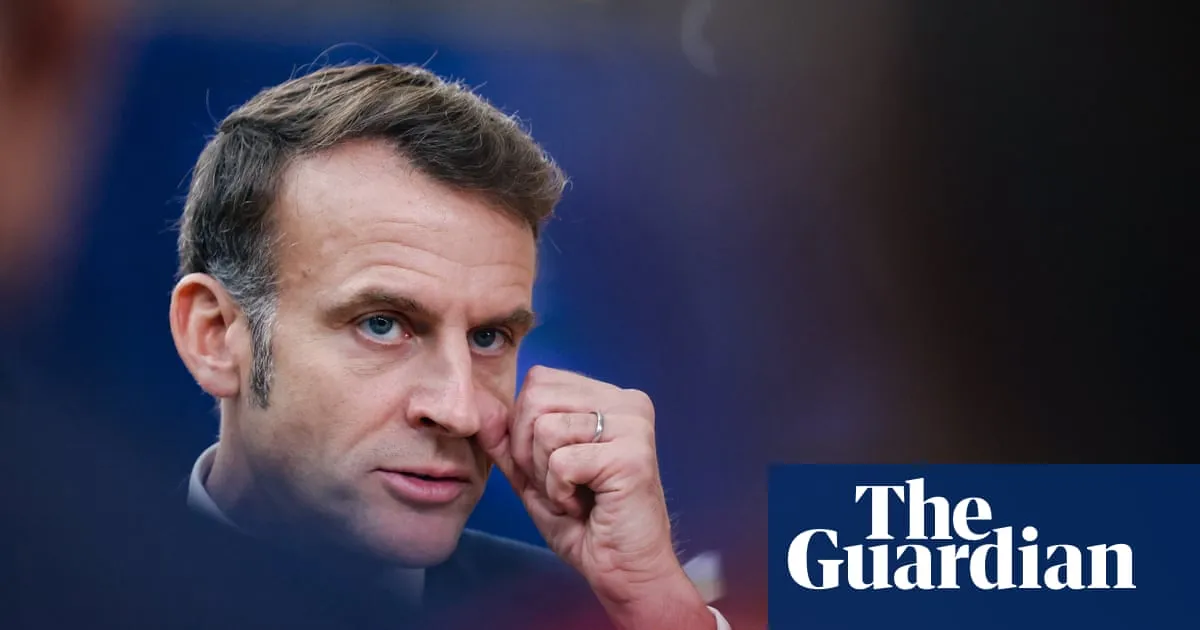
European leaders including Emmanuel Macron have accused Washington of “coercion and intimidation”, after the US imposed a visa ban on five prominent European figures who have been at heart of the campaign to introduce laws regulating American tech companies.The visa bans were imposed on Tuesday on Thierry Breton, the former EU commissioner and one of the architects of the bloc’s Digital Services Act (DSA), and four anti-disinformation campaigners, including two in Germany and two in the UK.The other individuals targeted were Imran Ahmed, the British chief executive of the US-based Center for Countering Digital Hate; Anna-Lena von Hodenberg and Josephine Ballon of the German non-profit HateAid; and Clare Melford, co-founder of the Global Disinformation Index.Justifying the visa bans, the US secretary of state, Marco Rubio, wrote on X: “For far too long, ideologues in Europe have led organised efforts to coerce American platforms to punish American viewpoints they oppose. The Trump administration will no longer tolerate these egregious acts of extraterritorial censorship.”Germany, Spain, the UK and a chorus of EU officials joined the French president in condemning the move, with Brussels signalling it could “respond swiftly and decisively” against the “unjustified measures”.The DSA is seen by Washington as a form of censorship while European leaders say the regulations are necessary to control hate speech, but the row threatens to become part of a far wider existing cultural and political conflict between Donald Trump’s administration and Europe. Artificial intelligence and digital technologies were always likely to become a major theatre of confrontation between the US and Europe, as these technologies become ever more central to wielding power.Macron condemned the visa ban in furious terms. “These measures amount to intimidation and coercion aimed at undermining European digital sovereignty,” he wrote, also on X. “The European Union’s digital regulations were adopted following a democratic and sovereign process by the European Parliament and the Council. They apply within Europe to ensure fair competition among platforms, without targeting any third country, and to ensure that what is illegal offline is also illegal online. The rules governing the European Union’s digital space are not meant to be determined outside Europe”.He later added he had spoken to Breton, who is French, and had thanked him for his work. “We will not give up, and we will protect Europe’s independence and the freedom of Europeans,” Macron said.The French foreign minister, Jean-Noël Barrot, said: “The peoples of Europe are free and sovereign and cannot let the rules governing their digital space be imposed by others upon them.”Breton, a former French finance minister and the European commissioner for the internal market from 2019 to 2024, said: “Is McCarthy’s witch-hunt back?“As a reminder: 90% of the European parliament – our democratically elected body – and all 27 member states unanimously voted the DSA. To our American friends: censorship isn’t where you think it is.”The EU Commission president, Ursula von der Leyen, said: “Freedom of speech is the foundation of our strong and vibrant European democracy. We are proud of it. We will protect it.” A commission spokesperson added: “If needed, we will respond swiftly and decisively to defend our regulatory autonomy against unjustified measures.”In the UK, the government said it was “fully committed” to upholding free speech.The EU law, passed in 2022, requires large digital platforms to show they are taking steps to address online risks, including the spread of illegal content, hate speech and the use of disinformation to manipulate election results.After two years of investigation, Elon Musk’s X platform was this month fined €120m (£104m) over a series of transgressions mainly relating to transparency, including deceiving users about verification checks, and researcher’s access.Washington said the EU was pursuing “undue” restrictions on freedom of expression and the DSA’s s extraterritorial restrictions were designed to weaken US tech firms and US citizens.Breton was replaced in the internal market role at the EU by another French politician, Stéphane Séjourné, who is the Commission’s executive vice-president. Séjourné expressed his support for his predecessor saying: “No sanction will silence the sovereignty of the European peoples. Total solidarity with him and all the people of Europe affected by this”.Outlining the bans on Tuesday, US under secretary for public diplomacy, Sarah Rogers, classified Breton as a “mastermind” of the DSA.Germany’s justice ministry said the two German campaigners had the government’s “support and solidarity” and the visa bans were unacceptable, adding that HateAid supported people affected by unlawful digital hate speech. The German foreign minister, Johann Wadephul, echoed the remarks on X: “The DSA was democratically adopted by the EU for the EU – it does not have extraterritorial effect.Spain’s foreign ministry also condemned the US measures, saying in a statement: “A safe digital space, free from illegal content and disinformation, is a fundamental value for democracy in Europe and a responsibility for everyone.“Anyone who describes this as censorship is misrepresenting our constitutional system. The rules by which we want to live in the digital space in Germany and in Europe are not decided in Washington.” Dennis Radtke, an MEP and member of the German ruling CDU, said: “The Trump fans in Europe defend this as a fight for freedom of speech. Where exactly has an opinion been suppressed? Where is the fight for freedom of speech with regard to China and Russia? It’s only about business here and the fight against the rule of law.”Raphaël Glucksmann, a French socialist MEP, said in a message to Rubio: “For far too long, Europe has been weak in implementing its own laws and defending its own interests. You have chosen to cosy up tyrants and confront democracies. The time has come for us to stand up. Kneel as much as you want in front of Putin, we are the free world now.“We are not a colony of the United States. We are Europeans, we must defend our laws, our principles, our interests. This scandalous sanction against Thierry Breton pays tribute to his fight for our sovereignty. We will continue it together. To the end.”The row is the latest to showcase tensions between the US and Europe. In August, Washington imposed sanctions on the French judge Nicolas Yann Guillou, who sits on the international criminal court, for the tribunal’s targeting of Israeli leaders and a past decision to investigate US officials.Michel Duclos, a former senior French diplomat and resident senior fellow in geopolitics and diplomacy at the Institut Montaigne thinktank lamented the move, referencing Russian envoy Kirill Dmitriev’s recent trip to Miami for talks on the Ukraine war. He said: “Dmitriev celebrated in Miami, Breton denied US visa: Europe is becoming the new Russia for Washington. It brings to mind the 1920s – America favouring the former enemy [Germany) against its former allies – but worse.”The chair of the German Journalists’ Association, Mika Beuster, expressed, solidarity with the Berlin-based HateAid. “This is censorship in its purest form, the likes of which we have previously only known from autocratic regimes,” said Beuster.
SRCThe Guardian - World News
LANGEN
LEANCenter-Left
WORDS1 151
ENT12
WED · 2025-12-24 · 12:36 GMTBRIEF NSR-2025-1224-4144
NSR-2025-1224-4144News Report·EN·Diplomatic
European leaders condemn US visa bans as row over ‘censorship’ escalates
European leaders, including Emmanuel Macron, are condemning the US for imposing visa bans on five prominent European figures involved in regulating American tech companies. The US Secretary of State, Marco Rubio, justified the bans by accusing these individuals of coercing American platforms to censor opposing viewpoints.
Patrick Wintour Diplomatic EditorThe Guardian - World NewsFiled 2025-12-24 · 12:36 GMTLean · Center-LeftRead · 5 min
The Guardian - World NewsFIG 01
Reading time
5min
Word count
1 151words
Sources cited
7cited
Entities identified
12entities
Quality score
100%
§ 01
Briefing Summary
AI-generatedNEWSAR · AI
European leaders, including Emmanuel Macron, are condemning the US for imposing visa bans on five prominent European figures involved in regulating American tech companies. The US Secretary of State, Marco Rubio, justified the bans by accusing these individuals of coercing American platforms to censor opposing viewpoints. Those targeted include Thierry Breton, a key architect of the EU's Digital Services Act (DSA), and four anti-disinformation campaigners from Germany and the UK. The DSA, intended to control hate speech, is viewed by Washington as censorship. Germany, Spain, the UK, and EU officials have joined France in criticizing the US action, with Brussels threatening a response. Macron described the visa bans as intimidation aimed at undermining European digital sovereignty.
Confidence 0.90Sources 7Claims 10Entities 12
§ 02
Article analysis
Model · rule-basedFraming
Diplomatic
Political Strategy
Tone
Measured
AI-assessed
CalmNeutralAlarmist
Factuality
0.70 / 1.00
Factual
LowHigh
Sources cited
7
Well sourced
FewMany
§ 03
Key claims
10 extracted01
Macron condemned the visa ban as intimidation and coercion aimed at undermining European digital sovereignty.
quoteMacron
Confidence
1.00
02
The DSA is seen by Washington as a form of censorship.
factualArticle
Confidence
1.00
03
European leaders, including Macron, condemned the US visa bans as "coercion and intimidation."
factualArticle
Confidence
1.00
04
Marco Rubio stated the visa bans were due to European efforts to coerce American platforms to punish American viewpoints.
quoteMarco Rubio
Confidence
1.00
05
The US imposed a visa ban on five prominent European figures involved in regulating American tech companies.
factualArticle
Confidence
1.00
06
These measures amount to intimidation and coercion aimed at undermining European digital sovereignty.
quoteEmmanuel Macron
Confidence
1.00
07
The DSA is seen by Washington as a form of censorship.
factualArticle
Confidence
1.00
08
Ideologues in Europe have led organised efforts to coerce American platforms.
quoteMarco Rubio
Confidence
1.00
09
The visa bans targeted individuals involved in regulating American tech companies.
factualArticle
Confidence
1.00
10
The US imposed a visa ban on five prominent European figures.
factualArticle
Confidence
1.00
§ 04
Full report
5 min read · 1 151 words§ 05
Entities
12 identifiedKey playerOppositionContextPositiveNeutralNegative
People8
Organizations1
§ 06
Keywords & salience
10 termsvisa ban
0.90
censorship
0.80
us-europe relations
0.70
digital sovereignty
0.70
digital services act
0.70
disinformation
0.60
tech companies
0.60
emmanuel macron
0.50
hate speech
0.50
marco rubio
0.40
§ 07
Topic connections
Interactive graph Network visualization showing 51 related topics
View Full Graph Person Organization Location Event|Click node to navigate|Edge numbers = shared articles