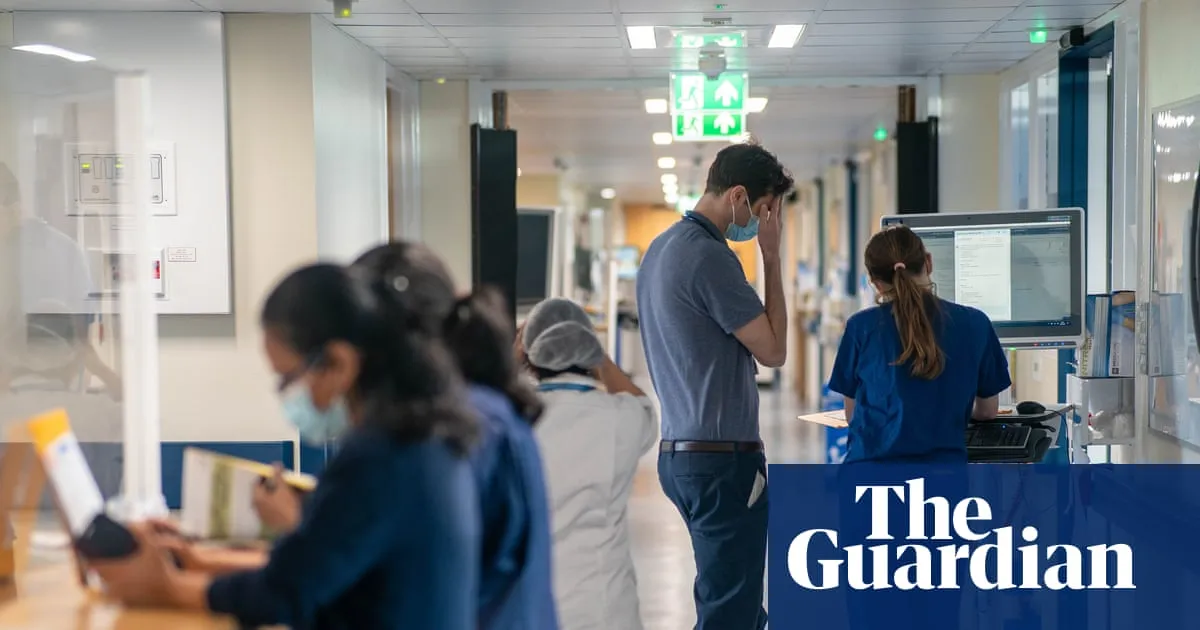
In the Great Hall at the University of East London last Wednesday, the perennially upbeat Wes Streeting was exuding even greater positivity than usual. After years of neglect under the Conservatives, he said, the NHS was starting to revive thanks to Labour’s medicine.In a bravura performance in front of an audience of health service bosses, policy experts and student nurses in their blue and green uniforms, Streeting reeled off a long list of improvements in his 20-month tenure as health secretary.The NHS backlog: down by 374,000 since Labour took over in July 2024. A&E waiting times: the best last winter for four years. Ambulance response times for heart attack and stroke victims: the best for five years. There had been 1,000 extra GPs promised but 2,000 actually delivered. Extra mental health staff, NHS dentistry appointments and funding for the NHS in England – £26bn, no less.But he was also buoyed because of the latest statistics on public satisfaction with the NHS, published that morning. Satisfaction across England, Scotland and Wales rose last year from 2024’s all-time low of 21% to 26% – the first rise in seven years. And dissatisfaction fell from 59% to 51% – the biggest drop since 1998. That was further proof, he added, that “the NHS is on the road to recovery” and “people are beginning to feel that change”.As he spoke, 150 miles away in Cheshire that recovery seemed elusive at Leighton Hospital in Crewe. Last Wednesday, and indeed all last week, it was under some of the most intense pressure it has ever faced. Despite winter being over, its emergency department was at one point full to bursting.At one point it was looking after a near-record 170 patients, while across its wards 110 others were medically fit to leave but still occupying a bed, thus compounding the intense pressures on the A&E.One member of staff said: “It’s been the worst few weeks of my career. I’ve been ashamed to work for the NHS. You could see the despair on everyone’s faces. There were just no answers as there was no space anywhere for patients. Everyone was really trying their best. People were staying late and missing breaks.”Leighton’s struggles were an example of another thing Streeting said: that while he was “proud of our progress” he was also “often ashamed when confronted with the reality of an NHS that still isn’t there for people when they need it”.But, he added, “the NHS today is better than it was when we came to power – and it will be better in the coming years”.Research published last week by University College London’s Global Business School for Health, based on the views of 850 NHS leaders and senior managers, illustrated why the NHS has a long way to go before it is back to the generally well-performing service it was until 2010.While staff goodwill remains strong, “people are exhausted”. Relentless demand for care and constrained resources mean “the system is running so close to the line operationally”. And high vacancy rates mean NHS bosses spend a lot of time trying to ensure safe staffing of services.Streeting’s tenure so far has involved three priorities. First, action to deliver on his repeated promises to restore NHS waiting times standards for key areas of care – on A&E, access to GPs, cancer care and planned hospital treatment.Second, a 10-year health plan that aims to modernise how the service works through “three big shifts”: from analogue to digital, from treatment to prevention and from hospital-based to community-based care.And third, a radical restructuring of the NHS – which he had previously ruled out – including the abolition of NHS England, which he insists will ultimately save money and ensure the service revives faster.Streeting knows that the public cares most about waiting times. At UEL he said that while waits for hospital treatment would definitely be back to 18 weeks by 2029, he could not guarantee the same for the others, such as four-hour A&E care, timely cancer treatment and prompt ambulance callouts after a 999 call.But when he spoke to the Guardian’s Politics Weekly podcast hours later he was more positive, and apparently now confident of success on all the key metrics.The Guardian sought the views of trust leaders, thinktank experts, senior NHS figures, current and ex-government health advisers, and a former Labour health minister about Streeting’s progress so far. They were also asked about the obstacles Streeting will have to overcome in order to rescue the NHS from the mess he inherited in 2024 and make it once again a service that gives people fast, high-quality care when they need it.On the “three big shifts”, NHS insiders agree that progress is slow. Plans announced far outstrip delivery on the ground. “I can’t yet hear the sound of the machinery of the ‘three big shifts’ clanking into gear,” one senior figure in the service said. Fulfilling plans for the promised creation of dozens of “neighbourhood health centres” – offering different types of physical and mental health care under one roof – is also important politically.But the greatest danger to Streeting may yet come from an issue that is not much on the public’s radar: the restructuring of the NHS and legislation – still unpublished – needed to formalise NHS England being merged with the Department of Health and Social Care.The last government to reorganise the NHS – the Tory/Lib Dem coalition in 2010 – expended a lot of energy dealing with the endless complications of doing so.“The reorganisation of the NHS has been a total car crash,” said Bill Morgan, who advised Rishi Sunak on health until the 2024 general election and is otherwise impressed by Streeting. “They haven’t introduced the legislation, which shows how little thought was given to it.”Stuart Hoddinott, an NHS expert at the Institute for Government thinktank, said he could see why the health secretary became so frustrated with a body that often duplicated the functions of his own Department of Health and Social Care (DHSC) and limited his power to order changes.But he said the abolition of NHS England “was an incredibly hasty decision that seems to have been made with little consideration of the wide-ranging impacts. It is creating a lot of turmoil”.There is the human, and financial cost through redundancies, of halving the staff who work for the DHSC, NHS England and its 42 regional integrated care boards. But, Hoddinott added, there was also a risk for Streeting that staff and organisations left dispirited, disengaged and possibly jobless by the “chaotic” restructuring would be too distracted by all that to help deliver his priorities.
SRCThe Guardian - World News
LANGEN
LEANCenter-Left
WORDS1 098
ENT11
SUN · 2026-03-29 · 18:45 GMTBRIEF NSR-2026-0329-42345
NSR-2026-0329-42345News Report·EN·Political Strategy
NHS restructure is greatest danger to Streeting’s effort to revive service
Health Secretary Wes Streeting highlighted improvements in the NHS since Labour took power in July 2024, citing reduced backlogs, improved A&E and ambulance response times, increased GP numbers, and additional funding. Public satisfaction with the NHS has also increased for the first time in seven years.
Denis Campbell and Kiran StaceyThe Guardian - World NewsFiled 2026-03-29 · 18:45 GMTLean · Center-LeftRead · 5 min
The Guardian - World NewsFIG 01
Reading time
5min
Word count
1 098words
Sources cited
3cited
Entities identified
11entities
Quality score
100%
§ 01
Briefing Summary
AI-generatedNEWSAR · AI
Health Secretary Wes Streeting highlighted improvements in the NHS since Labour took power in July 2024, citing reduced backlogs, improved A&E and ambulance response times, increased GP numbers, and additional funding. Public satisfaction with the NHS has also increased for the first time in seven years. Streeting acknowledged ongoing challenges and disparities in patient experience, exemplified by the intense pressures faced by Leighton Hospital in Crewe. Despite improvements, the hospital's emergency department was overwhelmed, with many patients awaiting discharge due to bed shortages. Streeting stated that the NHS is improving but still faces significant hurdles in providing consistent care across the country.
Confidence 0.90Sources 3Claims 5Entities 11
§ 02
Article analysis
Model · rule-basedFraming
Political Strategy
Public Health
Tone
Measured
AI-assessed
CalmNeutralAlarmist
Factuality
0.60 / 1.00
Mixed
LowHigh
Sources cited
3
Well sourced
FewMany
§ 03
Key claims
5 extracted01
Dissatisfaction with the NHS fell from 59% to 51% – the biggest drop since 1998.
statisticWes Streeting
Confidence
1.00
02
Public satisfaction with the NHS rose last year from 2024’s all-time low of 21% to 26%.
statisticWes Streeting
Confidence
1.00
03
The NHS backlog is down by 374,000 since Labour took over in July 2024.
statisticWes Streeting
Confidence
1.00
04
One member of staff said: 'It’s been the worst few weeks of my career. I’ve been ashamed to work for the NHS.'
quoteUnnamed NHS Staff Member
Confidence
0.90
05
Leighton hospital in Crewe was under some of the most intense pressure it has ever faced.
factualArticle (reporting on situation)
Confidence
0.90
§ 04
Full report
5 min read · 1 098 words§ 05
Entities
11 identifiedKey playerOppositionContextPositiveNeutralNegative
Organizations5
§ 06
Keywords & salience
9 termsnhs
1.00
healthcare
0.80
patient care
0.70
a&e waiting times
0.60
nhs backlog
0.60
public satisfaction
0.50
wes streeting
0.50
ambulance response times
0.40
emergency department
0.40
§ 07
Topic connections
Interactive graph No topic relationship data available yet. This graph will appear once topic relationships have been computed.