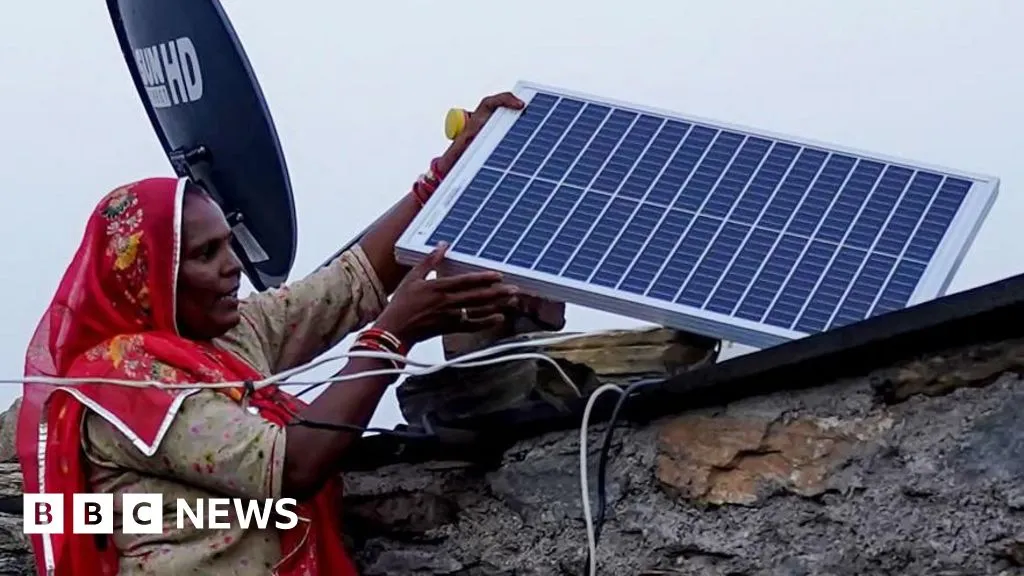
6 hours agoNikita Yadav AFP via Getty ImagesIndia gets plenty of sunlight throughout the year, which makes solar power highly efficientIndia's rapid solar energy expansion is widely hailed as a success. But without a plan to manage the waste it will generate, how clean is the transition?In just over a decade, India has become the world's third-largest solar producer, with renewables now central to its climate strategy. Solar panels are everywhere - from vast solar parks to blue rooftops across cities, towns and villages.Alongside large solar parks, millions of rooftop systems now feed power into the electricity grid. Government data show nearly 2.4 million households have adopted solar under a subsidy scheme.Solar growth has cut India's reliance on coal. Though thermal and other non-renewables still supply over half of installed capacity, solar now contributes more than 20%. Yet the achievement carries a challenge: while clean in use, solar panels can pose environmental risks if not properly managed.Solar panels are mostly recyclable, made of glass, aluminium, silver, and polymers - but trace toxic metals like lead and cadmium can pollute soil and water if mishandled.Solar panels typically last about 25 years, after which they are removed and discarded. India currently has no dedicated budget for solar-waste recycling and only a few small facilities to process old panels.Bloomberg via Getty ImagesThermal power plants continue to dominate India's energy generation capacityIndia has no official data on solar waste, but a study estimated around 100,000 tonnes by 2023, rising to 600,000 tonnes by 2030. For now, the volume is small, but experts warn the bulk is yet to come - and without rapid recycling investment, India could face a growing waste crisis.A new study by the Council on Energy, Environment and Water (CEEW) estimates that India could generate more than 11 million tonnes of solar waste by 2047. Managing this would require almost 300 dedicated recycling facilities and an investment of $478 (£362m) over the next two decades."Most of India's large solar parks were built in the mid-2010s, so the real wave of waste is coming in 10 to 15 years," says Rohit Pahwa of energy company Targray.India's solar-waste projections mirror global patterns: the US may generate 170,000–1 million tonnes and China nearly one million tonnes by 2030, following rapid solar expansion in the 2010s.The policy landscape, however, differs significantly.In the US, solar-panel recycling is mostly market-driven under a patchwork of state rules. China's system, like India's, is still developing and lacks a dedicated regulatory framework.In 2022, India brought solar panels under e-waste rules, making manufacturers responsible for collecting, storing, dismantling and recycling them at end of life.Experts say enforcement is uneven, especially for home and small-scale panels, which make up 5–10% of installations. Though modest, these panels can still generate substantial waste, as they are harder to track, collect, and recycle.Damaged or discarded panels often end up in landfills or with unauthorised recyclers, where unsafe methods can release toxic materials. The BBC has contacted India's renewable energy ministry for comment.Hindustan Times via Getty ImagesDamaged and ageing rooftop panels are rarely recycled"Solar power gives an illusion of clean energy for two decades, but without a serious plan for recycling panels it risks leaving behind a graveyard of modules and not much of a legacy," says environment expert Sai Bhaskar Reddy Nakka.Despite the challenges, experts say the problem is not without opportunities. "As waste rises, so will the demand for companies that know how to process it," Mr Pahwa says. Efficient recycling could reclaim 38% of materials for new panels by 2047 and prevent 37 million tonnes of carbon emissions from mining, says CEEW.India already has markets for glass and aluminium, and metals found in solar cells - silicon, silver, and copper - can be recovered for new panels or other industries, says Akansha Tyagi, co-author of the study.Currently, most solar waste is processed with basic methods that recover only low-value materials like glass and aluminium, while precious metals are lost, damaged or extracted in tiny amounts.Experts say the next decade will be decisive for India's solar goals. The country must act fast - building a regulated, self-sustaining recycling system, raising household awareness, and integrating waste collection into solar business models.Companies that profit from solar power should also be responsible for what happens to panels once they stop working, says Mr Nakka. "Without proper recycling, clean energy today could mean more waste tomorrow," he warned.Follow BBC News India on Instagram, YouTube, X and Facebook.
SRCBBC News - World
LANGEN
LEANCenter
WORDS739
ENT5
THU · 2025-12-25 · 23:11 GMTBRIEF NSR-2025-1226-4307
NSR-2025-1226-4307News Report·EN·Environmental
India's solar boom faces a hidden waste problem
India's rapid expansion of solar energy, now contributing over 20% to its power capacity, faces a growing waste management challenge. While solar power reduces reliance on coal, discarded panels, lasting about 25 years, contain recyclable materials and trace toxic metals that can pollute if mishandled.
BBC News - WorldFiled 2025-12-25 · 23:11 GMTLean · CenterRead · 3 min
BBC News - WorldFIG 01
Reading time
3min
Word count
739words
Sources cited
3cited
Entities identified
5entities
Quality score
100%
§ 01
Briefing Summary
AI-generatedNEWSAR · AI
India's rapid expansion of solar energy, now contributing over 20% to its power capacity, faces a growing waste management challenge. While solar power reduces reliance on coal, discarded panels, lasting about 25 years, contain recyclable materials and trace toxic metals that can pollute if mishandled. India currently lacks a dedicated budget and sufficient facilities for solar panel recycling. Estimates suggest India could generate 600,000 tonnes of solar waste by 2030 and over 11 million tonnes by 2047, requiring significant investment in recycling infrastructure. Experts warn that without proactive measures, India risks a waste crisis as the first wave of discarded panels from large solar parks built in the mid-2010s approaches.
Confidence 0.90Sources 3Claims 5Entities 5
§ 02
Article analysis
Model · rule-basedFraming
Environmental
Economic Impact
Tone
Measured
AI-assessed
CalmNeutralAlarmist
Factuality
0.80 / 1.00
Factual
LowHigh
Sources cited
3
Well sourced
FewMany
§ 03
Key claims
5 extracted01
Government data show nearly 2.4 million households have adopted solar under a subsidy scheme.
statistic
Confidence
1.00
02
India has become the world's third-largest solar producer.
factual
Confidence
1.00
03
A study estimated India's solar waste around 100,000 tonnes by 2023, rising to 600,000 tonnes by 2030.
statistic
Confidence
0.90
04
Managing solar waste would require almost 300 dedicated recycling facilities and an investment of $478 over the next two decades.
predictionCouncil on Energy, Environment and Water (CEEW)
Confidence
0.80
05
India could generate more than 11 million tonnes of solar waste by 2047.
predictionCouncil on Energy, Environment and Water (CEEW)
Confidence
0.80
§ 04
Full report
3 min read · 739 words§ 05
Entities
5 identifiedKey playerOppositionContextPositiveNeutralNegative
People1
Organizations1
§ 06
Keywords & salience
8 termssolar energy
1.00
solar waste
0.90
solar panels
0.80
recycling
0.70
environmental risks
0.60
waste management
0.60
renewable energy
0.50
toxic metals
0.40
§ 07
Topic connections
Interactive graph Network visualization showing 51 related topics
View Full Graph Person Organization Location Event|Click node to navigate|Edge numbers = shared articles