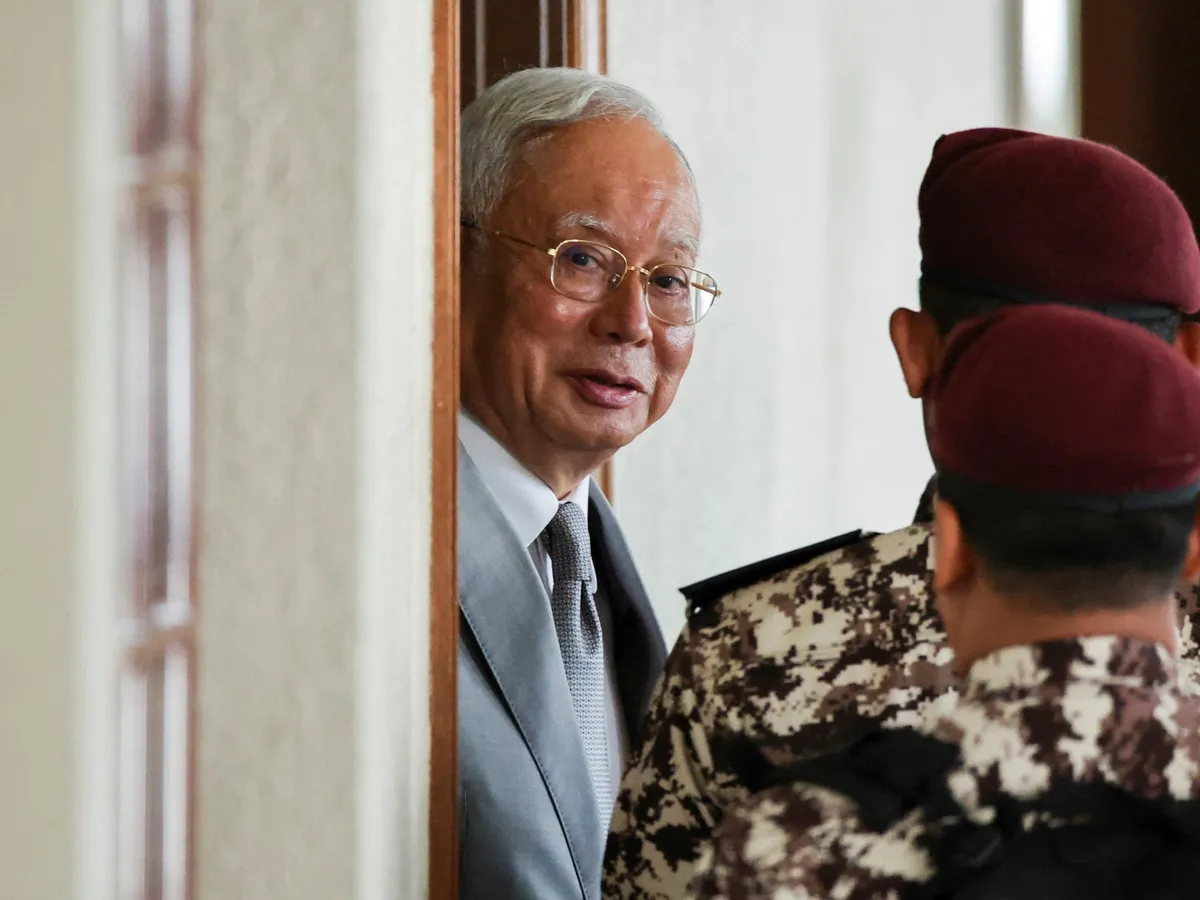
Malaysian High Court finds former PM Najib guilty in trial related to the 1MDB sovereign wealth fund scandal.Malaysia's former Prime Minister Najib Razak is escorted by prison guards at the Kuala Lumpur Courts Complex, Kuala Lumpur, Malaysia, on December 22, 2025 [Hasnoor Hussain/Reuters]Published On 26 Dec 2025Former Malaysian Prime Minister Najib Razak has been found guilty in his second major trial involving the multibillion-dollar 1MDB scandal.The ruling was handed down by the Kuala Lumpur High Court on Friday, where Najib, 72, was found guilty on all 21 counts of money laundering and four counts of abuse of power in the illegal transfer of 2.2 billion Malaysian ringgit ($543m) from Malaysia’s 1MDB sovereign wealth fund into his accounts.Recommended Stories list of 4 itemslist 1 of 4Venezuela frees dozens detained during protests against Madurolist 2 of 4Trump says US launched strike against ISIL in northwest Nigerialist 3 of 4‘A comedy show’: Myanmar youth in exile slam military-run ‘sham’ electionlist 4 of 4Russia-Ukraine war: List of key events, day 1,401end of list“The contention by the accused that the charges against him were a witch hunt and politically motivated were debunked by the cold, hard and incontrovertible evidence against him that pointed towards the accused having abused his own powerful position in 1MDB, coupled with the extensive powers conferred upon him,” Judge Collin Lawrence Sequerah said in his verdict.Each charge carries between 15 and 20 years’ imprisonment, although the final sentencing has yet to be announced.Prosecutors accused Najib of abusing his position as prime minister, finance minister and 1MDB advisory board chairman by moving large amounts of money from the sovereign wealth fund to his personal accounts more than a decade ago.Najib was found guilty in 2020 and sentenced to 12 years in prison for misappropriating about $9.9m in 1MDB funds. His sentence was later commuted to six years.Malaysia’s former Prime Minister Najib Razak in 2022 [File: Ahmad Luqman Ismail/EPA]This latest trial, Najib’s second, was widely considered the most significant to date because it directly involved 1MDB entities and much larger sums of money.The marathon legal proceedings have spanned seven years and saw lawyers call 76 witnesses to the stand, including Najib himself.“The trial has had a lot of delays, and it’s a very complicated thing to understand,” said Bridget Welsh, an honorary research associate with the University of Nottingham Asia Research Institute Malaysia.“These financial crimes are multi-layered, and it’s been a long, extensive process,” Welsh told Al Jazeera.Najib apologised last year for mishandling the 1MDB scandal, but during his recent trial maintained that he had been led astray by the fugitive Malaysian financier Jho Low, who has been wanted by Interpol since 2016.Judge Sequerah said on Friday that evidence indicated Najib had an “unmistakable bond and connection” with Low, who served as the prime minister’s “proxy and intermediary”, the Reuters news agency reported.The judge also challenged Najib’s defence that he mistakenly believed some of his ill-gotten funds were “donations” from the Saudi royal family, Reuters said.‘A test of Malaysia’s judiciary’The 1MDB scandal was a watershed moment for Malaysia when it broke in 2015 and helped unseat the United Malays National Organisation (UMNO) in 2018 after six decades in power.Despite the scope of the charges against him, Najib is still popular among some Malaysians and his trial remains a “red line” issue for the UMNO, according to Kuala Lumpur-based political analyst James Chai.Chai told Al Jazeera that Friday’s verdict could also threaten the future stability of Prime Minister Anwar Ibrahim’s unity government. The UMNO is a member of the coalition, but there have been calls for the party to withdraw. Chai said the trend may accelerate following the ruling.“While the judgement was fair and appropriate, without obvious lapses, the conviction on all charges could be interpreted as ‘harsh’ by Najib supporters at a time of shifting political sentiments in Malaysia,” Chai said.“The irony is that the anticorruption credentials that propelled this government to its ascendancy may now serve as a burden,” he continued.With sentencing and an appeals process still to come, the Asia Research Institute’s Welsh told Al Jazeera that the outcome of Najib’s trial will demonstrate the strength of political accountability in Malaysia.“This is a test of Malaysia’s judiciary, and it’s a test of political will to allow this to continue, especially given that the party involved is also part of the government,” she said.
SRCAl Jazeera
LANGEN
LEANCenter
WORDS722
ENT5
FRI · 2025-12-26 · 07:48 GMTBRIEF NSR-2025-1226-4324
NSR-2025-1226-4324News Report·EN·Legal & Judicial
Malaysia’s ex-PM Najib found guilty of money laundering, abuse of power
Former Malaysian Prime Minister Najib Razak was found guilty on December 26, 2025, in his second major trial related to the 1MDB scandal. The Kuala Lumpur High Court convicted him on 21 counts of money laundering and four counts of abuse of power for illegally transferring 2.2 billion Malaysian ringgit ($543m) from the 1MDB sovereign wealth fund into his personal accounts.
By News AgenciesAl JazeeraFiled 2025-12-26 · 07:48 GMTLean · CenterRead · 3 min
Al JazeeraFIG 01
Reading time
3min
Word count
722words
Sources cited
2cited
Entities identified
5entities
Quality score
100%
§ 01
Briefing Summary
AI-generatedNEWSAR · AI
Former Malaysian Prime Minister Najib Razak was found guilty on December 26, 2025, in his second major trial related to the 1MDB scandal. The Kuala Lumpur High Court convicted him on 21 counts of money laundering and four counts of abuse of power for illegally transferring 2.2 billion Malaysian ringgit ($543m) from the 1MDB sovereign wealth fund into his personal accounts. Prosecutors argued that Najib abused his positions as prime minister, finance minister, and 1MDB advisory board chairman. Each charge carries a potential sentence of 15 to 20 years imprisonment, with the final sentencing yet to be announced. Najib was previously convicted in 2020 for misappropriating 1MDB funds, and this second trial was considered significant due to the larger sums of money involved.
Confidence 0.90Sources 2Claims 5Entities 5
§ 02
Article analysis
Model · rule-basedFraming
Legal & Judicial
Political Strategy
Tone
Measured
AI-assessed
CalmNeutralAlarmist
Factuality
0.80 / 1.00
Factual
LowHigh
Sources cited
2
Limited
FewMany
§ 03
Key claims
5 extracted01
The trial has had a lot of delays, and it’s a very complicated thing to understand.
quoteBridget Welsh
Confidence
1.00
02
Najib apologised last year for mishandling the 1MDB scandal.
factual
Confidence
1.00
03
Each charge carries between 15 and 20 years’ imprisonment.
factual
Confidence
1.00
04
The illegal transfer involved 2.2 billion Malaysian ringgit ($543m) from Malaysia’s 1MDB fund.
factualKuala Lumpur High Court
Confidence
1.00
05
Najib Razak was found guilty on 21 counts of money laundering and 4 counts of abuse of power.
factualKuala Lumpur High Court
Confidence
1.00
§ 04
Full report
3 min read · 722 words§ 05
Entities
5 identifiedKey playerOppositionContextPositiveNeutralNegative
Organizations1
§ 06
Keywords & salience
10 termsnajib razak
1.00
1mdb scandal
1.00
money laundering
0.90
abuse of power
0.80
malaysia
0.80
sovereign wealth fund
0.70
kuala lumpur high court
0.70
political corruption
0.60
malaysian ringgit
0.60
criminal trial
0.50
§ 07
Topic connections
Interactive graph Network visualization showing 20 related topics
View Full Graph Person Organization Location Event|Click node to navigate|Edge numbers = shared articles