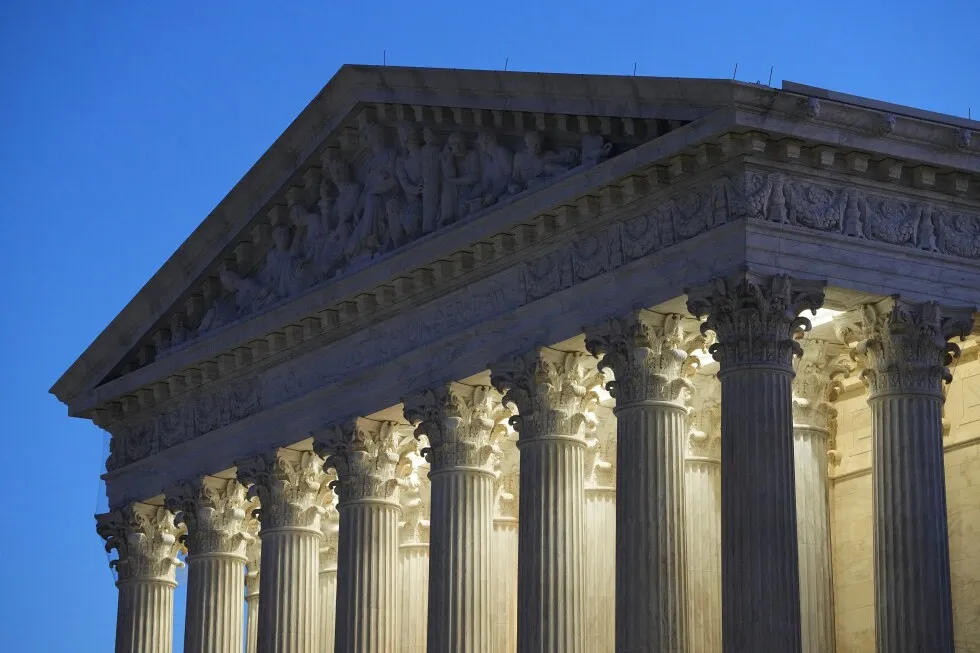
The U.S. Supreme Court is seen in Washington on Feb. 24, 2026. (AP Photo/Matt Rourke, File) Updated [hour]:[minute] [AMPM] [timezone], [monthFull] [day], [year] WASHINGTON (AP) — One of the first things an Argentine emigre did after her son was born in Florida last year was get him a U.S. passport.She saw the passport as tangible evidence that he’s an American. But now people like her are in a legal fight over President Donald Trump’s executive order that would deny U.S. citizenship to children born in the United States to people who are in the country illegally or temporarily. “It’s funny because I actually booked him for his passport application appointment even before he was born,” the 28-year-old woman said, as her now 7-month-old son napped nearby. She spoke to The Associated Press on the condition of anonymity, insisted upon by her lawyers, out of fear of possible retribution by the Republican administration if she were publicly identified.“I would say that I am definitely relieved that at least he is protected,” she said. The Supreme Court is hearing arguments on Wednesday over whether Trump’s order, signed on Jan. 20, 2025, his first day back in office, comports with the post-Civil War 14th Amendment and an 86-year-old federal law that has been widely understood to make citizens of everyone born in the country, with narrow exceptions for the children of foreign diplomats and invading armies. Every court to have considered the issue has found the order to be illegal and prevented it from taking effect. The call to repeal birthright citizenship is part of the Trump administration’s broader crackdown on immigrants that has included stepped-up deportations, drastic reductions in the number of refugees allowed into the U.S., suspension of asylum at the border and stripping temporary legal protections from people fleeing political and economic instability.The case presents another test for a high court that has allowed some anti-immigration efforts to continue, even after lower courts had blocked them. Constitution vs. executive orderThe first sentence of the 14th Amendment, the Citizenship Clause, makes citizens of “all persons born or naturalized in the United States, and subject to the jurisdiction thereof.” The case turns on the meaning of the final phrase about jurisdiction, which also was used in citizenship laws enacted in 1940 and 1952.Trump’s view, asserted in the order titled “Protecting the Meaning and Value of American Citizenship” and backed by some conservative legal scholars, is that people here illegally or temporarily are not “subject to the jurisdiction” of the United States and therefore their U.S.-born children are not entitled to citizenship. The court should use the case to set straight “long-enduring misconceptions about the Constitution’s meaning,” Solicitor General D. John Sauer wrote. In that regard, Sauer likened the case to the seminal 1954 decision in Brown v. Board of Education, which outlawed segregation in public schools, and the landmark 2008 Heller case, which declared that people have a constitutional right to keep guns for self-defense. Last year, Justice Sonia Sotomayor called the Trump administration’s effort to defend the order “an impossible task in light of the Constitution’s text, history, this Court’s precedents, federal law, and Executive Branch practice.” Sotomayor was joined by the other two liberal justices in a dissent from a decision by the court’s six conservative justices that used an earlier round of the birthright citizenship dispute to limit the use of nationwide injunctions by federal judges. Challenging TrumpThe pregnant mothers and their advocates challenging the order, as well as lower-court judges who have blocked it, have said the Trump administration’s arguments lack merit.“We have the president of the United States trying to radically reinterpret the definition of American citizenship,” said Cecillia Wang, the American Civil Liberties Union legal director who will face off against Sauer on Wednesday.More than one-quarter of a million babies born in the U.S. each year would be affected by the executive order, according to research by the Migration Policy Institute and Pennsylvania State University’s Population Research Institute.While Trump has largely focused on illegal immigration in his rhetoric and actions, the birthright restrictions also would apply to people who are legally in the United States, including students and applicants for green cards, or permanent resident status. ‘The most beautiful thing’The woman from Argentina said she came to the U.S. in 2016 on a visa to attend college and has since applied for a green card.She described a moment of panic following the court’s June ruling, when it was at least possible that the restrictions could take effect, particularly in states such as Florida that had not challenged Trump’s order. Lower-court rulings over the summer ensured the order remained on hold and set up the current Supreme Court case.On top of the predictable worries of a first-time mother, she said, “I never thought that, you know, so close to the end of my pregnancy that I would have to be even thinking about ... the executive order and how it would have impacted my baby.” She has not reconsidered her decision to come to the United States or her desire to stay, she said, as her son stirred.“And so nothing that happens, politically or otherwise, would have changed my views of the country, I mean, because it gave me the most beautiful thing I have today, which is my family,” she said.___Follow the AP’s coverage of the U.S. Supreme Court at https://apnews.com/hub/us-supreme-court. Sherman has covered the Supreme Court for The Associated Press since 2006. His journalism career spans five decades. He is based in Washington, D.C., and previously lived in New York, Paris and Atlanta.
SRCAssociated Press (AP)
LANGEN
LEANCenter
WORDS928
ENT6
MON · 2026-03-30 · 11:23 GMTBRIEF NSR-2026-0330-43289
NSR-2026-0330-43289News Report·EN·Legal & Judicial
The birthright citizenship case at the Supreme Court hits close to home for this immigrant mother
The Supreme Court is hearing arguments regarding the legality of a 2025 executive order by President Trump that seeks to deny U.S. citizenship to children born in the U.S.
By
MARK SHERMANAssociated Press (AP)Filed 2026-03-30 · 11:23 GMTLean · CenterRead · 4 min
Associated Press (AP)FIG 01
Reading time
4min
Word count
928words
Sources cited
2cited
Entities identified
6entities
Quality score
100%
§ 01
Briefing Summary
AI-generatedNEWSAR · AI
The Supreme Court is hearing arguments regarding the legality of a 2025 executive order by President Trump that seeks to deny U.S. citizenship to children born in the U.S. to parents who are in the country illegally or temporarily. The case centers on the 14th Amendment's Citizenship Clause and its "subject to the jurisdiction thereof" provision. Every court that has considered the order has found it illegal. The order is part of a broader Trump administration crackdown on immigration. The case presents a test for the Supreme Court, which has previously allowed some anti-immigration efforts to proceed despite lower court rulings. The article highlights the concerns of an immigrant mother who obtained a U.S. passport for her son, born in Florida, and fears potential repercussions from the administration.
Confidence 0.90Sources 2Claims 5Entities 6
§ 02
Article analysis
Model · rule-basedFraming
Legal & Judicial
Human Interest
Tone
Measured
AI-assessed
CalmNeutralAlarmist
Factuality
0.80 / 1.00
Factual
LowHigh
Sources cited
2
Limited
FewMany
§ 03
Key claims
5 extracted01
The court should use the case to set straight “long-enduring misconceptions about the Constitution’s meaning.”
quoteSolicitor General D. John Sauer
Confidence
1.00
02
The case turns on the meaning of the phrase about jurisdiction in the 14th amendment.
factualnull
Confidence
1.00
03
Every court to have considered the issue has found the order to be illegal and prevented it from taking effect.
factualnull
Confidence
1.00
04
The Supreme Court is hearing arguments on whether Trump’s order comports with the 14th Amendment.
factualnull
Confidence
1.00
05
President Trump signed an executive order that would deny U.S. citizenship to children born in the United States to people who are in the country illegally or temporarily.
factualnull
Confidence
1.00
§ 04
Full report
4 min read · 928 words§ 05
Entities
6 identifiedKey playerOppositionContextPositiveNeutralNegative
§ 06
Keywords & salience
9 termsbirthright citizenship
1.00
supreme court
0.80
14th amendment
0.80
immigration
0.70
executive order
0.70
u.s. passport
0.60
legal fight
0.50
illegally or temporarily
0.50
immigrant mother
0.40
§ 07
Topic connections
Interactive graph Network visualization showing 51 related topics
View Full Graph Person Organization Location Event|Click node to navigate|Edge numbers = shared articles