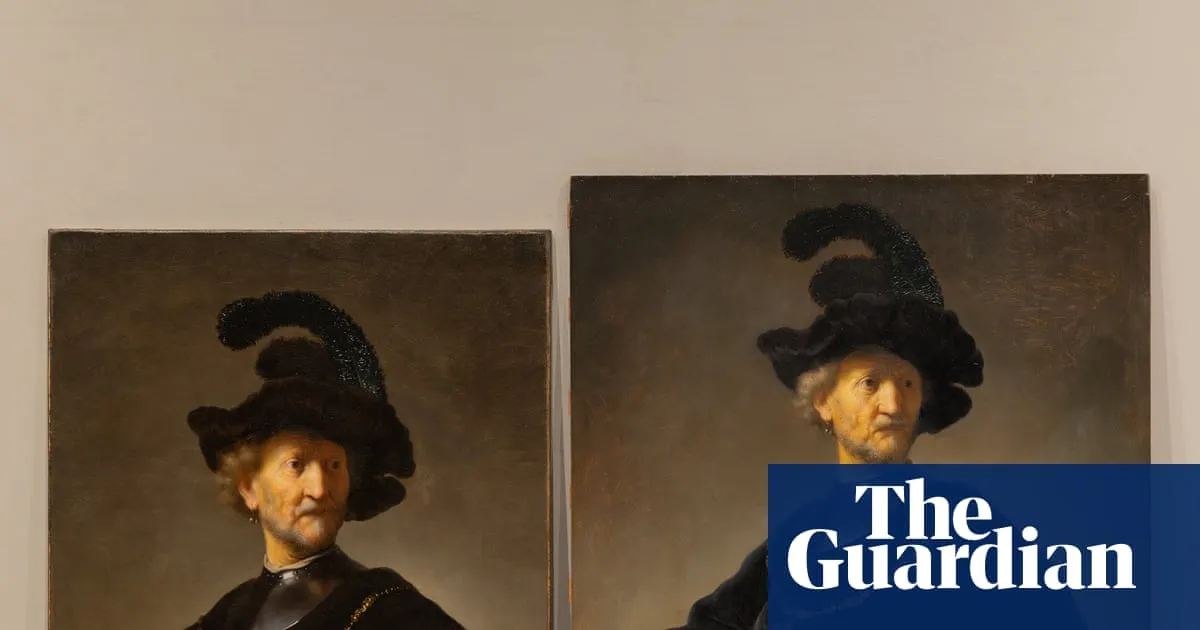
A portrait in a UK collection that has long been dismissed as a workshop copy of an almost identical painting by Rembrandt was in fact also painted by the 17th-century Dutch master, according to a leading scholar.Each of the paintings, titled Old Man with a Gold Chain and dated to the early 1630s, is a near-lifesize depiction of an older man wearing a gold chain and a plumed hat.For the first time in almost four centuries, the two portraits have been reunited by the Art Institute of Chicago, which owns the undisputed version, painted on panel.The other portrait, which is slightly smaller and painted on canvas, is on loan from Sir Francis Newman, a Cambridge-based entrepreneur, and is labelled as a “copy” by an artist in Rembrandt’s workshop.However, the Rembrandt scholar Gary Schwartz has concluded that both are by the master. In addition to the quality of the brushwork, he argued, many Dutch artists of the period created replicas of their own paintings.In 1699, a French near-contemporary of Rembrandt observed: “There is hardly any painter [in the Netherlands] who did not repeat one of his works because he liked it, or because someone asked him to make one exactly the same.”The contested version of the portrait was bought by Sir Francis Newman’s great-grandfather as a Rembrandt in 1898.Schwartz told the Guardian: “It’s just whether or not we will aim to accept that Rembrandt did it. I find it very exciting. It opens up all sorts of possibilities for looking again at many paintings.”He added: “If Rembrandt had a customer for a replica of his attractive Old Man, what would be the most effective and efficient way of making it? Assigning it to a pupil, whose work would have to be corrected – and the Newman painting shows no sign of corrections – or re-enacting the steps he had just taken, when they were still fresh in mind and hand? Surely the latter makes more sense. This assumption accounts for the outstanding quality of the canvas.”X-ray and infrared imaging of the Chicago picture revealed underdrawing that showed, for example, adjustments to the man’s costume. Such corrections during painting were absent from the canvas, Schwartz said: “If it were a pupil doing it, he would have made slips that the master will have wanted to correct. This one is so exact.”Newman’s great-grandfather bought the painting as a Rembrandt in 1898 from the London gallery Agnews for a sizeable sum. “So it really was taken very seriously at that time,” Schwartz said. But when the other painting turned up in 1912, this one was discounted by the noted German art historian Wilhelm Bode, who concluded that it was “a clever reproduction”.Schwartz, who will deliver a talk on Dutch painting at the National Gallery, in London, on Monday, has written numerous books on Rembrandt and Dutch painting, and has just published a new volume in Thames & Hudson’s World of Art series.He said that Bode offered “no serious reasoning for his contention”.The Newman version has only been exhibited once before, in 1952, as part of an exhibition at the Royal Academy in London. Schwartz said: “In the catalogue, they called it a Rembrandt original. But experts who visited the exhibition corrected this and, in the Burlington [magazine], there was an article by a leading Dutch art historian who said, this is a studio copy.”Although many of the details appeared the same in both works, close examination revealed differences, research from Chicago showed. While the eyelashes in the UK painting were created with tiny brushstrokes of light-coloured paint, those in the Chicago painting were made by scratching through dark paint while it was still wet to reveal light paint below.However, a study by the Hamilton Kerr Institute, at the University of Cambridge, found that the UK version’s canvas and colour pigments matched those used by Rembrandt and his studio. It also found that it had the same oil-bound, double-ground layer as eight Rembrandt paintings dating from 1632 and 1633.The Art Institute of Chicago said that after reviewing infrared scans, X-rays and pigment analysis, differences in the two works suggested the UK version was a workshop reproduction. But they acknowledged that “the conversation about the purpose and authorship of these copies continues to evolve”.Newman, asked whether he had always believed it to be a Rembrandt, said: “My view is it’s always been a mystery. I’ve enjoyed the mystery because it meant I could enjoy it on the wall … and not have the responsibility of its potential importance.”If it is a Rembrandt, it will go to a museum, he said.
SRCThe Guardian - World News
LANGEN
LEANCenter-Left
WORDS764
ENT8
MON · 2026-03-30 · 11:29 GMTBRIEF NSR-2026-0330-43365
NSR-2026-0330-43365News Report·EN·Human Interest
Painting considered workshop copy is in fact by Rembrandt, expert says
Exclusive: UK owner’s version of Old Man with a Gold Chain reunited in Chicago with undisputed work by Dutch master A portrait in a UK collection that has long been dismissed as a workshop copy of an almost identical painting by Rembrandt was in fact also painted by the 17th-century Dutch master, ac
Dalya AlbergeThe Guardian - World NewsFiled 2026-03-30 · 11:29 GMTLean · Center-LeftRead · 4 min
The Guardian - World NewsFIG 01
Reading time
4min
Word count
764words
Sources cited
2cited
Entities identified
8entities
Quality score
75%
§ 02
Article analysis
Model · rule-basedFraming
Human Interest
Tone
Measured
AI-assessed
CalmNeutralAlarmist
Factuality
0.70 / 1.00
Factual
LowHigh
Sources cited
2
Limited
FewMany
§ 03
Key claims
5 extracted01
Wilhelm Bode concluded in 1912 that the painting was a clever reproduction.
factualnull
Confidence
1.00
02
The contested version of the portrait was bought as a Rembrandt in 1898.
factualnull
Confidence
1.00
03
The Art Institute of Chicago owns the undisputed version of Old Man with a Gold Chain, painted on panel.
factualnull
Confidence
1.00
04
The two paintings, titled Old Man with a Gold Chain and dated to the early 1630s, depict an older man with a gold chain and plumed hat.
factualnull
Confidence
1.00
05
A portrait in a UK collection, previously dismissed as a workshop copy, is in fact by Rembrandt.
factualGary Schwartz
Confidence
0.80
§ 04
Full report
4 min read · 764 words§ 05
Entities
8 identifiedKey playerOppositionContextPositiveNeutralNegative
People3
Organizations2
§ 06
Keywords & salience
8 termsrembrandt
1.00
painting attribution
0.80
old man with a gold chain
0.70
art history
0.60
workshop copy
0.60
art authentication
0.50
dutch masters
0.50
gary schwartz
0.40
§ 07
Topic connections
Interactive graph No topic relationship data available yet. This graph will appear once topic relationships have been computed.