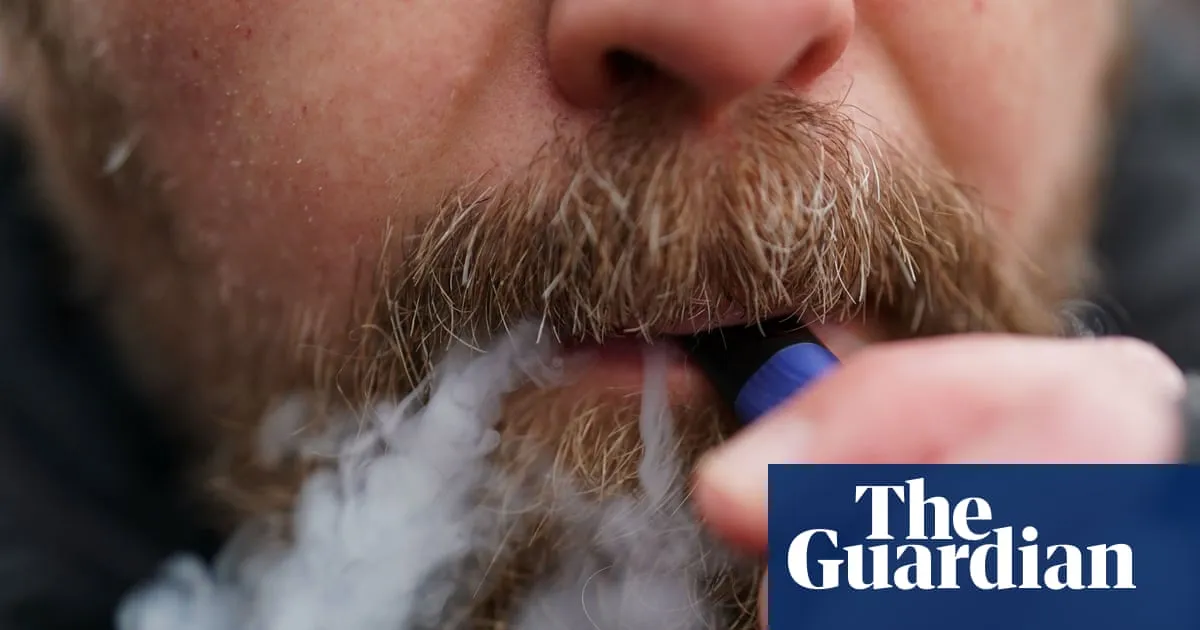
Researchers find there are early warning signs in the body from vaping strongly linked to cancer risk, including DNA damage and inflammation. Photograph: Jacob King/PA View image in fullscreen Researchers find there are early warning signs in the body from vaping strongly linked to cancer risk, including DNA damage and inflammation. Photograph: Jacob King/PA Vaping likely to cause lung and oral cancer, Australian researchers find in new review of evidence ‘There is no doubt that the cells and tissues of the oral cavity, the mouth and the lungs are altered by inhalation from e-cigarettes,’ academic says Follow our Australia news live blog for latest updates Get our breaking news email, free app or daily news podcast Vaping is likely to cause lung and oral cancer, researchers have found, as they urged regulators to act now rather than wait decades for a definitive level of risk. Cancer researchers led by the University of New South Wales in Sydney analysed reviews of evidence from animal studies, human case reports and laboratory research published between 2017 and 2025, in one of the most detailed assessments to date of whether nicotine e-cigarettes could cause cancer. There are early warning signs in the body strongly linked to cancer risk, including DNA damage and inflammation, co-author Adjunct Prof Bernard Stewart said. The review, published in the journal Carcinogenesis on Tuesday, found vaping is associated with these pre-carcinogenic changes. “There is no doubt that the cells and tissues of the oral cavity, the mouth and the lungs are altered by inhalation from e-cigarettes,” Stewart said. Because modern e-cigarettes were only invented in the early 2000s, there is not enough long-term data from large numbers of people vaping and who developed cancer to determine definitive risk. Many vapers also smoke, making it difficult to distinguish the effects of vaping alone from those of tobacco. For these reasons, the review did not measure how many people might develop cancer from vaping, but instead assessed whether it causes the kinds of biological changes known to lead to the disease. However, the review included case reports from dentists who noticed oral cancer in people who had only vaped and who had never smoked. It also examined animal studies, and Stewart referred to a study that found mice exposed to e-cigarette vapour developed lung tumours at greater rates than unexposed mice, although such findings do not necessarily translate directly to humans. “On the basis of all of that knowledge … we determined e-cigarettes are likely to cause lung cancer and oral cancer, though we cannot say how great that burden will be,” he said. Lead author of the study, epidemiologist Associate Prof Freddy Sitas, said it took 100 years of emerging and growing evidence before the US Surgeon General recognised smoking as a cause of lung cancer in 1964. Calvin Cochran, a research fellow at the University of Otago’s Department of Public Health in New Zealand, said nearly 8,000 studies were ultimately assessed to reach that conclusion, despite earlier warning signs that were often dismissed or discredited, including by doctors. “We risk repeating that same fate with vaping if we don’t take emerging research and warning signs seriously,” Cochran said. “Every study like this should be considered seriously by policymakers, government’s and health organisations. There is likely going to be no planting the flag moment where we can conclusively say vaping causes x,y,z types of cancer. That is years and most probably decades away.” Though smoking was once given the benefit of doubt, the same should not now be accorded to vaping given the strength of carcinogenicity data, Sitas said. “We’ve always assumed that vapes are safer than cigarettes, but you know, what we’re showing is that they might not be safe after all. We have no conclusive way in which to get people off the vapes. “So in smoking, we’ve got ways in nicotine gum, various drugs that we can give people to stop them from smoking. The evidence regarding people stopping vaping is very inconclusive.” He said regulators needed to act to protect people, especially children, from harm. “What is important is that regulators have at their disposal the full spectrum of evidence,” he said. “It’s not an alternative to smoking … It’s not an alternative to anything in the context of being safer, it is dangerous, and that’s the message,” he said. Prof Stephen Duffy, from Queen Mary University London, said it would be an “overinterpretation” to say vaping is as harmful as smoking off the back of the research, as “vaping does not involve exposure to the combustion products in smoking which have massive carcinogenic effects”. But Stewart said vaping was often assessed in terms of health risks compared with smoking, and said it was important to assess whether vapes could cause cancer “in their own right”. Prof Becky Freeman, a tobacco control researcher with the University of Sydney, said: “This study is the first to assert that there is likely an increased cancer risk for people who vape, compared to people who do not vape. “This information is particularly important for young people who have never smoked,” she said. “Vaping is not a safe alternative to smoking for nonsmokers. “The results of this paper reinforce that Australian laws that limit vapes to pharmacy-only access for people who are using them to quit smoking are the right approach. Preventing young people from accessing vaping products, while also providing a tightly regulated channel for those using them to quit smoking, is a balance.” Explore more on these topics Vaping Health (Australia news) Cancer Smoking Medical research Health (Society) news Share Reuse this content
SRCThe Guardian - World News
LANGEN
LEANCenter-Left
WORDS934
ENT3
MON · 2026-03-30 · 21:11 GMTBRIEF NSR-2026-0330-44108
NSR-2026-0330-44108News Report·EN·Public Health
Vaping likely to cause lung and oral cancer, Australian researchers find in new review of evidence
Australian researchers at UNSW Sydney have found that vaping is likely to cause lung and oral cancer. Their analysis, encompassing animal studies, human case reports, and lab research published between 2017 and 2025, represents a detailed assessment of the carcinogenic potential of nicotine e-cigarettes.
Melissa Davey Medical editorThe Guardian - World NewsFiled 2026-03-30 · 21:11 GMTLean · Center-LeftRead · 4 min
The Guardian - World NewsFIG 01
Reading time
4min
Word count
934words
Sources cited
1cited
Entities identified
3entities
Quality score
100%
§ 01
Briefing Summary
AI-generatedNEWSAR · AI
Australian researchers at UNSW Sydney have found that vaping is likely to cause lung and oral cancer. Their analysis, encompassing animal studies, human case reports, and lab research published between 2017 and 2025, represents a detailed assessment of the carcinogenic potential of nicotine e-cigarettes. The researchers examined the effects of e-cigarette inhalation on cells and tissues in the mouth and lungs. The study urges regulators to take immediate action, rather than waiting for conclusive long-term risk data to emerge over decades. The findings highlight a potential link between vaping and cancer development.
Confidence 0.85Sources 1Claims 4Entities 3
§ 02
Article analysis
Model · rule-basedFraming
Public Health
Technology
Tone
Mixed Tone
AI-assessed
CalmNeutralAlarmist
Factuality
0.70 / 1.00
Factual
LowHigh
Sources cited
1
Limited
FewMany
§ 03
Key claims
4 extracted01
The research was published between 2017 and 2025.
factualnull
Confidence
1.00
02
Researchers analysed reviews of evidence from animal studies, human case reports and laboratory research.
factualUNSW in Sydney
Confidence
1.00
03
Cells and tissues of the oral cavity, the mouth and the lungs are altered by inhalation from e-cigarettes.
quoteacademic
Confidence
0.90
04
Vaping is likely to cause lung and oral cancer.
factualAustralian researchers
Confidence
0.80
§ 04
Full report
4 min read · 934 words§ 05
Entities
3 identifiedKey playerOppositionContextPositiveNeutralNegative
Organizations1
§ 06
Keywords & salience
8 termsvaping
1.00
e-cigarettes
0.90
lung cancer
0.80
oral cancer
0.80
cancer research
0.70
health risks
0.60
nicotine
0.50
regulators
0.40
§ 07
Topic connections
Interactive graph Network visualization showing 51 related topics
View Full Graph Person Organization Location Event|Click node to navigate|Edge numbers = shared articles