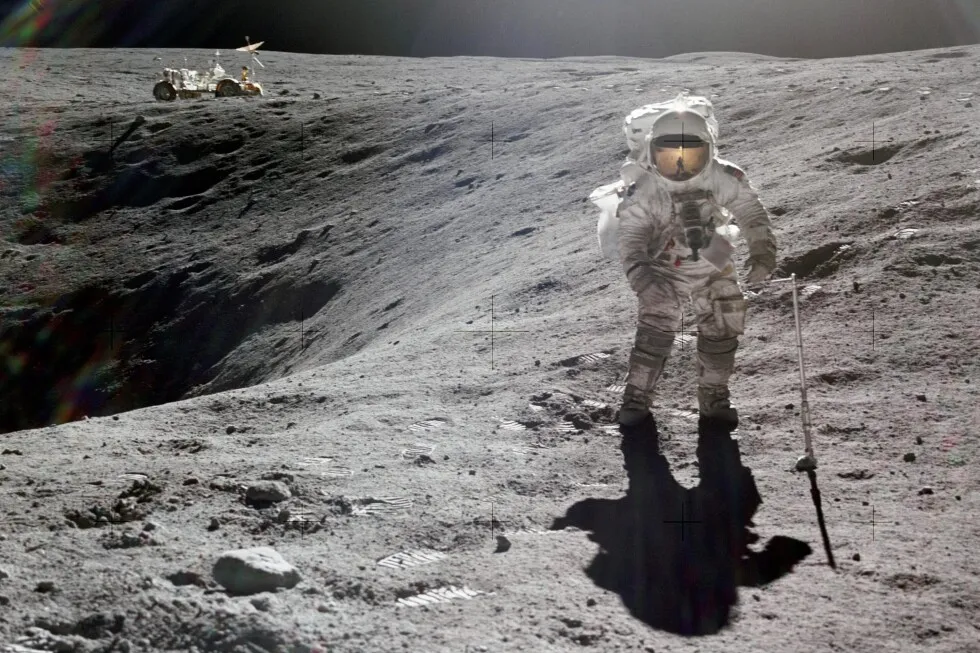
NASA begins the countdown for humanity’s first launch to the Moon in 53 years 1 of 5 | In this photo provided by NASA, astronaut Charles M. Duke Jr. collects lunar samples at Station No. 1 during the first Apollo 16 extravehicular activity at the Descartes landing site, April 21, 1972. (John W. Young/NASA via AP) 2 of 5 | Photographers setup remote cameras near NASA’s Artermis II Moon rocket on Launch Pad 39-B at the Kennedy Space Center Sunday, March 29, 2026, in Cape Canaveral, Fla. (AP Photo/Chris O’Meara) 3 of 5 | Crew lunar observations lead Sara Schmidt demonstrates software at Johnson Space Center on Thursday, July 24, 2025, in Houston. (AP Photo/Ashley Landis) 4 of 5 | NASA’s Artermis II Moon rocket sits on Launch Pad 39-B at the Kennedy Space Center at sunrise Sunday, March 29, 2026, in Cape Canaveral, Fla. (AP Photo/Terry Renna) 5 of 5 | NASA’s Artermis II Moon rocket sits on Launch Pad 39-B at the Kennedy Space Center Sunday, March 29, 2026, in Cape Canaveral, Fla. (AP Photo/Chris O’Meara) 1 of 5 In this photo provided by NASA, astronaut Charles M. Duke Jr. collects lunar samples at Station No. 1 during the first Apollo 16 extravehicular activity at the Descartes landing site, April 21, 1972. (John W. Young/NASA via AP) Add AP News on Google Add AP News as your preferred source to see more of our stories on Google. 2 of 5 Photographers setup remote cameras near NASA’s Artermis II Moon rocket on Launch Pad 39-B at the Kennedy Space Center Sunday, March 29, 2026, in Cape Canaveral, Fla. (AP Photo/Chris O’Meara) Add AP News on Google Add AP News as your preferred source to see more of our stories on Google. 3 of 5 Crew lunar observations lead Sara Schmidt demonstrates software at Johnson Space Center on Thursday, July 24, 2025, in Houston. (AP Photo/Ashley Landis) Add AP News on Google Add AP News as your preferred source to see more of our stories on Google. 4 of 5 NASA’s Artermis II Moon rocket sits on Launch Pad 39-B at the Kennedy Space Center at sunrise Sunday, March 29, 2026, in Cape Canaveral, Fla. (AP Photo/Terry Renna) Add AP News on Google Add AP News as your preferred source to see more of our stories on Google. 5 of 5 NASA’s Artermis II Moon rocket sits on Launch Pad 39-B at the Kennedy Space Center Sunday, March 29, 2026, in Cape Canaveral, Fla. (AP Photo/Chris O’Meara) Add AP News on Google Add AP News as your preferred source to see more of our stories on Google. Updated [hour]:[minute] [AMPM] [timezone], [monthFull] [day], [year] Cape Canaveral, Fla. (AP) — NASA began the countdown Monday for humanity’s first launch to the Moon in 53 years. The 32-story Space Launch System rocket is poised to blast off Wednesday evening with four astronauts. After a day in orbit around Earth, their Orion capsule will propel them to the Moon and back. There are no stops — just a quick U-turn around the Moon. The nearly 10-day flight will end with a splashdown in the Pacific.“Our team has worked extremely hard to get us to this moment,” said launch director Charlie Blackwell-Thompson. “Certainly all indications are right now we are in excellent, excellent shape.” Managers said the rocket is doing well following the latest round of repairs. Forecasters said the weather should cooperate.NASA’s Artemis II mission should have soared in February, but was grounded by hydrogen fuel leaks. The leaks were fixed, but then a helium pressurization line became clogged, forcing a return to the hangar late last month. The rocket returned to the pad 1 1/2 weeks ago, and its U.S.-Canadian crew arrived at the launch site on Friday. Unlike Apollo, which sent only men to the Moon from 1968 through 1972, Artemis’ debut crew includes a woman, person of color and a non-U.S. citizen. Artemis II’s pilot Victor Glover said over the weekend that he wants young people to see them and think, “Girl power and that’s awesome, and that young brown boys and girls can look at me and go ‘Hey, he looks like me and he’s doing what???’” At the same time, Glover, who is Black, looks forward to when ”one day we don’t have to talk about these firsts” and exploring the cosmos becomes an all-encompassing “human history.”NASA has the first six days of April to launch Artemis II before standing down until the end of the month.___The Associated Press Health and Science Department receives support from the Howard Hughes Medical Institute’s Department of Science Education and the Robert Wood Johnson Foundation. The AP is solely responsible for all content.
SRCAssociated Press (AP)
LANGEN
LEANCenter
WORDS781
ENT12
MON · 2026-03-30 · 21:23 GMTBRIEF NSR-2026-0330-44208
NSR-2026-0330-44208News Report·EN·Technology
NASA begins the countdown for humanity’s first launch to the moon in 53 years
NASA has begun the countdown for the Artemis II mission, humanity's first launch to the moon in 53 years. The Artemis II moon rocket is currently situated on Launch Pad 39-B at the Kennedy Space Center in Cape Canaveral, Florida.
By
MARCIA DUNNAssociated Press (AP)Filed 2026-03-30 · 21:23 GMTLean · CenterRead · 4 min
Associated Press (AP)FIG 01
Reading time
4min
Word count
781words
Sources cited
1cited
Entities identified
12entities
Quality score
100%
§ 01
Briefing Summary
AI-generatedNEWSAR · AI
NASA has begun the countdown for the Artemis II mission, humanity's first launch to the moon in 53 years. The Artemis II moon rocket is currently situated on Launch Pad 39-B at the Kennedy Space Center in Cape Canaveral, Florida. This mission marks a significant step in lunar exploration since the Apollo 16 mission in April 1972. Preparations are underway, including software demonstrations and remote camera setups, to support the crew's lunar observations. The Artemis II mission aims to further scientific understanding of the moon and pave the way for future lunar endeavors.
Confidence 0.90Sources 1Claims 5Entities 12
§ 02
Article analysis
Model · rule-basedFraming
Technology
Human Interest
Tone
Measured
AI-assessed
CalmNeutralAlarmist
Factuality
0.90 / 1.00
Factual
LowHigh
Sources cited
1
Limited
FewMany
§ 03
Key claims
5 extracted01
Our team has worked extremely hard to get us to this moment.
quote
Confidence
1.00
02
The nearly 10-day flight will end with a splashdown in the Pacific.
factual
Confidence
1.00
03
After a day in orbit around Earth, their Orion capsule will propel them to the moon and back.
factual
Confidence
1.00
04
The 32-story Space Launch System rocket is poised to blast off Wednesday evening with four astronauts.
factual
Confidence
1.00
05
NASA began the countdown Monday for humanity’s first launch to the moon in 53 years.
factual
Confidence
1.00
§ 04
Full report
4 min read · 781 words§ 05
Entities
12 identifiedKey playerOppositionContextPositiveNeutralNegative
People4
Organizations1
Locations5
§ 06
Keywords & salience
6 termsmoon launch
0.90
nasa
0.80
artemis ii
0.70
lunar exploration
0.60
space exploration
0.50
rocket
0.40
§ 07
Topic connections
Interactive graph Network visualization showing 9 related topics
View Full Graph Person Organization Location Event|Click node to navigate|Edge numbers = shared articles