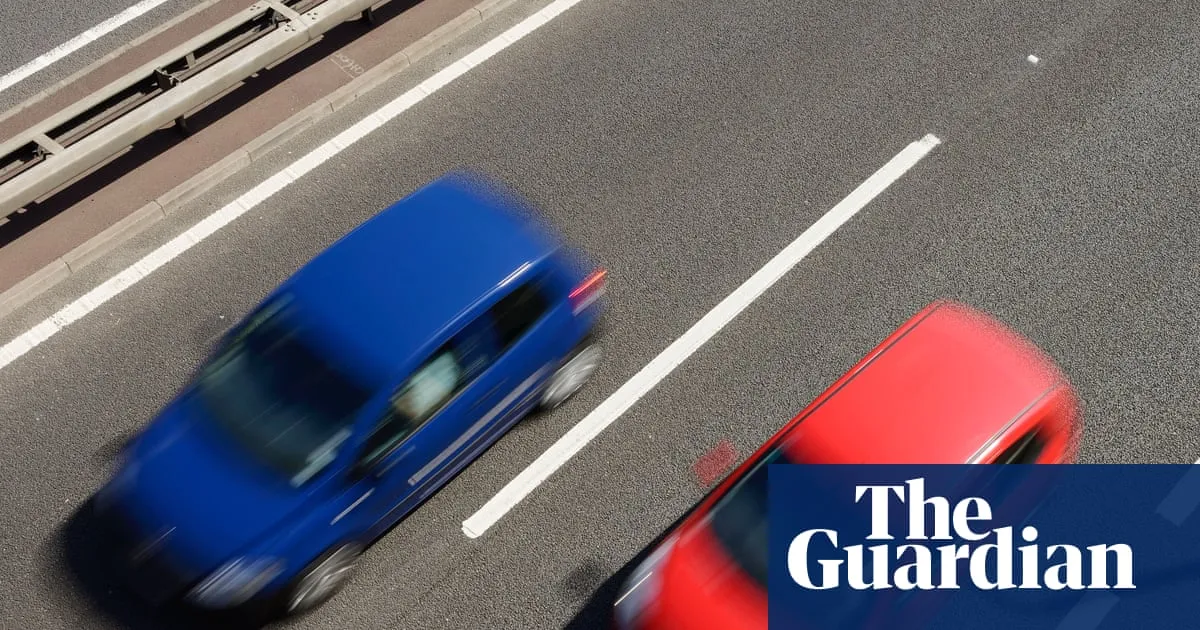
It is a situation experienced by many motorists: one driver overtakes another only to find the slower car is right behind them when they reach a red light. Now a researcher has used mathematics to reveal why the situation feels inevitable.Dr Conor Boland from Dublin City University has called his work “The Voorhees law of traffic”.The name is a nod to the character Jason Voorhees from the American horror film franchise Friday the 13th.“I always thought of him because he seems to just walk everywhere … His victims are running away, they’re sprinting, but he just catches them,” Boland said.Kane Hodder as Jason Voorhees in Jason X, the 10th Friday the 13th film. Photograph: Ava Gerlitz/APHowever, in the case of cars it is traffic lights rather than stones or tree branches that prevent the “escape” of the faster individual.Writing in the journal Royal Society Open Science, Boland explains that as two cars travelling at different speeds encounter a traffic light, the spacing between them can either increase, stay the same, partly decrease or be completely lost, depending on the colour of the traffic light, its duration, the time advantage of the faster car and the overall time it takes for the traffic lights to complete a cycle.Assuming that the traffic light changes colour based on a set time cycle rather than a sensor, and that the cars are travelling on a single-lane road, the results reveal that, taking into account the probabilities of each of the four scenarios, on average the possible gains and losses in spacing between the cars balance exactly.That means, on average, the lead of one car over the other remains the same after the light as before.The results suggest the idea the slower car will inevitably catch up at the lights is something of an illusion.“Recurrent encounters are known to be disproportionately salient in human perception, particularly when they follow an attempted separation or avoidance,” Boland writes.Put simply, it is probably just more memorable for a driver when the car they overtook catches up with them again.However, when drivers encounter a succession of independent traffic lights – as might occur in towns and cities – the situation is different.As Boland explains, here the eventual catchup of the slower car at at least one of the lights becomes statistically near-certain. That’s because the probability that the slower car never catches up relies on multiplying the probability of no catchup for each traffic light – meaning the more lights, the less overall chance no catchup will occur.Boland said the results have implications for road safety, suggesting speeding past others does not necessarily give an advantage.Kit Yates, professor of mathematical biology and public engagement at the University of Bath who was not involved in the work, welcomed the study.“It’s something I, as a slower driver, often think about. Was it really worth it for that car that sped to overtake me? When I catch them up at the lights I smugly think, ‘No, it wasn’t.’ So it’s good that someone has sat down and modelled how and when this happens,” he said.However, Yates added that in his experience, catching up to a faster car does not seem to happen constantly, or to be surprising when it does occur.He also noted that the study made a number of assumptions, among them that cars travel at constant speed between lights with no acceleration when a light changes to green or deceleration when it changes to red.“But as the old adage goes, ‘all models are wrong, but some are useful’ and I think this one is definitely useful to explain why slower cars can often catch up with quicker ones,” Yates said.
SRCThe Guardian - World News
LANGEN
LEANCenter-Left
WORDS610
ENT4
TUE · 2026-03-31 · 23:01 GMTBRIEF NSR-2026-0401-46177
NSR-2026-0401-46177News Report·EN·Human Interest
The Voorhees law of traffic: when overtaken slow cars seem to always catch up at a red light
A Dublin City University researcher, Dr. Conor Boland, has mathematically explored why slower cars often seem to catch up to faster cars at red lights, a phenomenon he calls "The Voorhees law of traffic." Published in Royal Society Open Science, the study analyzes how traffic light cycles impact the spacing between two cars traveling at different speeds on a single-lane road.
Nicola Davis Science correspondentThe Guardian - World NewsFiled 2026-03-31 · 23:01 GMTLean · Center-LeftRead · 3 min
The Guardian - World NewsFIG 01
Reading time
3min
Word count
610words
Sources cited
3cited
Entities identified
4entities
Quality score
100%
§ 01
Briefing Summary
AI-generatedNEWSAR · AI
A Dublin City University researcher, Dr. Conor Boland, has mathematically explored why slower cars often seem to catch up to faster cars at red lights, a phenomenon he calls "The Voorhees law of traffic." Published in Royal Society Open Science, the study analyzes how traffic light cycles impact the spacing between two cars traveling at different speeds on a single-lane road. The research found that at a single traffic light, the average gains and losses in spacing between cars balance out, suggesting the perception of inevitable catch-up is an illusion. However, the study also reveals that with multiple independent traffic lights, the slower car is statistically likely to catch up at least once, making the experience more memorable for drivers.
Confidence 0.90Sources 3Claims 5Entities 4
§ 02
Article analysis
Model · rule-basedFraming
Human Interest
Technology
Tone
Measured
AI-assessed
CalmNeutralAlarmist
Factuality
0.80 / 1.00
Factual
LowHigh
Sources cited
3
Well sourced
FewMany
§ 03
Key claims
5 extracted01
Dr Conor Boland from Dublin City University has called his work “The Voorhees law of traffic”.
factual
Confidence
1.00
02
A researcher has used mathematics to reveal why the situation feels inevitable when slower cars catch up at red lights.
factual
Confidence
1.00
03
The eventual catchup of the slower car at at least one of the lights becomes statistically near-certain in towns and cities.
factualBoland
Confidence
0.90
04
On average, the lead of one car over the other remains the same after the light as before.
factualBoland
Confidence
0.90
05
Speeding past others does not necessarily give an advantage.
factualBoland
Confidence
0.80
§ 04
Full report
3 min read · 610 words§ 05
Entities
4 identifiedKey playerOppositionContextPositiveNeutralNegative
People3
Organizations1
§ 06
Keywords & salience
8 termstraffic
0.90
traffic lights
0.80
voorhees law of traffic
0.70
overtaking
0.70
probability
0.60
mathematics
0.60
perception
0.50
statistical
0.40
§ 07
Topic connections
Interactive graph No topic relationship data available yet. This graph will appear once topic relationships have been computed.