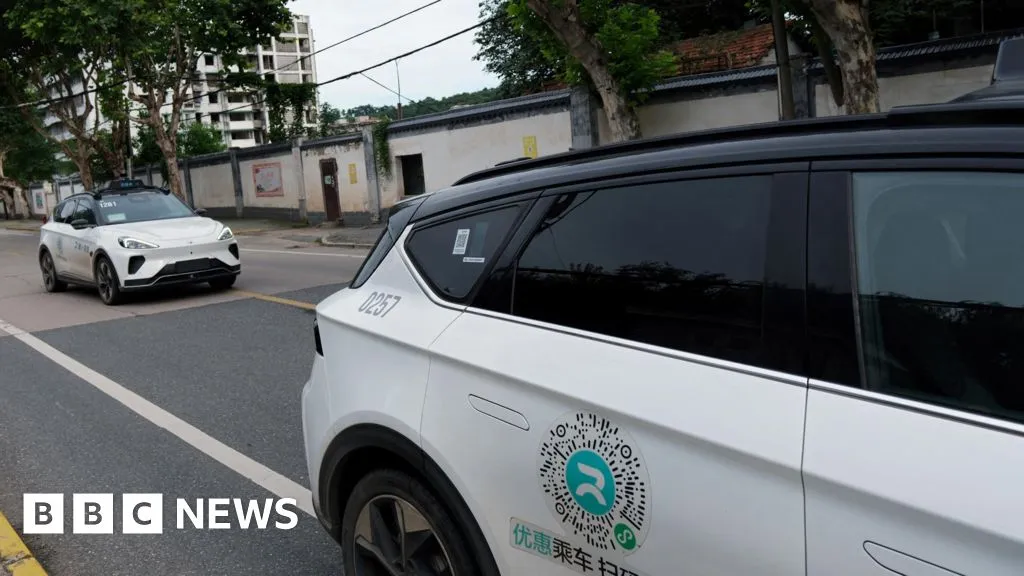
Mass robotaxi malfunction halts traffic in Chinese city26 minutes agoLaura CressTechnology reporterReutersApollo Go is Baidu's robotaxi service operating in ChinaA mass robotaxi outage in the Chinese city of Wuhan caused at least a hundred self-driving cars to stop mid-traffic, sparking renewed debate around the safety of driverless vehicles.Local police said initial findings suggested a "system malfunction" caused multiple vehicles to stop in the middle of the road on Tuesday.Videos on social media have documented the outage, with one appearing to show it resulting in a highway collision, although police said no injuries had been reported and passengers exited their vehicles safely.Baidu did not immediately respond to a request for comment.According to the police statement, posted on social media site Weibo, the cause of the incident is still under further investigation.Baidu operates its Apollo Go driverless taxi service in dozens of cities across the world, mostly in China.In December 2025, ride-sharing apps Uber and Lyft announced partnerships with the Chinese technology giant to test its Apollo Go cars on UK roads, aiming to start trials in 2026.However, both still need approval from regulators before they can begin the pilot programmes.ReutersSocial media users posted photos and videos of Apollo Go cars stranded in the middle of the roads due to the outageWhile driverless tech may be safer on average than human drivers, this incident showed it could "still go wrong in completely new ways," said Jack Stilgoe, professor of science and technology policy at University College London."If we're going to make good choices about this technology, we need to understand entirely new types of risk," he told BBC News.The outage is not the first time self-driving cars have faced technical difficulties.Meanwhile in August 2025, an Apollo Go robotaxi carrying a passenger in Chongqing fell into a construction pit.
SRCBBC News - World
LANGEN
LEANCenter
WORDS296
ENT11
WED · 2026-04-01 · 11:34 GMTBRIEF NSR-2026-0401-47136
NSR-2026-0401-47136News Report·EN·Technology
Mass robotaxi malfunction halts traffic in Chinese city
A mass malfunction of Baidu's Apollo Go robotaxis in Wuhan, China, caused at least a hundred self-driving cars to halt in traffic on Tuesday, prompting a police investigation into a suspected "system malfunction." Social media footage showed stranded vehicles, with one video appearing to show a highway collision, though no injuries were reported. Baidu has yet to comment on the incident.
BBC News - WorldFiled 2026-04-01 · 11:34 GMTLean · CenterRead · 2 min
BBC News - WorldFIG 01
Reading time
2min
Word count
296words
Sources cited
2cited
Entities identified
11entities
Quality score
100%
§ 01
Briefing Summary
AI-generatedNEWSAR · AI
A mass malfunction of Baidu's Apollo Go robotaxis in Wuhan, China, caused at least a hundred self-driving cars to halt in traffic on Tuesday, prompting a police investigation into a suspected "system malfunction." Social media footage showed stranded vehicles, with one video appearing to show a highway collision, though no injuries were reported. Baidu has yet to comment on the incident. The outage raises concerns about the safety of driverless technology, despite its potential advantages. This incident follows a previous event in August 2025 where an Apollo Go vehicle fell into a construction pit in Chongqing. Baidu's Apollo Go service operates in numerous cities, and the company has partnerships with Uber and Lyft to potentially test the technology in the UK, pending regulatory approval.
Confidence 0.90Sources 2Claims 5Entities 11
§ 02
Article analysis
Model · rule-basedFraming
Technology
Human Interest
Tone
Measured
AI-assessed
CalmNeutralAlarmist
Factuality
0.80 / 1.00
Factual
LowHigh
Sources cited
2
Limited
FewMany
§ 03
Key claims
5 extracted01
Baidu operates its Apollo Go driverless taxi service in dozens of cities across the world, mostly in China.
factualReuters
Confidence
1.00
02
No injuries were reported and passengers exited their vehicles safely.
factualPolice
Confidence
1.00
03
Uber and Lyft announced partnerships with Baidu to test Apollo Go cars on UK roads, aiming to start trials in 2026.
factualReuters
Confidence
0.90
04
A mass robotaxi outage in Wuhan caused at least a hundred self-driving cars to stop mid-traffic.
factualReuters
Confidence
0.90
05
Initial findings suggested a 'system malfunction' caused multiple vehicles to stop.
quoteLocal police
Confidence
0.80
§ 04
Full report
2 min read · 296 words§ 05
Entities
11 identifiedKey playerOppositionContextPositiveNeutralNegative
Organizations5
§ 06
Keywords & salience
10 termsrobotaxi malfunction
1.00
self-driving cars
0.90
driverless vehicles
0.80
apollo go
0.70
system malfunction
0.70
traffic halt
0.60
wuhan
0.60
autonomous vehicles
0.50
technology
0.40
safety
0.40
§ 07
Topic connections
Interactive graph Network visualization showing 3 related topics
View Full Graph Person Organization Location Event|Click node to navigate|Edge numbers = shared articles