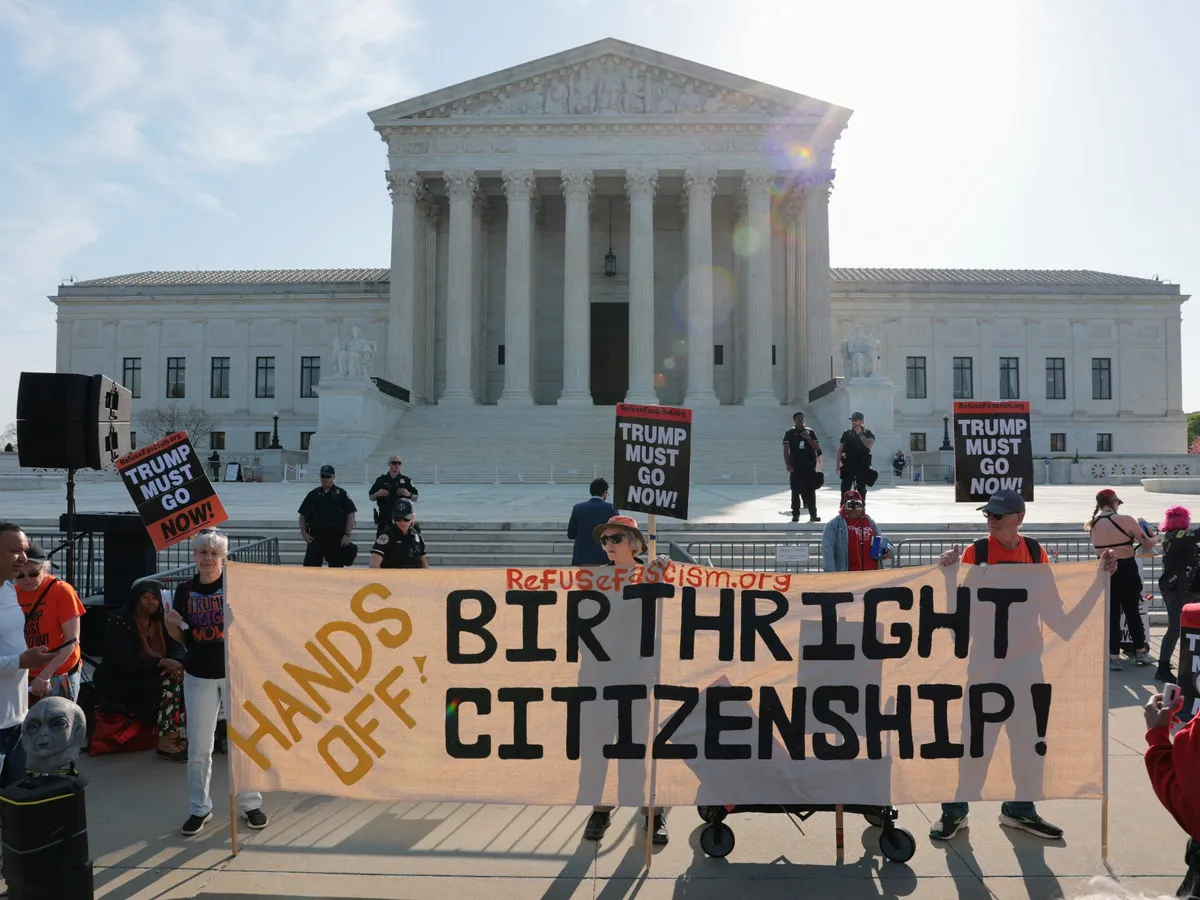
Case could determine future of century-old practice of infants being born in US automatically being granted citizenship.Demonstrators hold signs outside the US Supreme Court building in Washington, DC [File: Kylie Cooper/Reuters]Published On 1 Apr 2026Washington, DC – The United States Supreme Court has heard oral arguments on the administration of US President Donald Trump’s effort to end the longstanding practice of granting citizenship to anyone born in the United States.Hundreds of protesters, many associated with civil rights and immigration advocacy groups, gathered in front of the country’s top court during the proceedings, in which challenging lawyers argued that the Trump administration’s plan, laid out in an executive order signed on January 20, 2025, ran counter to the US Constitution and subsequent federal law.Recommended Stories list of 3 itemslist 1 of 3Can Trump end birthright citizenship? The US Supreme Court could decidelist 2 of 3What’s at stake in US Supreme Court birthright citizenship case?list 3 of 3Trump v US courts: Where do challenges to executive orders stand?end of listLawyers for the Trump administration, in contrast, argued that more than a century of US practice had been based on a “misreading” of the US Constitution, as they maintained that citizenship should not be granted to infants born to parents living in the US without documentation or those on “temporary” legal statuses.Underscoring the significance of the case to the administration, which has pursued a slate of hardline deportation and immigration policies, was the attendance of US President Donald Trump at Wednesday’s hearing. That made Trump the first sitting president in US history to attend oral arguments at the Supreme Court.“This hits close to home,” said Luis Villaguzman, a 21-year-old student fellow with the League of United Latin American Citizens (LULAC) from Riverside, California, who was among those gathered in front of the court. “Specifically when it comes to immigrants … mothers, who are pregnant, about to give birth … they will lose benefits and truly just lose a hope – a future in America.”He saw Trump’s unprecedented attendance at the Supreme Court as a “show of force” to sway the judges. The court currently holds a 6-3 conservative supermajority, which includes three justices appointed by Trump in his first term.The panel has ruled in Trump’s favour on several immigration decisions, but has also delivered the president a handful of major defeats in recent weeks.Roslyne Shiao, 46, from Montclair, New Jersey, also saw Trump’s attendance as trying to “sway the court in his favour”.Demonstrators hold placards in Washington, DC [Kylie Cooper/Reuters]“So the people need to be here,” said Shiao, who held a sign that read “born here belong here”.For his part, Trump stood up and abruptly departed in the middle of the hearing on Wednesday, writing on his Truth Social account moments later: “We are the only Country in the World STUPID enough to allow ‘Birthright’ Citizenship!”.At least 30 countries have practices similar to the US on birthright citizenship, according to the Pew Research Center.While no demonstrations were organised in support of Trump’s action on Wednesday, one longtime supporter of the theory, law professor John Eastman, attended the hearing.He told The New York Times he was “impressed” by the arguments of both sides, adding the hearing “proves that it’s not a radical fringe idea”.Trump adviser Stephen Miller, the architect of Trump’s hardline immigration policies, on X wrote that “birthright citizenship means the children of illegal aliens can vote to tax your children and seize their inheritance”.Arguments laid outThe Supreme Court was not set to issue a ruling in the case until later this year. Still, Wednesday’s hearing offered a window into the justice’s thinking towards the arguments put forth by both sides.Beginning the proceedings, Solicitor General John Sauer maintained the 14th Amendment to the United States Constitution, ratified in 1868, has been misinterpreted to say that all people born in the US – regardless of their parents’ legal status – are automatically US citizens.Luis Villaguzman stands in front of the US Supreme Court in Washington, DC [Joseph Stepansky/Al Jazeera]The text reads: “All persons born or naturalised in the United States, and subject to the jurisdiction thereof, are citizens of the United States and of the State wherein they reside.”Sauer argued that “subject to the jurisdiction thereof” opens the door to precluding some immigrant groups from birthright citizenship, further arguing that previous rulings indicate the amendment should apply only to those with “allegiance to the United States by virtue of domicile”.He equated the status with legal permanent residency in the US.Sauer further charged that the current standard of birthright citizenship “demeans the priceless and profound gift of American citizenship” and incentivises individuals to travel to the US to give birth.Cecillia Wang, a lawyer for the American Civil Liberties Union, one of several groups challenging Trump’s executive order, in turn, argued that the president’s efforts run blatantly counter to the clear language in the amendment, which she argued was reaffirmed in the United States v Wong Kim Ark case in 1898 and later codified in the 1952 Immigration and Nationality Act.US President Donald Trump and US Attorney General Pam Bondi depart the White House, en route to the US Supreme Court in Washington, DC [Kevin Lamarque/Reuters]“That rule was enshrined in the 14th Amendment to put it out of reach of any government official to destroy,” she said.She argued that the framers of the Constitution and later Congress would have included explicit language narrowing the amendment’s scope if that was their intent.Wang further warned that the president’s order would create a bureaucratic nightmare while raising questions about a potentially shifting threshold for when infants are citizens at birth.“The citizenship of millions of Americans, past, present and future could be called into question,” she said.Justices question lawyersThe justices pursued several lines of questioning, with particular emphasis on Sauer’s claim that birthright citizenship only applies to those with “allegiance” to the US by being “domiciled” in the country.“Who is domiciled? I’m struggling to figure out who is domiciled,” Justice Kentanji Brown Jackson, a liberal appointed by former President Joe Biden.In another exchange with ACLU lawyer Wang, conservative Justice Samuel Alito noted that the term “domicile” appears repeatedly in the Wong Kim Ark case, which has long been viewed as affirming birthright citizenship.“Isn’t it at least something to be concerned about to say that, since it’s discussed 20 different times and has that significant role in the opinion that you can just dismiss it as irrelevant?” he asked.Questioning Sauer, Justice Brett Kavanaugh, who was appointed by Trump, questioned why Congress had not included language more clearly delineating which infants were automatically granted citizenship if that was their intent in the 1952 Immigration and Nationality Act.“One might have expected Congress to use a different phrase if it wanted to try to disagree with Wong Kim Ark on what the scope of birthright citizenship or the scope of citizenship should be, and yet Congress repeats that same language, knowing what the interpretation had been,” Kavanaugh said.A demonstrator wearing a T-shirt with the phrase “We the people” is seen in Washington, DC [Reuters]Justice Amy Coney Barrett, another Trump appointee, pointed to the potentially chaotic situations Trump’s executive order would create.“I can imagine it being messy in some applications,” said Justice Amy Coney Barrett.
SRCAl Jazeera
LANGEN
LEANCenter
WORDS1 200
ENT8
WED · 2026-04-01 · 20:19 GMTBRIEF NSR-2026-0401-48135
NSR-2026-0401-48135News Report·EN·Legal & Judicial
‘Hits close to home’: US Supreme Court hears birthright citizenship case
In April 2026, the US Supreme Court heard arguments regarding President Trump's executive order from January 2025 aiming to end birthright citizenship. The case challenges the longstanding practice of automatically granting citizenship to anyone born in the United States.
Joseph StepanskyAl JazeeraFiled 2026-04-01 · 20:19 GMTLean · CenterRead · 5 min
Al JazeeraFIG 01
Reading time
5min
Word count
1 200words
Sources cited
3cited
Entities identified
8entities
Quality score
100%
§ 01
Briefing Summary
AI-generatedNEWSAR · AI
In April 2026, the US Supreme Court heard arguments regarding President Trump's executive order from January 2025 aiming to end birthright citizenship. The case challenges the longstanding practice of automatically granting citizenship to anyone born in the United States. Trump administration lawyers argued that the current practice is a misinterpretation of the Constitution, while opposing lawyers contended it violates the Constitution and federal law. Hundreds of protestors gathered outside the court during the proceedings. President Trump's attendance at the hearing marked the first time a sitting president has attended Supreme Court oral arguments. The case's outcome could significantly impact immigrants and the future of citizenship for children born in the US to undocumented parents or those with temporary legal status.
Confidence 0.90Sources 3Claims 5Entities 8
§ 02
Article analysis
Model · rule-basedFraming
Legal & Judicial
Political Strategy
Tone
Measured
AI-assessed
CalmNeutralAlarmist
Factuality
0.70 / 1.00
Factual
LowHigh
Sources cited
3
Well sourced
FewMany
§ 03
Key claims
5 extracted01
Trump abruptly departed the hearing and posted on Truth Social about the issue.
factual
Confidence
1.00
02
Trump attended the Supreme Court hearing, the first sitting president to do so.
factual
Confidence
1.00
03
Lawyers for the Trump administration argued that past practice was a 'misreading' of the Constitution.
factual
Confidence
1.00
04
The Trump administration wants to end the practice of granting citizenship to anyone born in the US.
factual
Confidence
1.00
05
The US Supreme Court heard oral arguments on ending birthright citizenship.
factual
Confidence
1.00
§ 04
Full report
5 min read · 1 200 words§ 05
Entities
8 identifiedKey playerOppositionContextPositiveNeutralNegative
Organizations3
§ 06
Keywords & salience
9 termsbirthright citizenship
1.00
us supreme court
0.90
immigration
0.80
us constitution
0.70
donald trump
0.70
executive order
0.60
immigration policy
0.50
oral arguments
0.50
legal status
0.50
§ 07
Topic connections
Interactive graph Network visualization showing 51 related topics
View Full Graph Person Organization Location Event|Click node to navigate|Edge numbers = shared articles