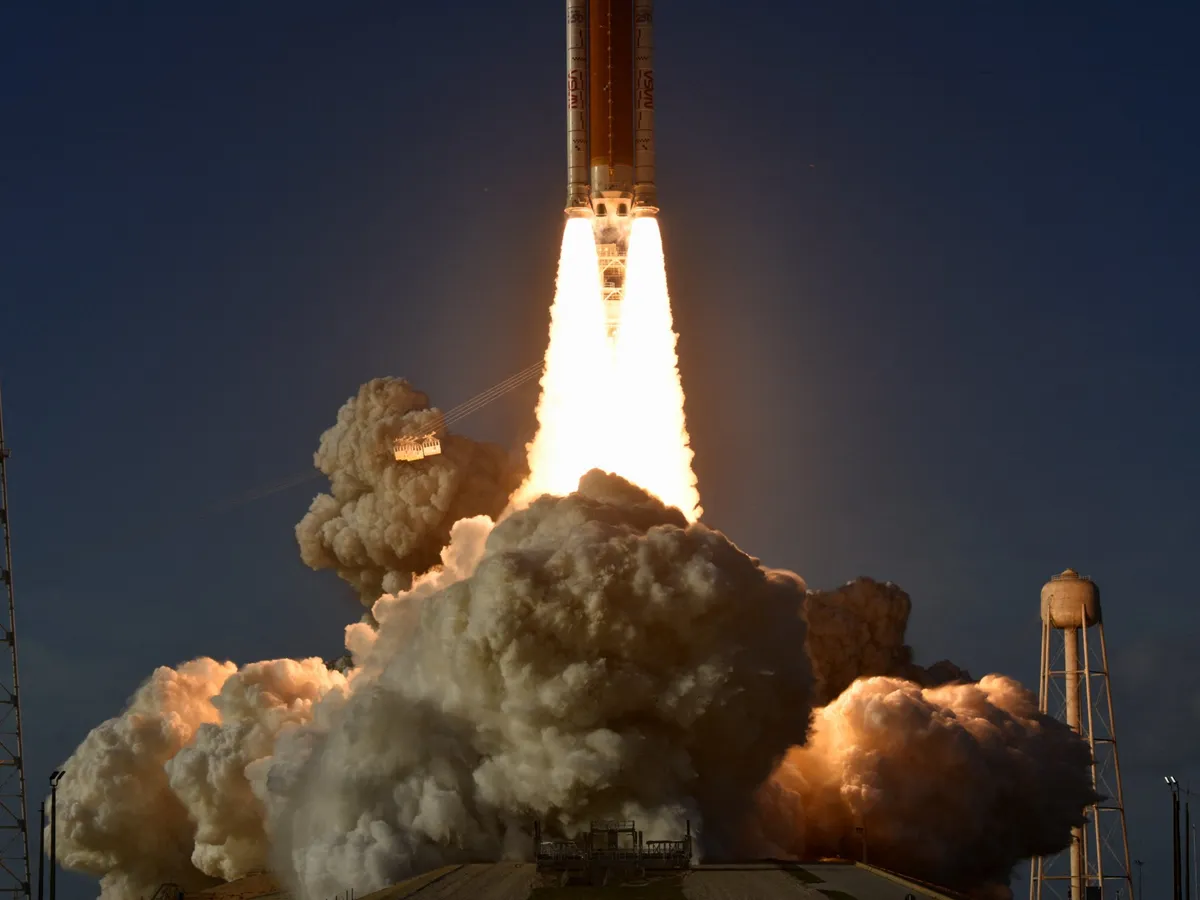
EXPLAINERThe capsule is expected to reach the Moon on about April 6, the sixth day of the mission.Artemis II successfully launches four astronauts into spacePublished On 2 Apr 2026NASA has successfully launched the Artemis II mission, marking the first crewed mission to the Moon’s vicinity since the Apollo programme ended in 1972.The 322-foot Space Launch System (SLS) rocket lifted off at 6:35pm ET (22:35 GMT) on Wednesday from Cape Canaveral, Florida, sending the Orion crew capsule on a 10-day journey.Recommended Stories list of 3 itemslist 1 of 3NASA successfully launches historic Artemis II Moon missionlist 2 of 3What is NASA’s Artemis II Moon mission, and when will it launch?list 3 of 3Watch the moment Artemis II launches historic mission around the moonend of listWhile Artemis II will not land on the Moon, it will fly a “free-return” trajectory that swings around it to prove the spacecraft can sustain a crew on future missions.The idea is to descend to the surface of the Earth’s only natural satellite again on Artemis IV in 2028.“We have a beautiful moonrise,” said Reid Wiseman, the NASA astronaut serving as mission commander, about five minutes after the launch. “We’re heading right at it.”Here is what we know:What happened?The Artemis II mission launched successfully from the Kennedy Space Center in Florida, sending four astronauts on a historic journey around the Moon, the first crewed mission beyond low-Earth orbit in more than 50 years.The launch followed a tense countdown, as engineers worked through several technical issues. Teams closely monitored the rocket during fuelling due to hydrogen leaks that had delayed the mission in the past, but no major leaks were detected on launch day.Engineers also resolved last-minute problems involving battery sensors and the rocket’s flight termination system, a critical safety system used to destroy the rocket if it goes off course, before clearing the mission for liftoff.The 32-storey rocket lifted off in the early evening in front of large crowds gathered near the launch site. The crew are now on a mission that will take them around the Moon and back to Earth.The launch had been planned for as early as February 6, and then March 6, until a hydrogen leak prompted NASA to roll the rocket back to its vehicle assembly building for scrutiny.It had earlier been scheduled for November 2024, but NASA announced a delay due to technical investigations, particularly into the Orion’s heat shield.Who is part of the Artemis II mission?All three NASA astronauts are veterans of Earth-orbit science expeditions to the International Space Station, while the lone Canadian joining them on a voyage around the Moon and back is a spaceflight rookie. Reid Wiseman, 50, commander: The NASA veteran and former International Space Station commander is leading the Artemis II mission. A test pilot-turned-astronaut, he has leadership and deep spaceflight experience. Victor Glover, 49, pilot: The US Navy aviator is the first Black astronaut assigned to a lunar mission and flew on SpaceX Crew-1. Christina Koch, 47, mission specialist: The record holder for the longest single spaceflight by a woman at 328 days is a veteran of multiple spacewalks and has scientific and deep-space mission expertise. Jeremy Hansen, 50, mission specialist: The first Canadian set to travel to the Moon is a former fighter pilot. His presence represents international collaboration in deep space exploration. (Al Jazeera)When will the mission reach the Moon?If the mission goes as planned, the capsule is expected to reach the Moon on about April 6, the sixth day of the mission.The crewed Orion capsule will then fly around the Moon, reaching its closest point before beginning the journey back to Earth, with splashdown expected on April 10, 2026.What is the mission plan for the next 10 days?The Artemis II mission is expected to last about 10 days and follows this general outline:Days 1-2 high Earth orbit : The crew will spend their first one to two days in high Earth orbit conducting extensive checks on the spacecraft’s systems.Once those checks are complete, Orion’s propulsion system will perform a “translunar injection”.A translunar injection is a critical manoeuvre performed by the Orion spacecraft’s propulsion system. Occurring after the crew completes their initial systems checks in high Earth orbit, this manoeuvre propels the spacecraft out of Earth orbit and sets it onto a direct trajectory towards the Moon.Days 3-4 translunar transit: As they transit to the Moon over the next several days, the astronauts will continue monitoring Orion’s systems.The spacecraft will then pass behind the Moon on a “free-return” trajectory, a strategic path that naturally swings the capsule back towards Earth without requiring any additional propulsion.Day 5 lunar sphere of influence: Orion enters the Moon’s gravitational pull, which becomes stronger than Earth’s.The astronauts will spend the first several hours of the day testing their spacesuits, including practising how quickly they can put them on, pressurising them and strapping into their seats.Day 6 lunar flyby: This is the day the crew fly by the Moon.The spacecraft reaches its closest approach, approximately 4,000-6,000 miles (6,450-9,650km) above the lunar surface.Day 7-9 Return journey: Following the flyby, Orion remains on its free-return trajectory. The crew conducts deep-space science, including medical monitoring through programmes like ARCHER.Day 10 Re-entry and splashdown: Orion separates from the service module and re-enters Earth’s atmosphere at roughly 25,000mph (40,230km/h). The mission concludes with a splashdown in the Pacific Ocean.What’s NASA’s next mission?Artemis III is the next mission and is currently planned for 2027.It will involve the Orion spacecraft docking in Earth orbit with at least one of NASA’s lunar landers, either Blue Origin’s Blue Moon system or SpaceX’s Starship.The docking manoeuvre is intended to demonstrate how the landers will collect astronauts in orbit before transporting them to the Moon’s surface.
SRCAl Jazeera
LANGEN
LEANCenter
WORDS947
ENT11
THU · 2026-04-02 · 05:48 GMTBRIEF NSR-2026-0402-48425
NSR-2026-0402-48425News Report·EN·Technology
How long will Artemis II take to reach the moon, and what happens next?
On April 2, 2026, NASA successfully launched the Artemis II mission from Cape Canaveral, Florida, sending four astronauts on a 10-day journey around the moon. This marks the first crewed mission to the moon's vicinity since 1972.
Elizabeth MelimopoulosAl JazeeraFiled 2026-04-02 · 05:48 GMTLean · CenterRead · 4 min
Al JazeeraFIG 01
Reading time
4min
Word count
947words
Sources cited
1cited
Entities identified
11entities
Quality score
100%
§ 01
Briefing Summary
AI-generatedNEWSAR · AI
On April 2, 2026, NASA successfully launched the Artemis II mission from Cape Canaveral, Florida, sending four astronauts on a 10-day journey around the moon. This marks the first crewed mission to the moon's vicinity since 1972. The Orion crew capsule, propelled by the Space Launch System (SLS) rocket, is expected to reach the moon around April 6, the sixth day of the mission. Artemis II will not land on the moon but will execute a "free-return" trajectory to prove the spacecraft's ability to sustain a crew for future missions. The mission aims to pave the way for Artemis IV in 2028, which plans to land on the moon. The launch, initially planned for earlier dates, faced delays due to technical issues, including hydrogen leaks.
Confidence 0.90Sources 1Claims 5Entities 11
§ 02
Article analysis
Model · rule-basedFraming
Technology
Human Interest
Tone
Measured
AI-assessed
CalmNeutralAlarmist
Factuality
0.90 / 1.00
Factual
LowHigh
Sources cited
1
Limited
FewMany
§ 03
Key claims
5 extracted01
Artemis II will fly a “free-return” trajectory around the moon.
factualNASA
Confidence
1.00
02
The Orion crew capsule is on a 10-day journey around the moon.
factualNASA
Confidence
1.00
03
The Artemis II mission marks the first crewed mission to the moon’s vicinity since the Apollo programme ended in 1972.
factualNASA
Confidence
1.00
04
Artemis II successfully launched four astronauts into space on April 2, 2026.
factualNASA
Confidence
1.00
05
The Artemis IV mission is planned to descend to the surface of the moon in 2028.
predictionNASA
Confidence
0.90
§ 04
Full report
4 min read · 947 words§ 05
Entities
11 identifiedKey playerOppositionContextPositiveNeutralNegative
Organizations3
Locations5
§ 06
Keywords & salience
10 termsartemis ii
1.00
moon mission
0.90
nasa
0.80
orion crew capsule
0.70
space launch system
0.70
rocket launch
0.60
crewed mission
0.60
hydrogen leaks
0.50
spacecraft trajectory
0.50
cape canaveral
0.40
§ 07
Topic connections
Interactive graph No topic relationship data available yet. This graph will appear once topic relationships have been computed.