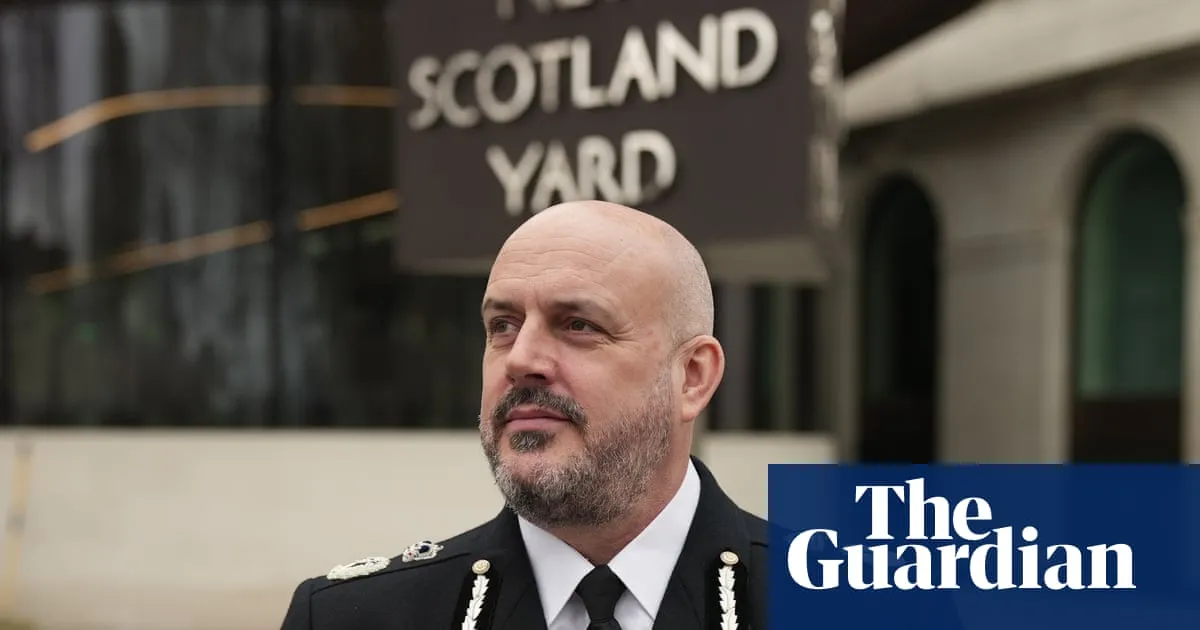
The scheme meant to identify people before they become terrorists is being “overwhelmed” by a large surge in referrals, Britain’s head of counterterrorism has said.Assistant commissioner Laurence Taylor told The Guardian that more than 10,000 people would be referred to Prevent this year, up more than a third from two years ago.While some referrals were trivial – including a primary school pupil being reported for kicking a classmate the day after watching the children’s movie Kung Fu Panda – the majority involved concerns about people being interested in violence, but where no ideology was involved.Reports to Prevent started to increase after the 2024 Southport-knife-attack" class="entity-link entity-event" data-entity-id="88565" data-entity-type="event">Southport knife attack. The Guardian revealed that the teenager who killed three schoolgirls at a dance class had been referred to the counter-terrorism scheme three times, but was dismissed because his fascination with violence was assessed as not being driven by jihadist or extreme rightwing ideologies.Taylor said the big increase in referrals was in part because there was nowhere else for people to report concerns about young people feared to be interested in violence. He said the rise meant Prevent risked missing the people it needed to deal with.“Firstly, when you increase the volume, then the time to do the assessments increases,” he said.Prevent was set up specifically to deal with people vulnerable to radicalisation, he said, so the more time spent assessing people who were not vulnerable in this way “it increases the risk of us not spotting somebody that is … because the system is overwhelmed with referrals”.More than half of those referred to Prevent last year were assessed as having no fixed ideology. Taylor said: “The challenge we have in the Prevent system is there is no triage that sits above it, so Prevent currently is the only bucket into which all of these referrals can sit.“We see people with material from ISIS and neo-Nazis. We see people watching beheadings and school shootings. We see the gamification of that. So it’s people who are just absorbing horrible stuff that is creating concern for the people who refer them, but they’re not motivated by an ideology specifically, ie extreme rightwing or Islamist.”A review by David Anderson after Southport said the government should consider a new scheme to spot those fascinated with violence, then refer them to where they can best get help.Taylor said: “Prevent is set up to deal with an ideology. So when you are driven by an ideology, then Prevent is absolutely the right forum for referral for you to be dealt with. If there is no ideology and there are mental health issues, Prevent is not the right place to challenge and deal and provide support to an individual with those challenges.”Later this month an independent review into Southport is expected to be critical of the handling of the killer by Prevent, health services and local authorities. Concerns were repeatedly raised about Axel Rudakubana, who was found guilty of the murders, before the atrocity in Southport.Taylor became the head of counter-terrorism last year. Threats from hostile states, such as Iran and Russia, increased in the first three months of 2026, having already surged by 500% in the year to December 2025. Taylor said hostile states and terrorist groups, such as Islamic State, were growing in their ambition. “They are looking for more sophisticated attacks.”He said the Iran war could increase the risk of attack: “With any global conflict, any sort of geopolitical instability, it’s sort of invariably the case that we see an impact on our casework.“Whilst the national threat level hasn’t increased, I think it’s fair to say the risk has probably increased in terms of activity we might see.”Asked whether the Trump presidency was having a radicalising effect, Taylor stressed he did not want to make a political comment. Rather, he said it could be one of several factors behind rising tensions: “We’ve seen for a number of years an increasing polarisation, without doubt. You only need to look at the level of protest in London and the diversity of protest in London to see how many different views there are …. Whether you could directly attribute that to the US and Trump, I wouldn’t like to say.“I think there are many, many things at play here, of which that is but one.”
SRCThe Guardian - World News
LANGEN
LEANCenter-Left
WORDS713
ENT8
THU · 2026-04-02 · 06:00 GMTBRIEF NSR-2026-0402-48652
NSR-2026-0402-48652News Report·EN·National Security
‘Overwhelmed’ Prevent at risk of missing threats as referrals rise, UK counter-terror chief says
The UK's Prevent counter-terrorism program is facing strain due to a surge in referrals, according to Assistant Commissioner Laurence Taylor. Referrals are up by over a third in two years, with over 10,000 expected this year.
Vikram Dodd Police and crime correspondentThe Guardian - World NewsFiled 2026-04-02 · 06:00 GMTLean · Center-LeftRead · 3 min
The Guardian - World NewsFIG 01
Reading time
3min
Word count
713words
Sources cited
1cited
Entities identified
8entities
Quality score
100%
§ 01
Briefing Summary
AI-generatedNEWSAR · AI
The UK's Prevent counter-terrorism program is facing strain due to a surge in referrals, according to Assistant Commissioner Laurence Taylor. Referrals are up by over a third in two years, with over 10,000 expected this year. While some are trivial, many involve concerns about individuals interested in violence without a specific ideology. This increase, partly due to a lack of alternative reporting avenues, is overwhelming the system and potentially hindering its ability to identify individuals vulnerable to radicalization. Taylor suggests that Prevent is not designed to deal with people who are fascinated with violence but not driven by a specific ideology. A review following the Southport knife attack recommended a new scheme to address this gap.
Confidence 0.90Sources 1Claims 5Entities 8
§ 02
Article analysis
Model · rule-basedFraming
National Security
Political Strategy
Tone
Measured
AI-assessed
CalmNeutralAlarmist
Factuality
0.80 / 1.00
Factual
LowHigh
Sources cited
1
Limited
FewMany
§ 03
Key claims
5 extracted01
A review by David Anderson after Southport said the government should consider a new scheme to spot those fascinated with violence.
factualDavid Anderson
Confidence
1.00
02
More than half of those referred to Prevent last year were assessed as having no fixed ideology.
statisticLaurence Taylor, assistant commissioner
Confidence
1.00
03
More than 10,000 people will be referred to Prevent this year, up more than a third from two years ago.
statisticLaurence Taylor, assistant commissioner
Confidence
1.00
04
Reports to Prevent started to increase after the 2024 Southport knife attack.
factualnull
Confidence
0.90
05
Prevent risks missing the people it needs to deal with due to the rise in referrals.
predictionLaurence Taylor, assistant commissioner
Confidence
0.80
§ 04
Full report
3 min read · 713 words§ 05
Entities
8 identifiedKey playerOppositionContextPositiveNeutralNegative
Organizations3
§ 06
Keywords & salience
10 termsprevent
1.00
counter-terrorism
0.80
referrals
0.80
violence
0.70
ideology
0.70
radicalisation
0.60
southport knife attack
0.50
threats
0.50
extreme rightwing
0.40
islamist
0.40
§ 07
Topic connections
Interactive graph Network visualization showing 51 related topics
View Full Graph Person Organization Location Event|Click node to navigate|Edge numbers = shared articles