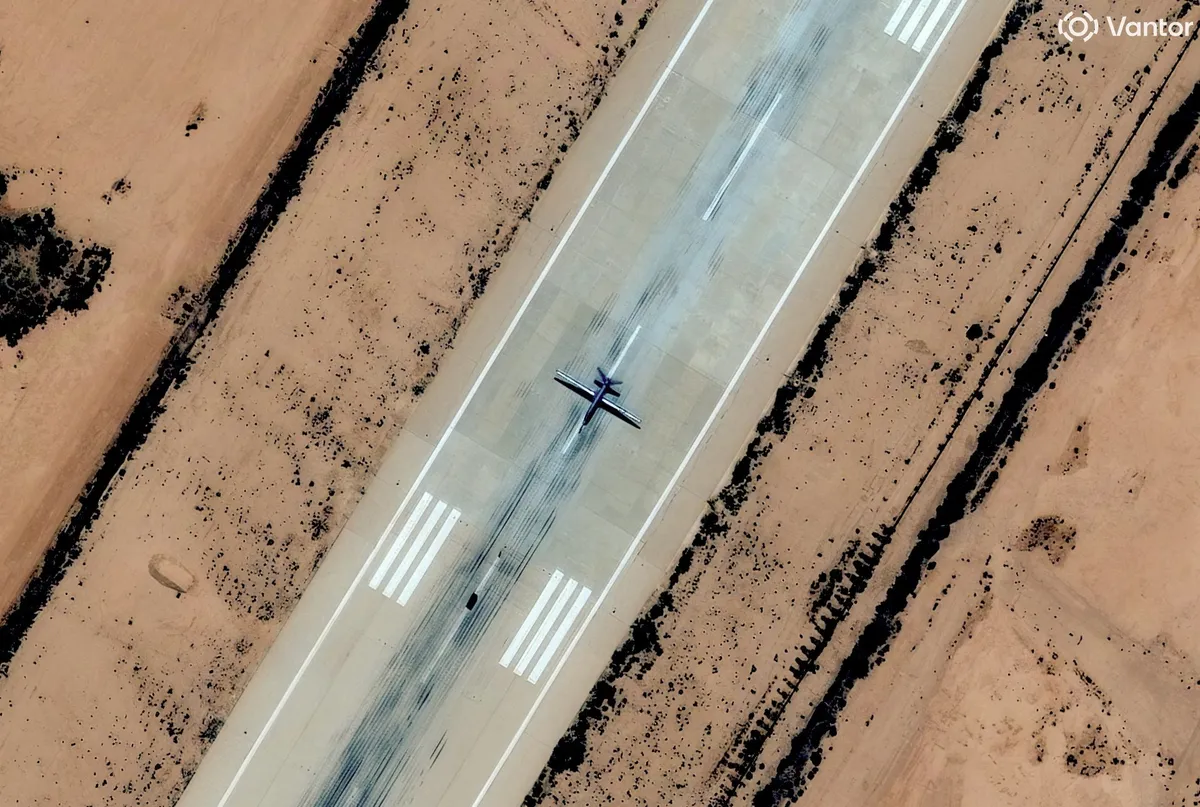
Reuters news agency says satellite images show at least three drones at Al Khadim airbase between April and December 2025.A satellite image shows a suspected combat drone at Al Khadim airbase, east of Benghazi, Libya, May 3, 2025. Experts identified it as most likely a Chinese-made Feilong-1 advanced surveillance and attack drone. [Vantor/Handout via Reuters]Published On 2 Apr 2026Chinese and Turkish combat drones may have been acquired by eastern Libya’s military leader, Khalifa Haftar – despite a United Nations weapons embargo, says the Reuters news agency.Reuters said commercial satellite images between April and December last year show at least three drones at Al Khadim desert airbase, about 100 kilometres (62 miles) east of the city of Benghazi.Recommended Stories list of 3 itemslist 1 of 3Why did Saif al-Islam Gaddafi have to die?list 2 of 3Libya issues rare oil exploration licences to foreign firmslist 3 of 3Iran today, Africa tomorrowend of listWhat appeared to be ground control equipment for the aircraft was still visible this year, according to three weapons experts who reviewed the images.Unmanned aerial vehicles (UAVs) played a significant role during the civil war in Libya between 2014-2020. Haftar’s Libyan National Army (LNA) tried to overthrow the UN-recognised government in Tripoli accusing it of harbouring armed gangs and “terrorists”. The government denied that.UN investigators said the United Arab Emirates (UAE), Egypt, Russia and other countries provided vital backing to Haftar. Turkiye supported the Tripoli-based administration. China avoided taking sides.Libya’s warring factions agreed a ceasefire in 2020, but the country remains divided between Haftar’s administration in the east and the Tripoli-based government in the west led by Prime Minister Abdulhamid Dbeibah.The arrival of new combat drones at Al Khadim “would be a huge symbolic win” for Haftar, said Anas El Gomati, head of the Libyan think tank the Sadeq Institute. He told Reuters that the drones reinforced Haftar’s hold over the east and much of the south, including major oilfields, and strengthened his hand in negotiations to form a unified Libyan government.But Gomati added that Haftar’s LNA is not known to have the technical expertise to pilot those kinds of drones.“The question remains: who’s operating them?”The experts who reviewed the satellite images said one was most likely a Chinese-made Feilong-1 (FL-1), an advanced surveillance and attack drone. The others appear to be less powerful, Turkish-made Bayraktar TB2 drones. All three experts agreed they could not rule out other types.Reuters said it could not determine who supplied the drones or when, or whether China, Turkiye or any other UN member states applied for exemptions to the embargo to send drones to eastern Libya.A satellite image shows a combat drone, which experts identified as most likely a Chinese-made Feilong-1, outside a hangar at Al Khadim airbase, east of Benghazi, Libya, May 28, 2025 [Vantor/Handout via Reuters]New drones spottedSatellite imagery reviewed by Reuters shows a type of drone not previously seen in Libya parked outside a hangar at the Al Khadim base between late April and July last year.The same type of drone also appeared on Al Khadim’s runway in a May 3 image from US satellite imaging company Vantor.Wim Zwijnenburg, a military technology expert at the Dutch peace organisation PAX says the photo suggests the drone was being flown. He added that the dimensions and body shape are similar to a Wing Loong II, but the wing design makes it more likely to be a Feilong-1.Agreeing with his assessment were Jeremy Binnie, a Middle East specialist at defence intelligence company Janes and Joseph Dempsey, a military analyst with the International Institute for Strategic Studies think tank in London.Few photographs have been released of the drone type. Reuters could not find any previous satellite imagery, making it difficult to identify with certainty.A new shelter was completed in November over the spot where the drone had been parked. Binnie said that might explain why it wasn’t visible in subsequent imagery. A truck carrying satellite equipment, which he said was likely used to pilot the aircraft, was standing near the apron as recently as January 12.Smaller dronesTwo smaller drones appeared on the same apron at Al Khadim in a Vantor image on December 17. Their length, wingspan and twin-boom tail design are consistent with Turkish TB2 drones, said Dempsey, who alerted Reuters to the image.Those drones gained renown when Ukraine deployed them against invading Russian forces and have been exported widely, including to the UAE.Manufacturers in countries including China, the UAE and Belarus have also produced similar-looking models. All three experts said two ground control units with distinctive double-antenna, spotted by satellite imagery between July and March, strongly suggest that TB2s were operating in the area.Satellite images from California-based Planet Labs show Al Khadim has undergone extensive renovations since early last year. They include at least three new hangars where the drones were spotted.Russian forces, which use Libya as a springboard for their own operations in West and Central Africa, have been based at Al Khadim. But the experts speaking to Reuters did not think Russians were operating the drones in the imagery. Russia’s defence and foreign ministries did not respond to Reuters’ requests for comment.Neither did the LNA, the Tripoli-based government, the governments of China and Turkiye nor the drones’ manufacturers, Xi’an-based defence company Zhongtian Feilong and Baykar based in Istanbul.The UN Security Council committee handling requests did not answer questions about the drones. The UN Department of Political and Peacebuilding Affairs (DPPA) referred Reuters to a Security Council resolution last year expressing “grave concern” over continued violations of the arms embargo. It requires UN approval for weapons shipments to Libya.The UN embargo has been imposed since 2011 when a NATO-backed uprising toppled Libya’s longtime ruler Muammar Gaddafi. But a UN panel of experts monitoring the embargo said high-tech weaponry flowed into the country during the war that followed, turning Libya into Africa’s first major theatre for drone combat.
SRCAl Jazeera
LANGEN
LEANCenter
WORDS975
ENT12
THU · 2026-04-02 · 11:01 GMTBRIEF NSR-2026-0402-49019
NSR-2026-0402-49019News Report·EN·National Security
Libyan military leader may have combat drones despite UN embargo
Reuters reports that Libyan military leader Khalifa Haftar may have acquired Chinese and Turkish combat drones in violation of a UN arms embargo. Satellite images from April to December 2025 show at least three drones at Al Khadim airbase, east of Benghazi.
By ReutersAl JazeeraFiled 2026-04-02 · 11:01 GMTLean · CenterRead · 4 min
Al JazeeraFIG 01
Reading time
4min
Word count
975words
Sources cited
4cited
Entities identified
12entities
Quality score
100%
§ 01
Briefing Summary
AI-generatedNEWSAR · AI
Reuters reports that Libyan military leader Khalifa Haftar may have acquired Chinese and Turkish combat drones in violation of a UN arms embargo. Satellite images from April to December 2025 show at least three drones at Al Khadim airbase, east of Benghazi. Weapons experts identified one drone as likely a Chinese-made Feilong-1, an advanced surveillance and attack drone. The presence of these drones could strengthen Haftar's control over eastern and southern Libya and bolster his position in negotiations for a unified government. While a ceasefire was agreed in 2020, Libya remains divided, and the operators of these drones are currently unknown.
Confidence 0.90Sources 4Claims 5Entities 12
§ 02
Article analysis
Model · rule-basedFraming
National Security
Political Strategy
Tone
Measured
AI-assessed
CalmNeutralAlarmist
Factuality
0.80 / 1.00
Factual
LowHigh
Sources cited
4
Well sourced
FewMany
§ 03
Key claims
5 extracted01
Satellite images show at least three drones at Al Khadim airbase between April and December 2025.
factualReuters news agency
Confidence
1.00
02
The arrival of new combat drones at Al Khadim would be a huge symbolic win for Haftar.
quoteAnas El Gomati, head of the Libyan think tank the Sadeq Institute
Confidence
0.90
03
Haftar's LNA is not known to have the technical expertise to pilot those kinds of drones.
quoteAnas El Gomati
Confidence
0.80
04
The drones may have been acquired by Khalifa Haftar despite a UN weapons embargo.
factualReuters news agency
Confidence
0.80
05
One drone was most likely a Chinese-made Feilong-1 advanced surveillance and attack drone.
factualweapons experts
Confidence
0.70
§ 04
Full report
4 min read · 975 words§ 05
Entities
12 identifiedKey playerOppositionContextPositiveNeutralNegative
Organizations4
§ 06
Keywords & salience
10 termscombat drones
1.00
libya
0.90
khalifa haftar
0.80
un embargo
0.70
satellite images
0.60
chinese drones
0.60
libyan national army
0.50
al khadim airbase
0.50
civil war
0.40
weapons
0.40
§ 07
Topic connections
Interactive graph Network visualization showing 48 related topics
View Full Graph Person Organization Location Event|Click node to navigate|Edge numbers = shared articles