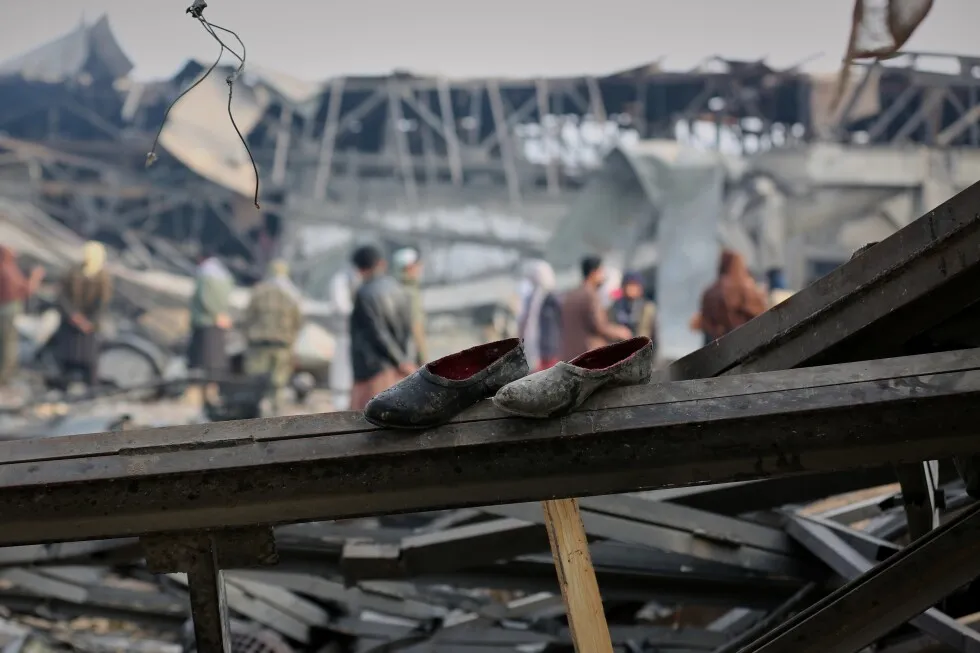
Residents and rescue workers inspect the site of an airstrike at a drug rehabilitation hospital in Kabul, Afghanistan, March 17, 2026. (AP Photo/Siddiqullah Alizai, File) Updated [hour]:[minute] [AMPM] [timezone], [monthFull] [day], [year] Islamabad (AP) — Pakistan on Thursday confirmed it was holding peace talks with Afghanistan’s Taliban government in China, where Beijing is mediating to broker a lasting ceasefire after weeks of fighting that have killed hundreds, disrupting trade and cross-border travel.The confirmation of the new round of talks came a day after officials from the two sides told The Associated Press that representatives from the two countries had traveled to Urumqi in northern China, where they held the first round of talks. It remains unclear who is representing Pakistan and Afghanistan in the latest negotiations in China.In Islamabad, Pakistan’s Foreign Ministry spokesperson Tahir Andrabi told a news briefing that the talks are ongoing. “Yes, Pakistan has sent a delegation to Urumqi, in line with its consistent position and longstanding practice of supporting a credible process that can help find a durable solution to cross-border terrorism from Afghanistan,” he said. However, Andrabi said success of the talks largely depends on Kabul. “The burden of a real process lies with Afghanistan, which must demonstrate visible and verifiable action against terrorist groups using Afghan soil against Pakistan,” he said. Andrabi said Pakistan has never shied away from dialogue on the issue. “We remain engaged with the Chinese leadership on this issue and other relevant international partners,” he said, but maintained that Pakistan is seeking written assurances from Kabul that Afghan soil will not be used for attacks against Pakistan.There was no immediate comment from Kabul.Though China has not officially confirmed the talks, the Chinese Foreign Ministry on Thursday said Xi Jinping’s government has been “actively mediating and facilitating the resolution of conflicts between Afghanistan and Pakistan.” Foreign Ministry spokesperson Mao Ning said China has “always supported both sides in resolving their differences through dialogue and negotiation.” Despite the ongoing peace talks, Pakistan’s operations against the Taliban" class="entity-link entity-organization" data-entity-id="17628" data-entity-type="organization">Pakistani Taliban along the border with Afghanistan and other militant groups will continue, according to Andrabi. On Wednesday, Farid Dehqan, a police spokesperson for the eastern Afghan province of Kunar, said Pakistan had fired mortars into Afghan territory late Wednesday, killing two civilians and wounding six others, including four children. He said the shelling was ongoing two hours after it started.Andrabi dismissed the accusation, saying Pakistan conducts operations against militants with care to avoid civilian casualties.Pakistan often accuses Afghanistan of providing a safe haven to militants who carry out attacks inside Pakistan, especially the Taliban" class="entity-link entity-organization" data-entity-id="17628" data-entity-type="organization">Pakistani Taliban, known as Tehrik-e-Taliban Pakistan or TTP. The group is separate from but allied with the Afghan Taliban, which took over Afghanistan in 2021 following the chaotic withdrawal of U.S.-led troops. Kabul denies the charge.The fighting between the two sides has been the deadliest since February, when Afghanistan’s Taliban government said Pakistan launched strikes in Kabul and several other areas, causing mostly civilian casualties. Pakistan has said it targeted hideouts of TTP. Pakistan has also said it is in “open war” with Afghanistan.Tensions have been especially high since last month when Afghanistan said a Pakistani airstrike at a drug-treatment center in Kabul killed more than 400 people. The death toll could not be independently confirmed, and Pakistan has disputed the claim. It denied targeting civilians, saying it struck an ammunition depot in Kabul.The latest peace talks in China followed earlier rounds held in Qatar and Turkey, during which the two sides agreed to a ceasefire which largely remained in place until Pakistan carried out strikes in Kabul and elsewhere in Afghanistan in late February, triggering border clashes which have subsided in recent days. Pakistan and the Afghan Taliban have a history of tense relations, but the ongoing violence has alarmed the international community, particularly because apart from outlawed TTP, other militant groups such as al-Qaida and the Islamic State group remain present in the region and have sought to regroup.Castillo reported from Beijing.
SRCAssociated Press (AP)
LANGEN
LEANCenter
WORDS661
ENT12
THU · 2026-04-02 · 10:53 GMTBRIEF NSR-2026-0402-49186
NSR-2026-0402-49186News Report·EN·Diplomatic
Pakistan says a new round of peace talks with Afghanistan is underway in China after deadly fighting
Pakistan confirmed that peace talks with Afghanistan's Taliban government are underway in Urumqi, China, mediated by Beijing. The talks aim to broker a lasting ceasefire after recent fighting that caused hundreds of deaths and disrupted trade.
By
MUNIR AHMED and E. EDUARDO CASTILLOAssociated Press (AP)Filed 2026-04-02 · 10:53 GMTLean · CenterRead · 3 min
Associated Press (AP)FIG 01
Reading time
3min
Word count
661words
Sources cited
5cited
Entities identified
12entities
Quality score
100%
§ 01
Briefing Summary
AI-generatedNEWSAR · AI
Pakistan confirmed that peace talks with Afghanistan's Taliban government are underway in Urumqi, China, mediated by Beijing. The talks aim to broker a lasting ceasefire after recent fighting that caused hundreds of deaths and disrupted trade. Pakistan's Foreign Ministry stated that its delegation is participating to support a solution to cross-border terrorism originating from Afghanistan, emphasizing that the success depends on Afghanistan taking verifiable action against terrorist groups. China's Foreign Ministry has stated that it has been "actively mediating and facilitating the resolution of conflicts between Afghanistan and Pakistan.” Pakistan is seeking written assurances from Kabul that Afghan soil will not be used for attacks against Pakistan. Despite the talks, Pakistan will continue operations against militant groups along the Afghan border.
Confidence 0.90Sources 5Claims 5Entities 12
§ 02
Article analysis
Model · rule-basedFraming
Diplomatic
National Security
Tone
Measured
AI-assessed
CalmNeutralAlarmist
Factuality
0.80 / 1.00
Factual
LowHigh
Sources cited
5
Well sourced
FewMany
§ 03
Key claims
5 extracted01
Pakistan had fired mortars into Afghan territory late Wednesday, killing two civilians and wounding six others.
quoteFarid Dehqan, a police spokesperson for the eastern Afghan province of Kunar
Confidence
1.00
02
Pakistan is seeking written assurances from Kabul that Afghan soil will not be used for attacks against Pakistan.
factualTahir Andrabi, Pakistan’s Foreign Ministry spokesperson
Confidence
1.00
03
The burden of a real process lies with Afghanistan, which must demonstrate visible and verifiable action against terrorist groups.
quoteTahir Andrabi, Pakistan’s Foreign Ministry spokesperson
Confidence
1.00
04
Pakistan has sent a delegation to Urumqi to support a credible process to find a durable solution to cross-border terrorism.
quoteTahir Andrabi, Pakistan’s Foreign Ministry spokesperson
Confidence
1.00
05
Pakistan confirmed it was holding peace talks with Afghanistan’s Taliban government in China.
factualPakistan
Confidence
1.00
§ 04
Full report
3 min read · 661 words§ 05
Entities
12 identifiedKey playerOppositionContextPositiveNeutralNegative
§ 06
Keywords & salience
10 termspeace talks
0.90
pakistan
0.80
afghanistan
0.80
taliban
0.70
china
0.70
ceasefire
0.60
cross-border terrorism
0.60
mediation
0.50
urumqi
0.40
militant groups
0.40
§ 07
Topic connections
Interactive graph Network visualization showing 51 related topics
View Full Graph Person Organization Location Event|Click node to navigate|Edge numbers = shared articles