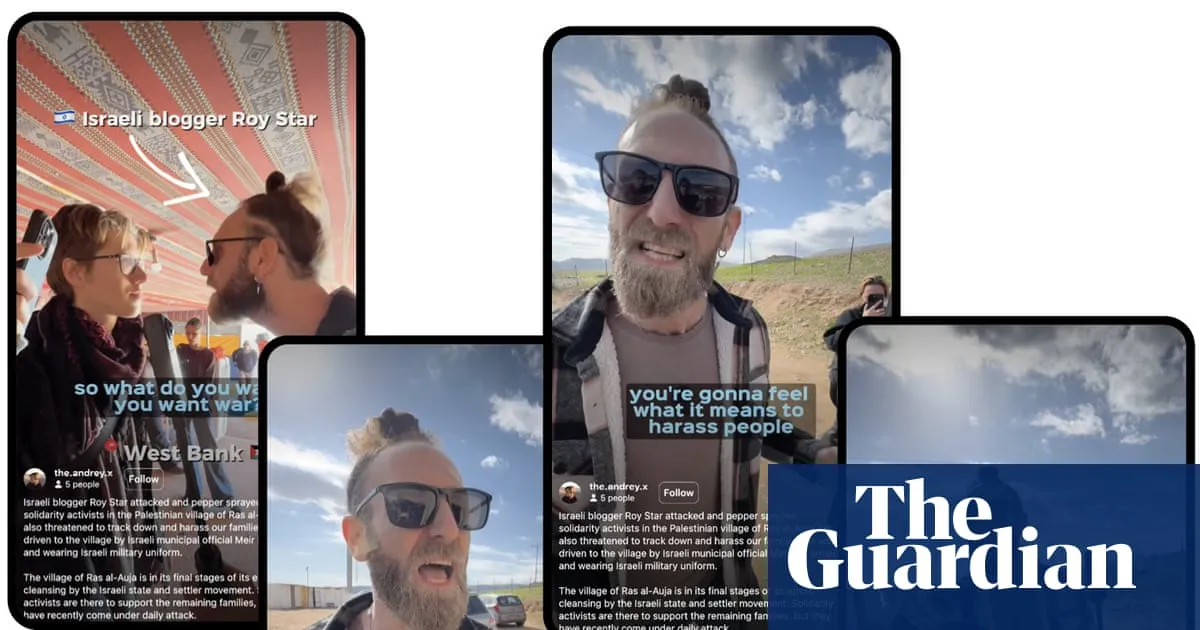
TikTok has removed an account belonging to an ultranationalist, pro-settlement Israeli influencer for breaching hate speech and bullying rules after The Guardian flagged videos showing him harassing activists in the occupied West Bank.The Guardian has reviewed dozens of videos posted by various social media figures that have gone viral on TikTok and Instagram documenting the harassment of Palestinians as well as physical attacks on Israeli and international activists.The accounts began to proliferate after the start of the war in Gaza in October 2023, since when Israeli forces and settlers have killed more than 1,000 Palestinians in the West Bank. In recent weeks violence has intensified further, with repeated attacks on homes.The burgeoning far-right ecosphere has risen in tandem with the growing influence of far-right parties and figures in Israeli politics.“Dehumanising Palestinians is now mainstream in Israel,” said Yuli Novak, the executive director of the Israeli human rights group B’Tselem. “Influencers gain popularity through incendiary messaging.”Prof Anat Ben-David, a digital media researcher at the Open University of Israel, said: “The circulation of videos showing settlers harassing Palestinians in the West Bank, alongside rightwing activists targeting journalists, points to a troubling convergence between platform dynamics and on-the-ground violence.”TikTok said this week it had removed an account belonging to the far-right social media personality Roi Star after it was flagged by The Guardian.In a video he posted to TikTok and Instagram in January, he films himself entering a house being used as a base by leftwing activists in Ras Ein al-Auja, in the Jordan valley, and pepper-spraying an activist who tries to prevent him for gaining access.The activists also filmed the encounter. “This is Judea, not fucking Palestine,” Star yells in a clip posted by one such activist, Andrey Khrzhanovskiy. In Khrzhanovskiy’s video, Star is heard threatening activists and their families with continued harassment. “I know your number. I know your family. I know where everyone lives,” he says at one point.Reached by The Guardian, Star said he had gone to “talk about peace” with the leftwing activists and claimed Ras Ein al-Auja was not Palestinian land but an open Israeli public space. He said he used pepper spray as it was “the most minimal thing you can do to defend yourself”.Asked about the threats he made, he said: “It’s all acting… It was just the moment got heated up … My intentions were not to get that extreme.” He added: “It is my right as a citizen of Israel to walk around public areas … It [the West Bank] belongs to Israel. And if Arabs want to live there, they should be good Israeli citizens.”TikoTok said it had taken down Star’s account for breaching the platform’s rules on hate speech and bullying. The platform said that under its community guidelines, it does not allow “the presence of violent and hateful individuals on our platform, including violent extremists, and do[es] not allow praise, glorification of extremists.”TikTok said it had also removed videos from “other TikTok creators linked to Israeli far-right agitators”, without identifying either the content or the creators.An Israeli settler films an anti-occupation activist in a private Palestinian property in Ras Ein al-Auja in July 2025. Photograph: Quique Kierszenbaum/The GuardianKhrzhanovskiy said: “This is not the first ethnic cleansing in history, but this is the first ethnic cleansing that you can watch live on TikTok. There is a certain irony in me denouncing this. Settlers film us, we film them – a parallel battle unfolding both on the ground and online.”Barak Cohen, an Israeli activist, said: “These far-right influencers have crossed a serious line. Violence against Palestinians feeds mob dynamics. The demand is for violence.”An Israeli settler argues with a Palestinian farmer (not pictured) during olive harvesting in Silwad, in the occupied West Bank, in October last year. Photograph: Mohamad Torokman/ReutersInfluencers’ use of social media to promote ultranationalist agendas is mirrored by Israel’s far-right politicians. In August last year the national security minister, Itamar Ben-Gvir, drew condemnation after he posted footage to X in which he was seen taunting the Palestinian leader Marwan Barghouti in jail.Another member of the Knesset, Zvi Sukkot, of the far-right Religious Zionist party, was filmed in the occupied West Bank denying settler violence.Sukkot said he was “proud to be part of the Jewish settlement enterprise in the land of Israel, which belongs to the Jewish people according to the Bible”. He dismissed accusations that he had denied settler violence, saying he had “led the fight against polluting environmental terrorism that endangers the health of the settlers”.Mohammad Hureini, a human rights activist who lives in Masafer Yatta, where settlers attack daily, said the videos posted by far-right agitators had a profound psychological and social impact. “When people see this content, it heightens fear,” he said.Instagram continues to host numerous accounts linked to far-right Israeli agitators. Meta, which owns Instagram, has not replied to a request for comment.Ben-David said: “While platform policies remain deliberately ambiguous on hate speech, they are explicit in prohibiting actions that threaten harm to individuals. Yet such content is routinely amplified without meaningful intervention.”
SRCThe Guardian - World News
LANGEN
LEANCenter-Left
WORDS838
ENT12
THU · 2026-04-02 · 16:08 GMTBRIEF NSR-2026-0402-49663
NSR-2026-0402-49663News Report·EN·Human Rights
TikTok pulls Israeli ultranationalist’s account for breach of hate speech rules
TikTok removed the account of Israeli ultranationalist Roi Star for violating hate speech and bullying policies after the Guardian flagged videos of him harassing activists in the occupied West Bank. These videos, along with others showing harassment and attacks on Palestinians and activists, have proliferated since the start of the Gaza war in October 2023, coinciding with increased violence against Palestinians by Israeli forces and settlers.
Lorenzo Tondo and Quique Kierszenbaum in JerusalemThe Guardian - World NewsFiled 2026-04-02 · 16:08 GMTLean · Center-LeftRead · 4 min
The Guardian - World NewsFIG 01
Reading time
4min
Word count
838words
Sources cited
4cited
Entities identified
12entities
Quality score
100%
§ 01
Briefing Summary
AI-generatedNEWSAR · AI
TikTok removed the account of Israeli ultranationalist Roi Star for violating hate speech and bullying policies after the Guardian flagged videos of him harassing activists in the occupied West Bank. These videos, along with others showing harassment and attacks on Palestinians and activists, have proliferated since the start of the Gaza war in October 2023, coinciding with increased violence against Palestinians by Israeli forces and settlers. Critics argue that the rise of this far-right online activity reflects a broader trend of dehumanizing Palestinians within Israeli society, fueled by the growing influence of far-right political figures. Star's videos included instances of pepper-spraying activists and making threats, which he defended as self-defense or "acting." TikTok's action follows concerns about the connection between online content and real-world violence in the region.
Confidence 0.90Sources 4Claims 5Entities 12
§ 02
Article analysis
Model · rule-basedFraming
Human Rights
Political Strategy
Tone
Measured
AI-assessed
CalmNeutralAlarmist
Factuality
0.70 / 1.00
Factual
LowHigh
Sources cited
4
Well sourced
FewMany
§ 03
Key claims
5 extracted01
Star claimed Ras Ein al-Auja was not Palestinian land but an open Israeli public space.
quoteRoi Star
Confidence
1.00
02
Roi Star pepper-sprayed an activist in Ras Ein al-Auja.
factualnull
Confidence
1.00
03
"Dehumanising Palestinians is now mainstream in Israel."
quoteYuli Novak, the executive director of the Israeli human rights group B’Tselem
Confidence
1.00
04
Israeli forces and settlers have killed more than 1,000 Palestinians in the West Bank since October 2023.
statisticnull
Confidence
1.00
05
TikTok removed an account belonging to Roi Star for breaching hate speech and bullying rules.
factualTikTok
Confidence
1.00
§ 04
Full report
4 min read · 838 words§ 05
Entities
12 identifiedKey playerOppositionContextPositiveNeutralNegative
People4
§ 06
Keywords & salience
10 termshate speech
0.90
tiktok
0.80
israeli-palestinian conflict
0.80
ultranationalist
0.70
west bank
0.70
settler violence
0.60
harassment
0.60
social media
0.60
influencer
0.50
far-right
0.50
§ 07
Topic connections
Interactive graph Network visualization showing 51 related topics
View Full Graph Person Organization Location Event|Click node to navigate|Edge numbers = shared articles