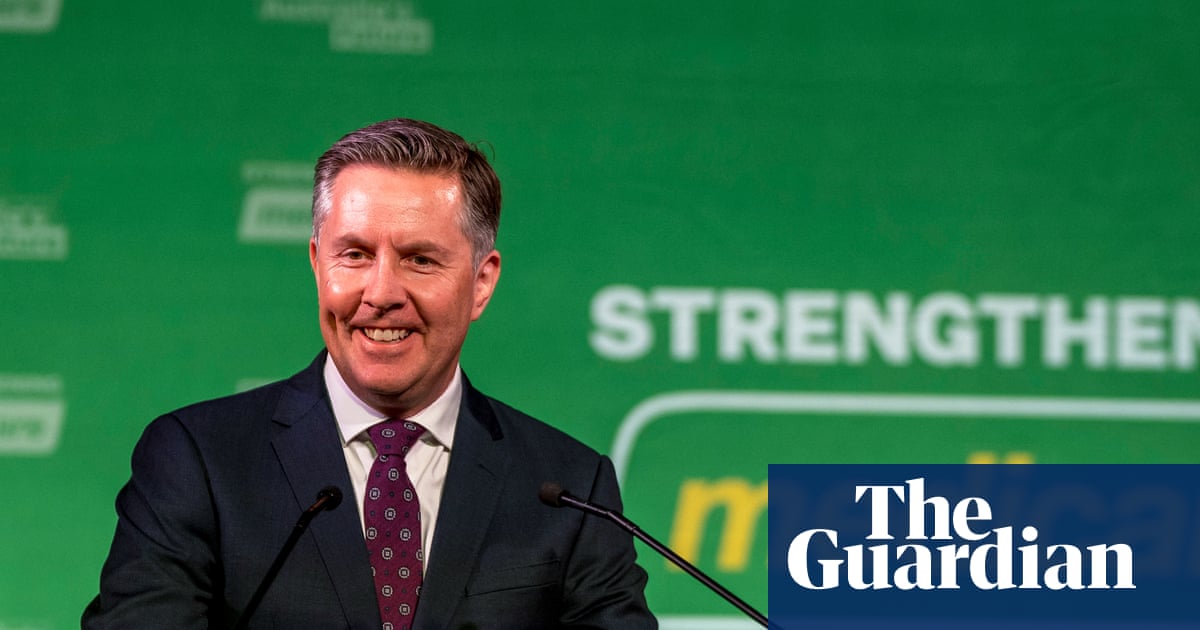
The health minister, Mark Butler, says the Australian government will not succumb to pressure to lift drug prices after Donald Trump’s new drug tariff. Photograph: Rob Burnett/AAP View image in fullscreen The health minister, Mark Butler, says the Australian government will not succumb to pressure to lift drug prices after Donald Trump’s new drug tariff. Photograph: Rob Burnett/AAP Australia says it won’t raise drug prices after Trump’s 100% tariff on pharmaceuticals imported into US Health minister Mark Butler says federal government is ‘not negotiating’ when it comes to removing price protections on common medications Get our breaking news email, free app or daily news podcast Australia will not cave in to pressure from pharmaceutical giants and the Trump administration by removing consumer price protections on common medications, the health minister, Mark Butler says. Donald Trump imposed a new 100% tariff on branded pharmaceuticals imported into the US overnight, Australian time, trying to force manufacturers to agree to drug-pricing deals or commit to making their products domestically. It is the latest challenge for Australian manufacturers selling products to American consumers and comes as the White House tries to force changes to Australia’s Pharmaceutical Benefits Scheme, which guarantees lower prices for prescription holders here. Under a new executive order signed by Trump, large pharmaceutical companies will have 120 days to announce plans to avoid the new tariff, while smaller companies have 180 days. Companies agreeing to move manufacturing to the US can see a reduced 20% tariff, with some carve-outs given to companies agreeing to preferred pricing deals for US consumers. Australia exports about $2bn worth of drugs to the US every year. Manufacturing giant CSL makes up the bulk of those exports with blood plasma products, expected to receive exemptions from the new tariffs. CSL last month opened a new manufacturing facility in Illinois. Butler said on Friday that the federal government would not succumb to pressure to lift prices in Australia. “We keep sending this clearest of possible messages to the US because we know they get the big drug companies in their ear trying to unpick the PBS here in Australia and equivalent schemes in other countries around the world,” he said. “We are not negotiating about those fundamentals.” Trump’s plan is expected to exempt generic drugs and maintain more favourable tariff rates for drugs produced in the European Union, Japan, South Korea and Switzerland. The UK has its own separate tariff deal. American consumers pay far more for prescription medicines than Australians, a source of frustration for Trump, who has struggled to help ease cost-of-living pressures in the US. Affordability is set to be a key issue in the November midterm congressional elections. Butler told Channel Seven the federal government would study the latest tariff move. “Our immediate concern, obviously, is our great exporters that have been sending product to America for many years, for 20 years under a free trade agreement with no tariffs. “The biggest of those exporters has very big manufacturing operations over in America, so we’re pretty confident they’ll be carved out.” A CSL spokesperson told Guardian Australia the company was reviewing information from the US but did not anticipate material impact from tariffs. “The vast majority of our trade into the US are plasma therapies that are made entirely from US-sourced plasma and we recently announced plans to spend $1.5bn to expand our plasma therapy manufacturing capabilities in the US,” they said. The Victorian premier, Jacinta Allan, said she was concerned the announcement would impact the state, which she describes as a “global capital for the medical technology industry”. “It’s another day, it’s another announcement that is putting pressure into the economy,” she said. “Whilst we work through the very new news that’s come out of the White House this morning, and work with the federal government in terms of understanding what that means, what I’m particularly concerned about is what that means for families who need the supplies of these medicines [and] what this means for the companies who employ many, many people here in Victoria.” The communications minister, Anika Wells, told ABC TV the tariff decision was disappointing “but the Australian PBS is not for sale.” “The quality of Australian pharmaceuticals is world class and it’s not something we’re prepared to compromise on,” Wells said. The opposition leader, Angus Taylor, meanwhile called for Labor to negotiate exemptions with Trump. “This is obviously not welcome news. We don’t want to see it. We’ll work with the government to do anything we have to get it overturned or get an exemption for Australian exporters,” he said. Australia had received the lowest 10% rate under Trump’s so-called Liberation Day tariff regime, announced in 2025, but struck down in a US supreme court ruling in February. Explore more on these topics Tariffs Donald Trump Mark Butler Angus Taylor Australian politics Labor party news Share Reuse this content
SRCThe Guardian - World News
LANGEN
LEANCenter-Left
WORDS812
ENT6
THU · 2026-04-02 · 22:24 GMTBRIEF NSR-2026-0403-50033
NSR-2026-0403-50033News Report·EN·Economic Impact
Australia says it won’t raise drug prices after Trump’s 100% tariff on pharmaceuticals imported into US
Australia's Health Minister, Mark Butler, announced the country will maintain its current drug pricing protections despite pressure from pharmaceutical companies and the Trump administration. This decision comes in response to Donald Trump's imposition of a 100% tariff on branded pharmaceuticals imported into the US.
Tom McIlroy and Benita KolovosThe Guardian - World NewsFiled 2026-04-02 · 22:24 GMTLean · Center-LeftRead · 4 min
The Guardian - World NewsFIG 01
Reading time
4min
Word count
812words
Sources cited
1cited
Entities identified
6entities
Quality score
100%
§ 01
Briefing Summary
AI-generatedNEWSAR · AI
Australia's Health Minister, Mark Butler, announced the country will maintain its current drug pricing protections despite pressure from pharmaceutical companies and the Trump administration. This decision comes in response to Donald Trump's imposition of a 100% tariff on branded pharmaceuticals imported into the US. The tariff aims to compel manufacturers to agree to drug-pricing deals or manufacture their products within the United States. Butler stated the Australian government is not negotiating the removal of price protections on common medications. The Australian government's decision ensures continued consumer price protections on pharmaceuticals within the country.
Confidence 0.85Sources 1Claims 4Entities 6
§ 02
Article analysis
Model · rule-basedFraming
Economic Impact
Political Strategy
Tone
Measured
AI-assessed
CalmNeutralAlarmist
Factuality
0.80 / 1.00
Factual
LowHigh
Sources cited
1
Limited
FewMany
§ 03
Key claims
4 extracted01
Federal government is ‘not negotiating’ when it comes to removing price protections.
quoteMark Butler
Confidence
1.00
02
Donald Trump imposed a 100% tariff on branded pharmaceuticals imported into the US.
factual
Confidence
1.00
03
Australia will not remove consumer price protections on common medications.
quoteMark Butler
Confidence
1.00
04
The tariff aims to force manufacturers to agree to drug-pricing deals or domestic production.
factual
Confidence
0.90
§ 04
Full report
4 min read · 812 words§ 05
Entities
6 identified§ 06
Keywords & salience
8 termsdrug prices
1.00
pharmaceuticals
0.80
tariffs
0.70
price protections
0.70
medications
0.60
pharmaceutical giants
0.50
trade
0.40
healthcare
0.40
§ 07
Topic connections
Interactive graph Network visualization showing 3 related topics
View Full Graph Person Organization Location Event|Click node to navigate|Edge numbers = shared articles