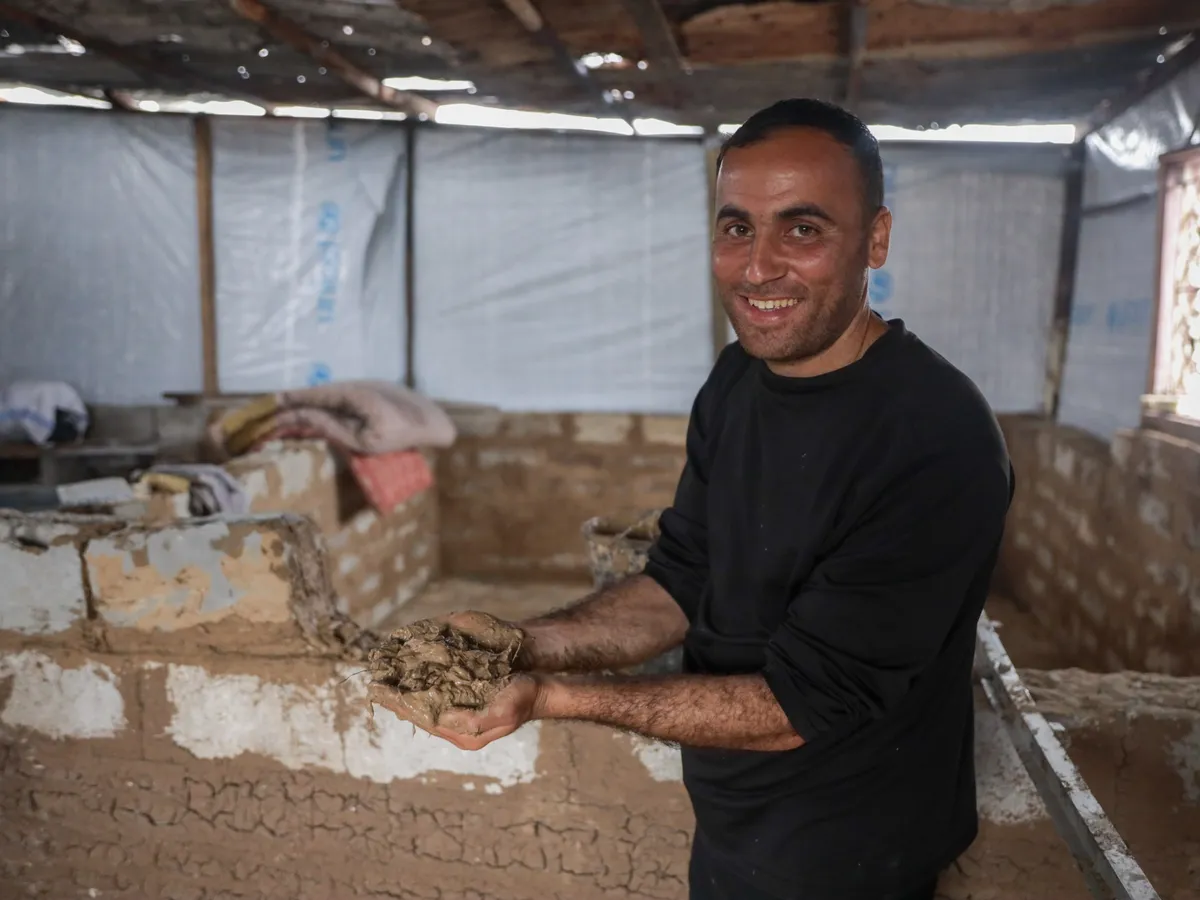
Partial rehabilitation replaces reconstruction in Gaza, with residents relying on temporary housing solutions.Mohammed al-Jadba is using whatever materials he can got hold of to rebuild his home in Gaza City [Abdelhakim Abu Riash/Al Jazeera]Published On 3 Apr 2026Gaza City – It’s a small space, covered with a worn-out metal sheet roof and tarpaulins. Mohammed al-Jadba is working on the walls, using stones from the rubble of his destroyed house and mud to fill the gaps.It almost looks like a home, but isn’t quite one yet.Recommended Stories list of 3 itemslist 1 of 3UN experts urge investigation into Israel’s killing of Lebanese journalistslist 2 of 3European Parliament member Rima Hassan taken into French police custodylist 3 of 3Why Lebanon should join the International Criminal Courtend of listMohammed’s old home – in Gaza City’s Tuffah neighbourhood – was once a four-storey building. But Israel’s genocidal war on Gaza has left it, and the area around it, resembling the aftermath of an earthquake.The 31-year-old has been living with his family of 10 in tents beside the rubble of their old home since the October ceasefire.After a rainy winter that left his family wet and cold, he has decided to use what he can to build a more permanent shelter. In the absence of construction materials, such as cement, because of Israeli restrictions on imports into Gaza, he is forced to use mud and whatever he can salvage from his old home.“I said I want to make a place … a small space, a room and a bathroom, that’s it,” Mohammed tells Al Jazeera, adding that the experiment has quickly grown into something much bigger than he had imagined.“I built one room, I liked it … so I said, I’ll build another … then a living room, a kitchen, a bathroom … I thought, ‘Oh God, what have I gotten myself into?'”Mohammed has been working on the small house for four months. He describes collecting iron, window frames, and door frames from his old house.The mud sticks everything together – but Mohammed soon faced a problem, a lack of straw, which is necessary to mix into the mud and make it more durable.“Straw isn’t available in the markets and hasn’t entered through the crossings for a long time,” he says.Mohammed soon found an alternative – human hair. He began collecting it from barbershops, and the subsequent mix of mud and hair, along with the stones extracted from the rubble, formed walls that proved to be stronger than expected.Mohammed’s motivation was not only to find shelter, but to secure a minimum level of safety, as gunfire continues daily from Israeli forces stationed about one kilometre (0.6 miles) away from them.His mother was injured about a week ago by a bullet that pierced their tent, and she was taken to hospital, prompting him to accelerate construction.“The tent is dangerous; it neither protects nor shelters,” he says. “My mother was injured, and months ago, our neighbour was killed by a bullet that pierced her heart while she was sleeping.”Mohammed knows that the structure he is building is not a permanent solution. But, with the reconstruction Gaza so desperately needs still absent, he has few other options.“Anyone following what’s happening in Gaza knows that reconstruction is a very distant dream … even a lie,” he says in frustration.“If rubble removal alone will take five years and hasn’t even started yet, what about reconstruction?”Mohammed al-Jadba mixes hair with mud to make it stronger – the straw that is normally used for the task is unavailable in Gaza [Abdelhakim Abu Riash/ Al Jazeera]Delayed reconstructionThe United Nations estimates that it will cost $70bn to fully reconstruct Gaza, which has been devastated by Israeli bombing and deliberate demolition.UN figures show that 92 percent of residential buildings in Gaza have been damaged or destroyed in the war, which began in October 2023.An urgent $20bn is needed within the first three years just to initiate basic recovery and restore essential services, such as water, health, education, and transport infrastructure.Despite those estimates, no large-scale reconstruction has taken place, largely due to continued Israeli restrictions on the entry of construction materials and heavy machinery.Palestinians in Gaza have instead focused on partial reconstruction, using what they can find until they are able to import more durable materials.“Partial rehabilitation is a non-structural intervention … we are not rebuilding destroyed structures, but making partially damaged homes habitable and protecting residents from the rain, cold, and wind,” said Muath Humaid, a project engineer and coordinator working on projects implemented in partnership with the United Nations Development Programme (UNDP).“We didn’t choose this model because it is the best, but because it is what is available,” said Humaid. “In Gaza today, real reconstruction materials simply do not exist – no cement and no steel in sufficient quantities.”According to Humaid, the UNDP has worked on more than 230 housing units, benefitting more than a thousand people. However, implementation has not been without challenges, as teams were forced to rely on whatever materials were available locally, rather than the ideal requirements.“Doors were sometimes made out of wood, aluminium … depending on what we could find,” he said.He also pointed to a severe cash liquidity crisis that has increased costs.“At the beginning of the project, cash withdrawal fees reached 30 percent … meaning a significant portion of the funding was lost before purchasing any materials,” he said.While these interventions have improved conditions for some families, Humaid stresses they remain temporary.“Partial rehabilitation reduces suffering, but it is not a solution … the real solution starts with allowing the entry of reconstruction materials and implementing actual rebuilding projects.”The scale of the crisis remains severe, with more than 213,000 families living in tents and widespread damage during winter storms.Residents of Gaza are looking for temporary solutions until real reconstruction can take place in the devastated Palestinian enclave [Abdelhakim Abu Riash/Al Jazeera]Unsustainable solutionsAmong those benefitting from partial rehabilitation is 55-year-old Abdel Nasser al-Jalousi from Khan Younis.Abdel Nasser recently returned to his heavily damaged home after months living displaced with his 16-member family between various areas of Gaza.When he returned to Khan Younis after the ceasefire, he found that his home had been damaged, but was still standing.“The house had no doors, no windows, no lights, no bathroom, no furniture … just completely empty, exposed rooms standing on columns, nothing but a damaged, abandoned structure,” he tells Al Jazeera.But without the proper materials or tools to rebuild, Abdel Nasser was stuck. It was only when the UNDP came in to help with a partial rehabilitation project that he was able to find a temporary solution.Tarpaulins have been used as a substitute for walls, doors, and room partitions in his house, as well as a way to seal open spaces and repair kitchens and bathrooms.“I now have a door made of tarpaulin … everything used to be completely open,” Abdel Nasser says.He is thankful to the UNDP for providing a solution amid the limited options that exist in Gaza, but stresses that the materials used will not be a long-term fix.“Tarpaulins don’t last with rain and sun … and wood deteriorates,” he says. “So you end up replacing them every season, which creates an endless cycle of costs.”What further complicates matters is the widespread destruction of basic infrastructure during the war, leaving even partially standing homes in severe hardship.“There is no electricity, no proper connections … no sewage network. When it rains, the house turns into a lake,” he says, describing how water accumulates inside.
SRCAl Jazeera
LANGEN
LEANCenter
WORDS1 244
ENT11
FRI · 2026-04-03 · 11:14 GMTBRIEF NSR-2026-0403-50824
NSR-2026-0403-50824News Report·EN·Human Interest
Rubble, mud and hair: How to rebuild a home in Gaza
In Gaza City, Mohammed al-Jadba is rebuilding his destroyed home using salvaged materials and mud due to restrictions on importing construction materials. Since the October ceasefire, he and his family of ten have been living in tents beside the rubble of their former four-story building.
Maram HumaidAl JazeeraFiled 2026-04-03 · 11:14 GMTLean · CenterRead · 5 min
Al JazeeraFIG 01
Reading time
5min
Word count
1 244words
Sources cited
1cited
Entities identified
11entities
Quality score
100%
§ 01
Briefing Summary
AI-generatedNEWSAR · AI
In Gaza City, Mohammed al-Jadba is rebuilding his destroyed home using salvaged materials and mud due to restrictions on importing construction materials. Since the October ceasefire, he and his family of ten have been living in tents beside the rubble of their former four-story building. Lacking cement and straw, Mohammed mixes mud with stones from the rubble and human hair collected from barbershops to create stronger walls. He aims to create a more permanent shelter for his family after a harsh winter in tents. The partial rehabilitation reflects a broader trend in Gaza, where residents are forced to rely on temporary housing solutions due to limited reconstruction efforts.
Confidence 0.90Sources 1Claims 5Entities 11
§ 02
Article analysis
Model · rule-basedFraming
Human Interest
Human Rights
Tone
Mixed Tone
AI-assessed
CalmNeutralAlarmist
Factuality
0.70 / 1.00
Factual
LowHigh
Sources cited
1
Limited
FewMany
§ 03
Key claims
5 extracted01
Mohammed's mother was injured by a bullet that pierced their tent.
quoteMohammed al-Jadba
Confidence
1.00
02
Mohammed is using human hair mixed with mud to build stronger walls for his home.
factualAl Jazeera
Confidence
1.00
03
Mohammed al-Jadba is rebuilding his home in Gaza City using stones and mud due to a lack of construction materials.
factualAl Jazeera
Confidence
1.00
04
Gunfire from Israeli forces stationed about one kilometer away continues daily.
factualAl Jazeera
Confidence
0.90
05
Israeli restrictions on imports into Gaza are causing a lack of construction materials like cement.
factualAl Jazeera
Confidence
0.90
§ 04
Full report
5 min read · 1 244 words§ 05
Entities
11 identifiedKey playerOppositionContextPositiveNeutralNegative
People3
Organizations3
§ 06
Keywords & salience
9 termsgaza
1.00
rebuilding home
0.90
rubble
0.80
temporary housing
0.70
mud
0.60
construction materials
0.60
human hair
0.50
israeli restrictions
0.50
gaza city
0.40
§ 07
Topic connections
Interactive graph No topic relationship data available yet. This graph will appear once topic relationships have been computed.