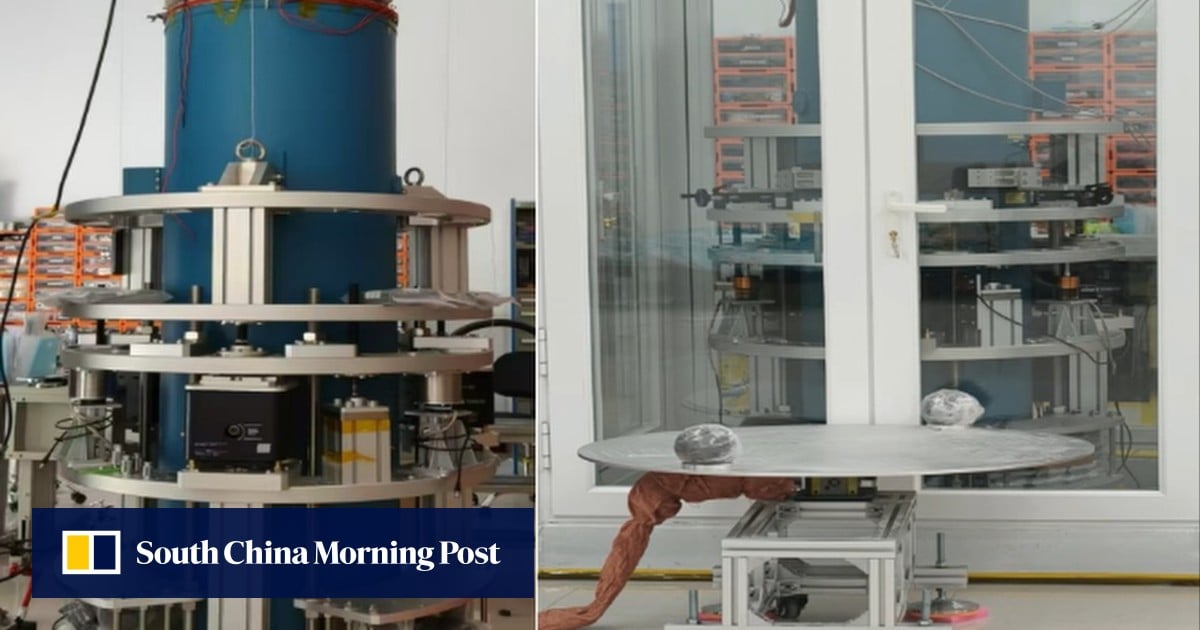
Chinese researchers unveiled a gravity detector with world-leading precision last month, potentially expanding the military applications of the technology.It uses a superconducting quantum interference device (SQUID) to detect objects by measuring tiny changes in gravity.The team that developed the instrument says it can be used for scientific research and finding underground resources. It also brings the country one step closer to being able to spot patrolling nuclear submarines.According to a report on the Chinese Academy of Sciences (CAS) website, the instrument reduces gravity gradient measurement noise – outside effects that can disrupt a gravity detector’s accuracy, such as vibrations from seismic activity – to a level that is second only to gravitational wave detectors built on the kilometre scale.One such detector is the Laser Interferometer Gravitational-Wave Observatory in the United States which uses mirrors spaced 4km (2.5 miles) apart to study the cosmos. Meanwhile, the instrument built by the CAS team is about the size of an office cubicle.Existing submarine detection methods – sonar, magnetic anomaly detection, and radar – can be evaded. However, gravity cannot be masked.
SRCSouth China Morning Post
LANGEN
LEANCenter-Right
WORDS178
ENT5
FRI · 2026-04-03 · 14:00 GMTBRIEF NSR-2026-0403-51115
NSR-2026-0403-51115News Report·EN·National Security
China’s gravity-detecting SQUID gets closer to spotting US nuclear submarines
Chinese researchers have developed a highly precise gravity detector using a superconducting quantum interference device (SQUID). The instrument, about the size of an office cubicle, measures subtle changes in gravity to detect objects.
Zhang TongSouth China Morning PostFiled 2026-04-03 · 14:00 GMTLean · Center-RightRead · 1 min
South China Morning PostFIG 01
Reading time
1min
Word count
178words
Sources cited
1cited
Entities identified
5entities
Quality score
100%
§ 01
Briefing Summary
AI-generatedNEWSAR · AI
Chinese researchers have developed a highly precise gravity detector using a superconducting quantum interference device (SQUID). The instrument, about the size of an office cubicle, measures subtle changes in gravity to detect objects. The Chinese Academy of Sciences (CAS) reports the device's gravity gradient measurement noise is only surpassed by large-scale gravitational wave detectors. While intended for scientific research and resource exploration, the technology could potentially be used to detect nuclear submarines, which are difficult to locate using conventional methods like sonar or radar. This development brings China closer to a new method of submarine detection, as gravity cannot be masked.
Confidence 0.90Sources 1Claims 5Entities 5
§ 02
Article analysis
Model · rule-basedFraming
National Security
Technology
Tone
Mixed Tone
AI-assessed
CalmNeutralAlarmist
Factuality
0.70 / 1.00
Factual
LowHigh
Sources cited
1
Limited
FewMany
§ 03
Key claims
5 extracted01
It uses a superconducting quantum interference device (SQUID) to detect objects by measuring tiny changes in gravity.
factualnull
Confidence
1.00
02
Chinese researchers unveiled a gravity detector with world-leading precision last month.
factualnull
Confidence
1.00
03
The instrument reduces gravity gradient measurement noise to a level that is second only to gravitational wave detectors.
factualChinese Academy of Sciences (CAS)
Confidence
0.90
04
Existing submarine detection methods can be evaded. However, gravity cannot be masked.
factualnull
Confidence
0.80
05
It also brings the country one step closer to being able to spot patrolling nuclear submarines.
predictionnull
Confidence
0.70
§ 04
Full report
1 min read · 178 words§ 05
Entities
5 identifiedKey playerOppositionContextPositiveNeutralNegative
Organizations3
§ 06
Keywords & salience
8 termsgravity detector
1.00
squid
0.90
nuclear submarines
0.80
submarine detection
0.70
gravity gradient measurement
0.60
military applications
0.50
chinese academy of sciences
0.50
scientific research
0.40
§ 07
Topic connections
Interactive graph Network visualization showing 51 related topics
View Full Graph Person Organization Location Event|Click node to navigate|Edge numbers = shared articles