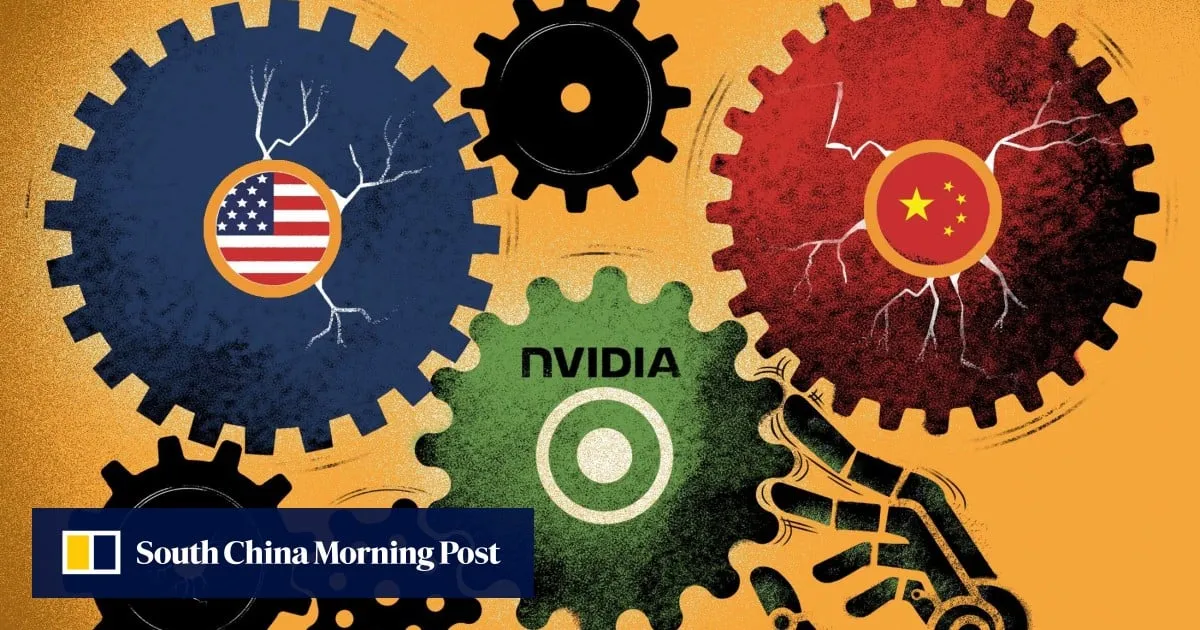
There was a surprise guest speaker at Nvidia’s widely watched GPU Technology Conference (GTC) in San Jose, California, last month: Yang Zhilin, the founder of Beijing-based Moonshot AI, the developer behind the Kimi family of foundational artificial intelligence models.Amid heated rhetoric about US-China AI competition, which some have likened to an “arms race”, the participation of a Chinese AI start-up’s CEO at the flagship event of American chipmaking giant Nvidia might have struck some as odd.Yang, a 30-something doctoral graduate of Pittsburgh’s Carnegie Mellon University from Shantou, Guangdong province, delivered an almost identical presentation less than two weeks later at China’s state-backed Zhongguancun Forum in Beijing, where attendees included Beijing Mayor Yin Yong and Ding Xuexiang, a member of the Politburo Standing Committee – the Communist Party’s highest decision-making body.Kyle Chan, a fellow at the Washington-based Brookings Institution think tank, said it was the latest example of new forms of convergence emerging between the AI ecosystems in the United States and China, even as geopolitical tensions tried to pull them apart.“There’s many different cross-cutting factors and interests that are pulling in either direction,” he said. “Even among the US companies themselves, they have very different perspectives and views on Chinese AI and competition.”Nvidia was a key driver of convergence as it stood to be its biggest beneficiary, Chan said. The company, the world’s leading designer of advanced semiconductor chips – the core hardware powering the global AI industry – announced at GTC a revenue outlook of at least US$1 trillion through to 2027, driven by exploding demand for its most advanced Blackwell and Rubin chips.Notably, the forecast did not include revenue from any potential sales of the advanced chips in the Chinese market. Since 2022, US export controls have restricted Nvidia from selling its most advanced chips in China, despite surging demand from Chinese tech giants.
SRCSouth China Morning Post
LANGEN
LEANCenter-Right
WORDS306
ENT12
SAT · 2026-04-04 · 02:00 GMTBRIEF NSR-2026-0404-51585
NSR-2026-0404-51585News Report·EN·Technology
Competition or ‘co-opetition’: how is convergence shaping AI race between China and US?
Despite US-China tensions, the AI ecosystems of both countries are showing signs of convergence. This was exemplified by the participation of Moonshot AI's founder at Nvidia's GPU Technology Conference in California, followed by a similar presentation in Beijing.
Vincent ChowSouth China Morning PostFiled 2026-04-04 · 02:00 GMTLean · Center-RightRead · 2 min
South China Morning PostFIG 01
Reading time
2min
Word count
306words
Sources cited
1cited
Entities identified
12entities
Quality score
100%
§ 01
Briefing Summary
AI-generatedNEWSAR · AI
Despite US-China tensions, the AI ecosystems of both countries are showing signs of convergence. This was exemplified by the participation of Moonshot AI's founder at Nvidia's GPU Technology Conference in California, followed by a similar presentation in Beijing. Nvidia, a major driver of this convergence, benefits from the global AI boom, projecting substantial revenue growth. However, US export controls restrict Nvidia from selling its most advanced chips in China, despite high demand. Experts suggest that conflicting interests and perspectives within US companies contribute to the complex dynamic of competition and cooperation in the AI sector between the two nations.
Confidence 0.90Sources 1Claims 5Entities 12
§ 02
Article analysis
Model · rule-basedFraming
Technology
Economic Impact
Tone
Measured
AI-assessed
CalmNeutralAlarmist
Factuality
0.70 / 1.00
Factual
LowHigh
Sources cited
1
Limited
FewMany
§ 03
Key claims
5 extracted01
Nvidia announced a revenue outlook of at least US$1 trillion through to 2027.
statistic
Confidence
1.00
02
US export controls restrict Nvidia from selling its most advanced chips in China since 2022.
factual
Confidence
1.00
03
Yang Zhilin presented at China’s state-backed Zhongguancun Forum in Beijing.
factual
Confidence
1.00
04
Yang Zhilin, founder of Moonshot AI, spoke at Nvidia's GTC in San Jose.
factual
Confidence
1.00
05
There's many different cross-cutting factors and interests that are pulling in either direction.
quoteKyle Chan
Confidence
0.90
§ 04
Full report
2 min read · 306 words§ 05
Entities
12 identifiedKey playerOppositionContextPositiveNeutralNegative
People4
Organizations4
§ 06
Keywords & salience
8 termsai competition
0.90
us-china relations
0.80
artificial intelligence
0.70
nvidia
0.70
semiconductor chips
0.60
convergence
0.50
export controls
0.50
moonshot ai
0.40
§ 07
Topic connections
Interactive graph Network visualization showing 51 related topics
View Full Graph Person Organization Location Event|Click node to navigate|Edge numbers = shared articles