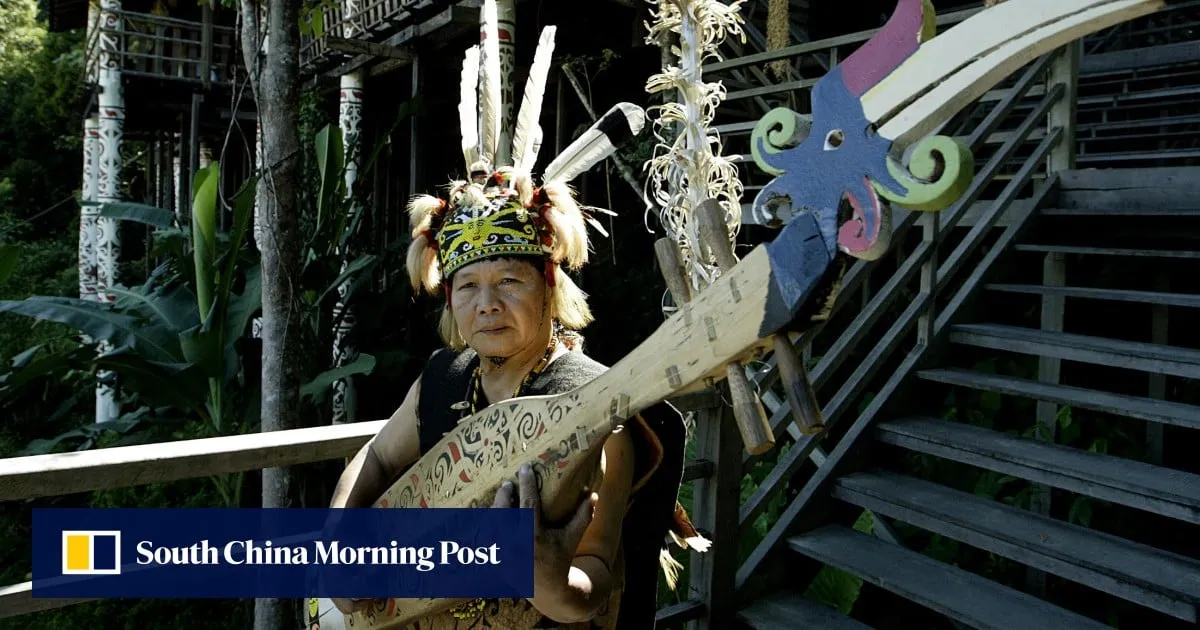
Among the stories Sarawak instrument craftsman Salomon Gau inherited from his elders is one that begins not with wood or strings but with spirits.He recalled being told how spirits first showed villagers how the earliest forms of the sape – a traditional carved wooden lute from Malaysian Borneo – should be made and played, at a time when the instrument was central to ceremonies, storytelling and social life.“The first one was the two-string version. The four-string one is already quite new, and the six-string contemporary version is very, very new,” he said.While a growing number of young musicians across the island have become drawn to playing the instrument in recent years, Gau and others warn the knowledge needed to make them is increasingly at risk.Closely associated with Sarawak’s Kenyah and Kayan communities, the sape is part of a wider family of boat-shaped lutes carved from a single block of local wood, including Sabah’s sundatang and Brunei’s kesapi.The sape, a Kenyah boat-shaped lute, is made out of a single piece of wood. Photo: Tuyang InitiativeRevival efforts have brought new performers and wider visibility, but practitioners say far fewer people are learning how to make the instruments, preserve older repertoires or carry forward the knowledge embedded in them.
SRCSouth China Morning Post
LANGEN
LEANCenter-Right
WORDS206
ENT7
SUN · 2026-04-05 · 02:30 GMTBRIEF NSR-2026-0405-52806
NSR-2026-0405-52806News Report·EN·Human Interest
Renewed interest in traditional Malaysian lutes comes with strings attached
Traditional Malaysian lutes, particularly the sape from Sarawak, are experiencing a resurgence in popularity among young musicians. The sape, historically central to ceremonies and storytelling for communities like the Kenyah and Kayan, is part of a family of boat-shaped lutes found across Borneo.
Ushar DanieleSouth China Morning PostFiled 2026-04-05 · 02:30 GMTLean · Center-RightRead · 1 min
South China Morning PostFIG 01
Reading time
1min
Word count
206words
Sources cited
1cited
Entities identified
7entities
Quality score
100%
§ 01
Briefing Summary
AI-generatedNEWSAR · AI
Traditional Malaysian lutes, particularly the sape from Sarawak, are experiencing a resurgence in popularity among young musicians. The sape, historically central to ceremonies and storytelling for communities like the Kenyah and Kayan, is part of a family of boat-shaped lutes found across Borneo. While performance of the instrument is increasing, concerns are growing that the traditional knowledge of crafting these instruments is at risk. Fewer individuals are learning the intricate skills needed to make the lutes, preserve traditional repertoires, and carry on the cultural knowledge associated with them. Efforts are underway to address this decline in craftsmanship and ensure the long-term preservation of this cultural heritage.
Confidence 0.90Sources 1Claims 5Entities 7
§ 02
Article analysis
Model · rule-basedFraming
Human Interest
Economic Impact
Tone
Measured
AI-assessed
CalmNeutralAlarmist
Factuality
0.70 / 1.00
Factual
LowHigh
Sources cited
1
Limited
FewMany
§ 03
Key claims
5 extracted01
The sape is part of a wider family of boat-shaped lutes carved from a single block of local wood.
factual
Confidence
1.00
02
The sape is closely associated with Sarawak’s Kenyah and Kayan communities.
factual
Confidence
1.00
03
Revival efforts have brought new performers and wider visibility.
factual
Confidence
0.90
04
Knowledge needed to make sapes is increasingly at risk.
quoteGau and others
Confidence
0.90
05
Spirits showed villagers how to make and play the earliest forms of the sape.
quoteSalomon Gau's elders
Confidence
0.80
§ 04
Full report
1 min read · 206 words§ 05
Entities
7 identifiedKey playerOppositionContextPositiveNeutralNegative
§ 06
Keywords & salience
10 termssape
1.00
traditional malaysian lutes
0.90
sarawak
0.70
cultural heritage
0.70
boat-shaped lutes
0.70
instrument craftsman
0.60
revival efforts
0.60
musical instrument
0.60
kayan
0.50
kenyah
0.50
§ 07
Topic connections
Interactive graph Network visualization showing 22 related topics
View Full Graph Person Organization Location Event|Click node to navigate|Edge numbers = shared articles