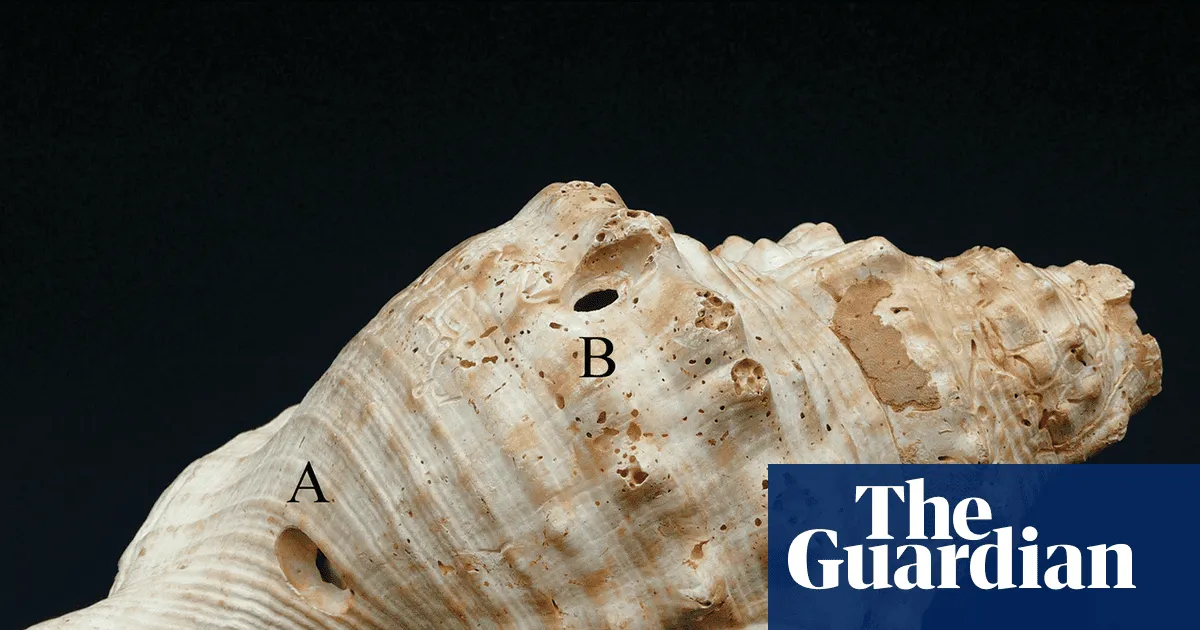
As a child, Miquel López García was fascinated by the conch shell, kept in the bathroom, that his father’s family in the southern Spanish region of Almería had blown to warn their fellow villagers of rising rivers and approaching flood waters.The hours he spent getting that “characteristically potent sound out of it” paid off last year when the archaeologist, musicologist and professional trumpet player pressed his lips to eight conch-shell trumpets. Their tones, he says, could carry insights into the lives of the people who lived in north-east Spain 6,000 years ago.In an article co-authored with his colleague Margarita Díaz-Andreu, the University of Barcelona researcher argues that 12 large shell trumpets found in Neolithic settlements and mines in Catalonia – and dated to between the late fifth and early fourth millennia BC – may have been used as long-distance communication devices and as rudimentary musical instruments.The fact that the shells appeared to have been collected after the Charonia lampas sea snails within them had died suggests they had been gathered for non-culinary purposes, just as the removal of the pointed tip of the shells indicates they were used as trumpets.The removal of the pointed tip of the shells indicates they were used as trumpets. Photograph: University of BarcelonaTo put their theories to the test, the pair obtained permission to conduct acoustic experiments on the eight shell trumpets, which are sufficiently intact to produce sound. In November 2024, López García coaxed a “really powerful, stable tone” from the shells.“It’s quite amazing that you get that very recognisable tone from a simple instrument that is just a very slightly modified animal body,” he says. “I think the closest instrument today in terms of tone is the french horn.”But he and Díaz-Andreu, a research professor at the Catalan Institution for Research and Advanced Studies who is also based at the University of Barcelona, wanted to go beyond single tones and determine the shells’ full musical potential.“We wanted to see if any of the pieces we played had room for improvisation or for the exploration of sound resources,” says López García. “So we made recordings of the small improvisations we played on these instruments. We realised that by doing different things, we could shape the tone of how the shell sounded and also the notes.”By putting his hand into the opening of the shells, he found he could change and lower their tone, while blowing in with a t-sound or an r-sound also changed the timbre.“These are basically among the first instruments – or pieces of sound technology – that we know of throughout all human history,” he says. “They work by the vibrations of your lips and the way you produce sound with them is very similar to modern-day brass instruments, such as trumpets and trombones; the shells are their most ancient ancestors.”In their article, published in the journal Antiquity, he and Díaz-Andreu posit that the shell trumpets may have been used “as communication tools, either between different communities inhabiting the region, or between these settlements and individuals working in the surrounding agricultural landscape”. They suggest the conches could also have been used by workers in different galleries of the variscite mines where six of the shells were found.“We know that this is one of the oldest and longest-surviving sound-producing technologies known to humans – at least on the continent of Europe,” says López García. “The oldest conch shell trumpet with practically identical characteristics to the ones found in Catalonia was found in the Marsoulas Cave in the south of France, which is an Upper Palaeolithic cave, and it’s been dated to about 18,000BC. So you’ve had almost identical instruments being used from 18,000 years ago, right through until the middle of the last century, when my family was using their conch shell in Almería.”Like the Marsoulas conch – which lay forgotten for more than 80 years in a museum collection before it was found to have been modified by its prehistoric owners to be used as a wind instrument – the Catalan shells’ “expressive qualities also hint at broader musical applications”.As López García puts it: “While these instruments have had a very utilitarian function ethnographically, they’re also instruments with sufficient melodic capacity to provide an expressive musical function. We think it’s plausible that beyond their utilitarian and pragmatic use, these instruments could also have been used for expressive discourses; they could meet the minimum requirements for developing music and developing expression.”The trumpeter, who plays everything from brass band music and Dixieland jazz to salsa, funk and Catalan folk music, says the ancient shells have led him to reflect on how and why humans first came to play instruments.“The whole debate about to what extent music is a utilitarian matter and to what extent it’s an aesthetic, expressive, emotional, much more personal matter, has always really fascinated me,” he says.“These shell trumpets have made me think about what the origin of humans’ musical expression was. Was it a question of necessity and of survival, as has been argued in some studies about the evolution of music? Or was it a question of other kinds of needs that are also important to humans – the less human material need to express ourselves, to create bonds and to show our love and feelings within groups?”
SRCThe Guardian - World News
LANGEN
LEANCenter-Left
WORDS880
ENT3
TUE · 2025-12-02 · 05:00 GMTBRIEF NSR-2025-1202-533
NSR-2025-1202-533News Report·EN·Human Interest
Shells found in Spain could be among oldest known musical instruments
Researchers in Spain are studying 12 large shell trumpets discovered in Neolithic settlements and mines in Catalonia, dating back to between the late fifth and early fourth millennia BC. Led by Miquel López García and Margarita Díaz-Andreu from the University of Barcelona, the team believes these shells, found in north-east Spain, may be among the oldest known musical instruments.
Sam Jones in MadridThe Guardian - World NewsFiled 2025-12-02 · 05:00 GMTLean · Center-LeftRead · 4 min
The Guardian - World NewsFIG 01
Reading time
4min
Word count
880words
Sources cited
2cited
Entities identified
3entities
Quality score
100%
§ 01
Briefing Summary
AI-generatedNEWSAR · AI
Researchers in Spain are studying 12 large shell trumpets discovered in Neolithic settlements and mines in Catalonia, dating back to between the late fifth and early fourth millennia BC. Led by Miquel López García and Margarita Díaz-Andreu from the University of Barcelona, the team believes these shells, found in north-east Spain, may be among the oldest known musical instruments. The shells, identified as Charonia lampas sea snails, appear to have been collected for non-culinary purposes, with their tips removed to function as trumpets. Acoustic experiments conducted on eight intact shells produced stable tones, similar to a french horn, suggesting their use for long-distance communication and musical expression. Researchers are exploring the shells' musical potential, noting the ability to shape the tone and notes through improvisation.
Confidence 0.90Sources 2Claims 5Entities 3
§ 02
Article analysis
Model · rule-basedFraming
Human Interest
Technology
Tone
Measured
AI-assessed
CalmNeutralAlarmist
Factuality
0.80 / 1.00
Factual
LowHigh
Sources cited
2
Limited
FewMany
§ 03
Key claims
5 extracted01
12 large shell trumpets found in Neolithic settlements and mines in Catalonia dated to between the late fifth and early fourth millennia BC.
factualUniversity of Barcelona researcher
Confidence
1.00
02
The shells work by the vibrations of your lips and the way you produce sound with them is very similar to modern-day brass instruments.
quoteMiquel López García
Confidence
0.90
03
These are basically among the first instruments – or pieces of sound technology – that we know of throughout all human history.
quoteMiquel López García
Confidence
0.90
04
The shells appeared to have been collected after the Charonia lampas sea snails within them had died, suggesting non-culinary purposes.
factualUniversity of Barcelona researcher
Confidence
0.90
05
The removal of the pointed tip of the shells indicates they were used as trumpets.
factualUniversity of Barcelona researcher
Confidence
0.80
§ 04
Full report
4 min read · 880 words§ 05
Entities
3 identifiedKey playerOppositionContextPositiveNeutralNegative
Organizations1
§ 06
Keywords & salience
9 termsmusical instruments
1.00
shell trumpets
0.90
archaeology
0.70
ancient music
0.70
sound
0.60
neolithic
0.60
catalonia
0.50
communication devices
0.50
acoustic experiments
0.40
§ 07
Topic connections
Interactive graph No topic relationship data available yet. This graph will appear once topic relationships have been computed.