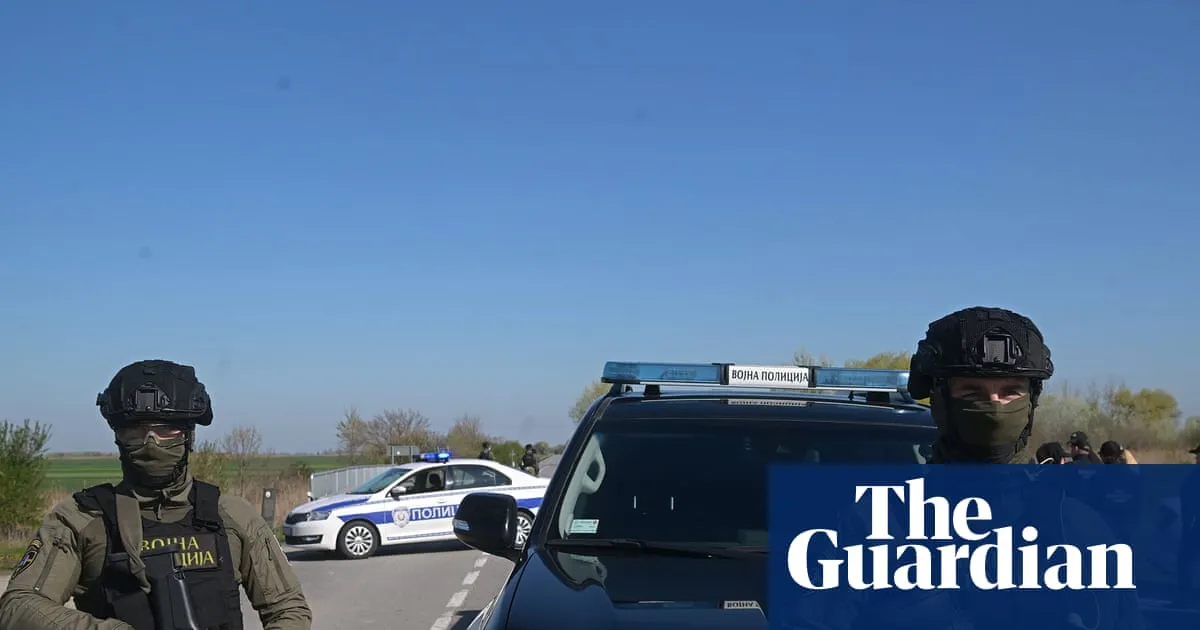
Serbia has said it found “explosives of devastating power” near a pipeline that carries Russian natural gas to Hungary and beyond, sparking claims by Hungary’s leading opposition candidate of a possible “false flag” operation aimed at influencing the country’s elections.On Sunday, Hungary’s prime minister, Viktor Orbán, said he had been informed by Serbia’s president, Aleksandar Vučić, of the discovery near an extension of the Turkstream Pipeline, which transports Russian gas through the Balkans to central and eastern Europe.“An investigation is under way,” Orbán said on social media, adding that he had convened an emergency meeting of the country’s defence council.The incident comes one week before Hungarians are due to cast their votes in a pivotal parliamentary election, in which Orbán’s 16-year hold on power is facing an unprecedented challenge from Péter Magyar, a former top member of the ruling Fidesz party.The election has pitted two versions of Hungary’s future against each other, as Orbán and Fidesz seek to convince voters that the war in Ukraine poses a deep threat to the country and that Orbán is best placed to handle this risk, while Magyar and his Tisza Party urge voters to focus on economic stagnation, fraying social services and corruption.Vučić said on Sunday that the Serbian army and police had found two backpacks containing “two large packages of explosives with detonators” in the northern Serbian municipality of Kanjiža, “a few hundred metres from the gas pipeline”.He said he had informed Orbán of the initial results of the investigation into what he described as a “threat to the critical gas infrastructure”. The explosives could have “endangered many lives” and caused significant damage to the pipeline, Vučić added.He did not detail the origins of the explosives, saying instead that there were “certain traces” he could not disclose. “Our intelligence services did a good job,” he said.Péter Magyar in Budapest last month. Photograph: Bernadett Szabó/ReutersThe incident, coming as Orbán trails in the polls, prompted political scrutiny across Hungary. On Sunday, Magyar said on social media that he and the Tisza Party had been warned by multiple sources that something might happen in Serbia around Easter, “possibly involving a gas pipeline”, and allegedly carried out with Serbian and Russian assistance. “And now it has,” he said.He called on Orbán’s government to stop spreading panic and causing disruption. “Hungarians have every reason to fear that the outgoing prime minister, following the advice of Russian agents, is attempting to instil fear in his own people through false-flag operations,” he said. “I also want to make it clear that he will not be able to prevent next Sunday’s election.”The scepticism was echoed by Mujtaba Rahman, the managing director for Europe at Eurasia Group, a political risk consultancy. “Looks like a seemingly convenient threat of terrorist action,” he said on social media. “Designed to whip up further fear of military action against Hungary, for which Ukraine will no doubt be blamed.”The campaign heated up in February after Orbán claimed, without providing evidence, that Ukraine was plotting to disrupt Hungary’s energy system and said he had dispatched troops to safeguard the country’s energy infrastructure.Orbán has also repeatedly accused Ukraine of intentionally delaying repairs to the Soviet-era Druzhba pipeline, which brings Russian oil to Hungary and Slovakia via Ukraine, and blocked EU approval of a €90bn loan to Ukraine over the feud.Rahman said Brussels and EU capitals “have been expecting a false-flag operation by Orbán – citing a national security risk – as grounds to postpone next Sunday’s elections that he looks set to lose. Could this be it?”On Sunday, Hungary’s foreign minister, Péter Szijjártó, singled out Ukraine but stopped short of blaming them outright for the latest incident.“In the past few days and weeks, the Ukrainians organised an oil blockade against us, and then tried to put us under a total energy blockade … And now we have today’s incident,” he said in a post on Facebook.Viktor Orbán greets supporters at a campaign rally in Győr last month. Photograph: Bernadett Szabó/ReutersOrbán, posting on social media after the defence council meeting, said that what was so far known of the incident pointed to a prepared “act of sabotage”. While he did not directly blame Ukraine for the incident, he said: “Ukraine has been for years trying to cut off Europe from Russian energy.”Ukraine’s foreign ministry said on Sunday that it rejected any attempt to link Kyiv to the incident. “Ukraine has nothing to do with this,” it said on social media, adding that it had most probably been “a Russian false-flag operation as part of Moscow’s heavy interference in Hungarian elections”.Ákos Hadházy, a Hungarian independent MP and longtime critic of Orbán, cast doubt on the news from Serbia. “This is completely transparent and pathetic,” he wrote on social media.“But let’s not forget that propaganda still works,” he added. “Nor should we forget that next week, quite brutal things could come from the struggling regime.”Szabolcs Panyi, one of the country’s most prominent investigative journalists, also urged people to treat Sunday’s revelations with caution. Weeks earlier, he and other journalists had been told by sources in Hungarian government circles of a “Russia-backed false flag attack in Serbia targeting the gas pipeline to Hungary”, Panyi said on social media.The Serbian claims could rock the final days of the campaign, just as the White House gears up to have JD and Usha Vance visit the country in an apparent effort by the US vice-president to bolster Orbán in the polls. The US administration has long rallied behind Orbán, with Donald Trump repeatedly endorsing him and describing him as a “fantastic guy” and a “strong, powerful leader.”In recent weeks, questions have swirled about the US effort to keep Orbán in power, particularly as Russia appears to also be working to sway the election in Orbán’s favour.The Washington Post reported recently that Russian intelligence operatives had proposed staging an assassination attempt on Orbán to boost his chances of winning, while the Guardian found that disinformation networks with links to Russia were publishing content aimed at undermining Orbán’s main opponent.
SRCThe Guardian - World News
LANGEN
LEANCenter-Left
WORDS1 003
ENT12
SUN · 2026-04-05 · 17:13 GMTBRIEF NSR-2026-0405-53761
NSR-2026-0405-53761News Report·EN·Political Strategy
Hungarian PM faces ‘false flag’ claims after Serbia says explosives found near pipeline
Serbian authorities discovered explosives near the TurkStream pipeline, which carries Russian natural gas to Hungary, prompting an investigation and raising concerns about potential threats to critical infrastructure. Serbian President Vučić informed Hungarian Prime Minister Orbán about the discovery in northern Serbia, a week before Hungary's parliamentary elections.
Ashifa Kassam in Budapest and agenciesThe Guardian - World NewsFiled 2026-04-05 · 17:13 GMTLean · Center-LeftRead · 5 min
The Guardian - World NewsFIG 01
Reading time
5min
Word count
1 003words
Sources cited
4cited
Entities identified
12entities
Quality score
100%
§ 01
Briefing Summary
AI-generatedNEWSAR · AI
Serbian authorities discovered explosives near the TurkStream pipeline, which carries Russian natural gas to Hungary, prompting an investigation and raising concerns about potential threats to critical infrastructure. Serbian President Vučić informed Hungarian Prime Minister Orbán about the discovery in northern Serbia, a week before Hungary's parliamentary elections. Orbán convened an emergency defense council meeting in response. The incident has sparked political scrutiny in Hungary, with opposition leader Péter Magyar suggesting it could be a "false flag" operation to influence the upcoming election. Magyar claims to have received warnings about a potential incident involving the pipeline, possibly with Serbian and Russian involvement.
Confidence 0.90Sources 4Claims 5Entities 12
§ 02
Article analysis
Model · rule-basedFraming
Political Strategy
National Security
Tone
Mixed Tone
AI-assessed
CalmNeutralAlarmist
Factuality
0.70 / 1.00
Factual
LowHigh
Sources cited
4
Well sourced
FewMany
§ 03
Key claims
5 extracted01
The incident comes one week before Hungarians are due to cast their votes in a pivotal parliamentary election.
factual
Confidence
1.00
02
Viktor Orbán said he was informed by Serbia’s president of the discovery.
quoteViktor Orbán
Confidence
1.00
03
Vučić said the Serbian army and police had found two backpacks containing “two large packages of explosives with detonators”.
quoteVučić
Confidence
0.90
04
Serbia found “explosives of devastating power” near a pipeline that carries Russian natural gas to Hungary.
factualSerbia
Confidence
0.90
05
Péter Magyar said he had been warned that something might happen in Serbia around Easter, possibly involving a gas pipeline.
quotePéter Magyar
Confidence
0.80
§ 04
Full report
5 min read · 1 003 words§ 05
Entities
12 identifiedKey playerOppositionContextPositiveNeutralNegative
People3
§ 06
Keywords & salience
10 termsgas pipeline
0.90
explosives
0.90
false flag
0.80
hungarian election
0.80
viktor orbán
0.70
serbia
0.70
turkstream pipeline
0.60
aleksandar vučić
0.60
péter magyar
0.50
political scrutiny
0.40
§ 07
Topic connections
Interactive graph Network visualization showing 10 related topics
View Full Graph Person Organization Location Event|Click node to navigate|Edge numbers = shared articles