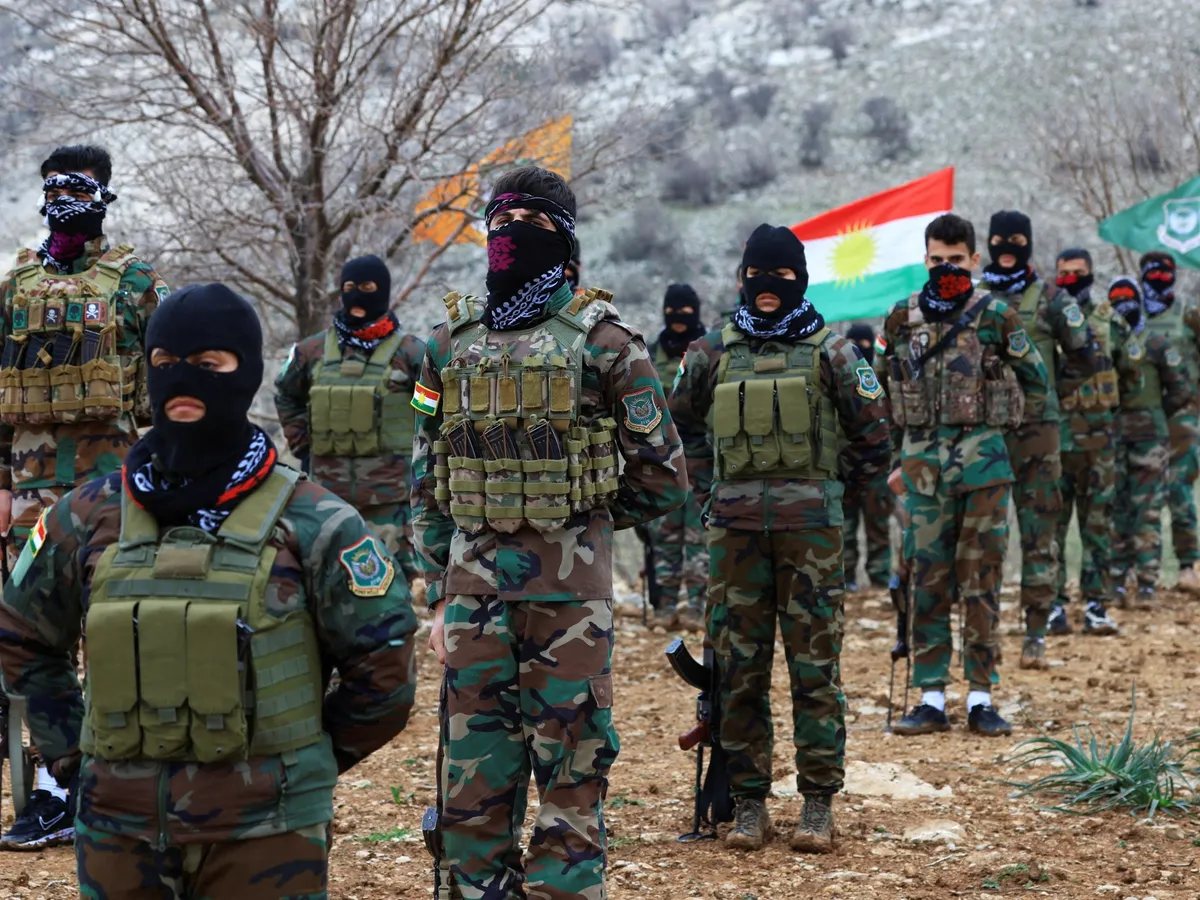
EXPLAINERUS president says Washington armed Kurdish Iranian opposition groups during the January demonstrations. That lends credence to Iran’s claims that the protests were foreign-inspired.Iranian Kurdish fighters from the Kurdistan Freedom Party take part in a training session at a base on the outskirts of Erbil, Iraq, on February 12, 2026 [Thaier Al-Sudani/Reuters]Published On 6 Apr 2026United States President Donald Trump says Washington had armed Iranian opposition groups and protesters during mass antigovernment demonstrations in December and January, in which thousands of people were killed during crackdowns by government forces.Speaking with Trey Yingst on Fox News in a Sunday morning phone interview, the president said the US had been directly involved in efforts to destabilise and overthrow the Iranian government weeks before strikes were launched on February 28 by the US and Israel across Iran and as American negotiators were engaging with senior Iranian officials in Europe.Recommended Stories list of 4 itemslist 1 of 4Trump says US armed Iranian dissidents via Kurds weeks before launching warlist 2 of 4Trump threatens Iran in expletive-filled social media postlist 3 of 4Israel continues deadly attacks on Gaza while striking Iran, Lebanonlist 4 of 4Is war more profitable than peace? David Keen explainsend of listAs the US-Israel war on Iran entered its 38th day, at least 2,076 people have been killed in Iran and 26,000 injured.“President Trump told me the United States sent guns to the Iranian protesters,” Yingst reported on Fox News channel.“He told me, ‘We sent them a lot of guns. We sent them to the Kurds.’ And the president says he thinks the Kurds kept them. He went on to say. ‘We sent guns to the protesters, a lot of them.’”Trump has often framed the decision to strike Iran alongside Israel as partly inspired by his wanting to “free” Iranians from the rule of the Islamic Republic after it cracked down on those protests in January.But his statements to Yingst could lend weight to Tehran’s own assertions that the protests were not organic and “foreign-backed terrorists” had instigated them. Still, analysts warned that Trump’s frequently shifting statements on Iran mean that it is hard to know with certainty the extent to which the US might have been involved in the protests.Here’s what we know:Protesters march against the government in Iran on January 24, 2026, in Berlin, Germany [Omer Messinger/Getty Images]What happened during the protests?Demonstrations started on December 28 among shopkeepers in downtown Tehran who were angry about a deepening economic crisis and the falling value of the Iranian rial.Soon, they spread to big and small cities across the country, morphing into nationwide demonstrations as hundreds of thousands of people of all ages took to the streets. Some protesters by then had begun to call for a change in the government.Rights groups said Iranian authorities cracked down on the protests, especially on January 8 and 9. Thousands of people, most of them young Iranians, were reportedly killed from gunshots and stab wounds, and tens of thousands of others were arrested.Iranian authorities also cut off the internet “to conceal their crimes”, according to Amnesty International, throwing the country into an information blackout for days.United Nations Special Rapporteur on Iran Mai Soto said at least 5,000 people were killed and the real death toll could be as high as 20,000.At least four people have since been executed in connection with the protests, according to Amnesty, with several more people on death row.The protests were the largest since the September 2022 women’s rights demonstrations that followed the death of Mahsa Amini in police custody. She had been arrested for not properly covering her hair. Amini’s death sparked nationwide demonstrations. Authorities were then also accused of firing at protesters and arresting and eventually executing some of them.What did the Iranian government say?Then-Supreme Leader Ali Khamenei said in a rare acknowledgement on January 17 that “several thousands” of people were killed in the protests after days of official hedging on casualty numbers as bodies piled up.However, Khamenei blamed the deaths not on Iranian forces but on US- and Israel-backed groups that he said had hijacked the economic protests.Khamenei accused Trump of being a “criminal” and of being personally involved in the instigation.Tehran has long blamed its enemies, the US and Israel, for fomenting domestic crises, but alleged this time that the US involvement was deeper than usual.“Those linked to Israel and the US caused massive damage and killed several thousands” during the protests that shook Iran for more than two weeks, Khamenei was quoted as saying by state media.“The latest anti-Iran sedition was different in that the US president personally became involved,” he added.Iranian officials later admitted the death toll was about 5,000, including at least 500 security personnel killed by “terrorists and armed rioters”.An unnamed Iranian official told the Reuters news agency most of the violence and deaths occurred in Kurdish territory in northwestern Iran. That area has long been home to Kurdish separatists and has often recorded unrest.The Iraq-Iran border crossing of Bashmaq near Sulaimaniyah in northern Iraq’s semiautonomous Kurdish region on March 11, 2026 [AFP]What did the US government say about the protests?About a week into the crisis, Trump warned Iran against targeting protesters.“If Iran sho[o]ts and violently kills peaceful protesters, which is their custom, the United States of America will come to their rescue,” Trump posted on his Truth Social platform without giving details about what a “rescue” would look like.“We are locked and loaded and ready to go,” the president added.Then on January 13, he wrote, “Help is on its way,” appearing to address Iranian demonstrators. He urged them to “take over your institutions” while issuing threats to Iranian authorities if protesters were killed.Trump’s warnings to Tehran came after the US bombed three of Iran’s most important nuclear sites during Israel’s 12-day war on Iran in June. Trump said then that the strikes “obliterated” Tehran’s nuclear capabilities. Iran launched retaliatory strikes on US military assets deployed at a base in Qatar.After Trump confirmed on February 28 that the US and Israel had launched strikes on Iran, he said the primary goal of the war was to eliminate Iran’s nuclear weapons.He also linked the action to the January protests.Tehran had “killed tens of thousands of its own citizens on the street as they protested”, Trump said. The US was now “giving you what you want”, he said, addressing Iranians he said had been calling for US intervention.Are Trump’s actions and words impacting the Iranian opposition?Several Iranian Kurdish groups on Sunday denied Trump’s claims of arming them during the December and January protests.Iranian Kurdish groups have long opposed the government in Tehran and are seeking self-determination. They share close ties with Iraqi Kurds, who successfully fought for a semiautonomous region decades ago. Many operate along the Iraq-Iran border and in northern Iraq.While they’ve long been fractured, several of the Iranian Kurdish groups banded together in a coalition days before the US and Israel launched the war.In its first week, Tehran began hitting Kurdish positions in Iraq after US media reported that some Kurdish opposition leaders were speaking with Trump.At the time, analysts speculated the US could be trying to support Iranian Kurds to seize parts of Iran bordering Iraq. The aim, they said, could be to create a buffer area that would allow invading Israeli or US ground forces to move in from Iraq.However, so far, neither Israel nor the US has launched ground attacks. Opposition Democrats in the US Congress have spoken out against the war and have particularly opposed US ground troops being sent into Iran although the Trump administration has not entirely ruled it out.
SRCAl Jazeera
LANGEN
LEANCenter
WORDS1 263
ENT9
MON · 2026-04-06 · 11:52 GMTBRIEF NSR-2026-0406-54765
NSR-2026-0406-54765News Report·EN·National Security
Has Trump confirmed Iran’s claim that protesters were US-armed?
In April 2026, US President Donald Trump stated in an interview that the US had armed Iranian opposition groups and protesters during anti-government demonstrations in December 2025 and January 2026. Trump claimed the US sent guns to Kurdish groups, some of which he believes were kept by the Kurds.
Shola LawalAl JazeeraFiled 2026-04-06 · 11:52 GMTLean · CenterRead · 6 min
Al JazeeraFIG 01
Reading time
6min
Word count
1 263words
Sources cited
2cited
Entities identified
9entities
Quality score
100%
§ 01
Briefing Summary
AI-generatedNEWSAR · AI
In April 2026, US President Donald Trump stated in an interview that the US had armed Iranian opposition groups and protesters during anti-government demonstrations in December 2025 and January 2026. Trump claimed the US sent guns to Kurdish groups, some of which he believes were kept by the Kurds. These statements were made weeks before the US and Israel launched strikes on Iran in February 2026. The US-Israel war on Iran has resulted in thousands of deaths and injuries. Trump's admission could support Iran's claim that the protests were instigated by foreign-backed terrorists, though analysts caution about the certainty of US involvement due to Trump's inconsistent statements on Iran.
Confidence 0.90Sources 2Claims 5Entities 9
§ 02
Article analysis
Model · rule-basedFraming
National Security
Political Strategy
Tone
Mixed Tone
AI-assessed
CalmNeutralAlarmist
Factuality
0.70 / 1.00
Factual
LowHigh
Sources cited
2
Limited
FewMany
§ 03
Key claims
5 extracted01
Demonstrations started on December 28 among shopkeepers in Tehran.
factualArticle's own claim
Confidence
1.00
02
The US and Israel launched strikes on Iran on February 28.
factualArticle's own claim
Confidence
1.00
03
Trump says the US armed Iranian opposition groups during demonstrations.
quoteDonald Trump
Confidence
1.00
04
At least 2,076 people have been killed in Iran and 26,000 injured in the war.
statisticArticle's own claim
Confidence
0.90
05
Thousands of people were killed during crackdowns by government forces.
factualArticle's own claim
Confidence
0.90
§ 04
Full report
6 min read · 1 263 words§ 05
Entities
9 identifiedKey playerOppositionContextPositiveNeutralNegative
§ 06
Keywords & salience
8 termsiran protests
0.90
donald trump
0.90
us involvement
0.80
armed opposition
0.70
destabilize iran
0.60
kurds
0.60
foreign-backed
0.50
us-israel war
0.50
§ 07
Topic connections
Interactive graph Network visualization showing 51 related topics
View Full Graph Person Organization Location Event|Click node to navigate|Edge numbers = shared articles