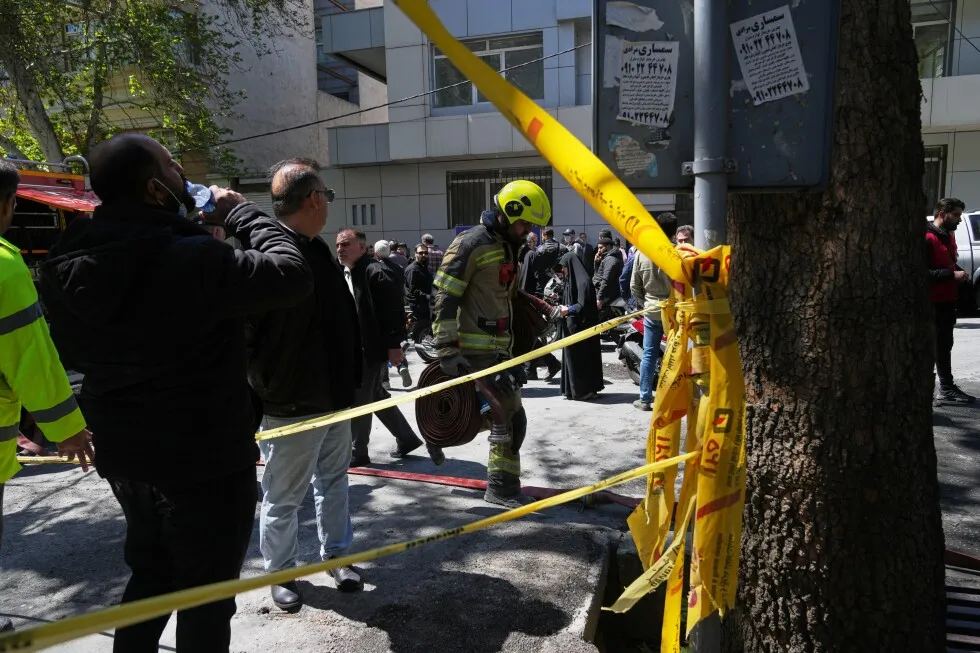
Iran calls for human chains around power plants as Trump’s deadline nears 1 of 6 | An Iranian official early Tuesday issued a video message calling on youths of the Islamic Republic to form “human chains” around power plants in the country ahead of threatened strikes by U.S. President Donald Trump. 2 of 6 | President Donald Trump said Monday he’s “not at all” concerned about committing possible war crimes as he continued to threaten the destruction of Iran’s bridges and power plants if they don’t meet his Tuesday 8 p.m. ET deadline to reopen the Strait of Hormuz. 3 of 6 | President Donald Trump departs after speaking with reporters during a news conference in the James Brady Press Briefing Room at the White House, Monday, April 6, 2026, in Washington. (AP Photo/Julia Demaree Nikhinson) 4 of 6 | A man inspects the damage to cars and an apartment building struck by an Iranian missile in Ramat Gan, Israel, Monday, April 6, 2026. (AP Photo/Oded Balilty) 5 of 6 | Displaced people wait to receive donated food beside the tents they use as shelters after fleeing Israeli bombardment in southern Lebanon, in Beirut, Lebanon, Monday, April 6, 2026. (AP Photo/Emilio Morenatti) 6 of 6 | People drive their motorbikes past a billboard that shows a graphic depicting Iran’s Supreme Leader Ayatollah Mojtaba Khamenei in downtown Tehran, Iran, Monday, April 6, 2026. (AP Photo/Vahid Salemi) 1 of 6 An Iranian official early Tuesday issued a video message calling on youths of the Islamic Republic to form “human chains” around power plants in the country ahead of threatened strikes by U.S. President Donald Trump. Add AP News on Google Add AP News as your preferred source to see more of our stories on Google. 2 of 6 President Donald Trump said Monday he’s “not at all” concerned about committing possible war crimes as he continued to threaten the destruction of Iran’s bridges and power plants if they don’t meet his Tuesday 8 p.m. ET deadline to reopen the Strait of Hormuz. Add AP News on Google Add AP News as your preferred source to see more of our stories on Google. 3 of 6 President Donald Trump departs after speaking with reporters during a news conference in the James Brady Press Briefing Room at the White House, Monday, April 6, 2026, in Washington. (AP Photo/Julia Demaree Nikhinson) Add AP News on Google Add AP News as your preferred source to see more of our stories on Google. 4 of 6 A man inspects the damage to cars and an apartment building struck by an Iranian missile in Ramat Gan, Israel, Monday, April 6, 2026. (AP Photo/Oded Balilty) Add AP News on Google Add AP News as your preferred source to see more of our stories on Google. 5 of 6 Displaced people wait to receive donated food beside the tents they use as shelters after fleeing Israeli bombardment in southern Lebanon, in Beirut, Lebanon, Monday, April 6, 2026. (AP Photo/Emilio Morenatti) Add AP News on Google Add AP News as your preferred source to see more of our stories on Google. 6 of 6 People drive their motorbikes past a billboard that shows a graphic depicting Iran’s Supreme Leader Ayatollah Mojtaba Khamenei in downtown Tehran, Iran, Monday, April 6, 2026. (AP Photo/Vahid Salemi) Add AP News on Google Add AP News as your preferred source to see more of our stories on Google. Updated [hour]:[minute] [AMPM] [timezone], [monthFull] [day], [year] DUBAI, United Arab Emirates (AP) — Airstrikes across Iran killed at least 15 people on Tuesday, while Iran fired on Israel and Saudi Arabia, prompting the temporary closure of a major bridge. The attacks came as Iranian officials urged youths to form human chains around power plants to protect them, as the latest deadline set by U.S. President Donald Trump for Iran to reopen the Strait of Hormuz drew closer.Trump has threatened to bomb all of Iran’s power plants and bridges if Iran does not meet his Tuesday 8 p.m. EDT deadline to allow shipping traffic to fully resume through the strategic waterway, through which a fifth of the world’s oil transits in peacetime. “The entire country can be taken out in one night,” Trump said. Trump has repeatedly extended previous deadlines, but suggested this one was final, saying he’d already given Iran enough extra time. Israel’s military warned Iranians in Farsi to avoid taking trains throughout the day, likely telegraphing intended strikes on the rail network. “Your presence puts your life at risk,” the warning posted on X read.France joined a growing chorus of international voices calling for restraint, with Foreign Minister Jean-Noël Barrot saying attacks targeting civilian and energy infrastructure “are barred by the rules of war, international law.” “They would without doubt trigger a new phase of escalation, of reprisals, that would drag the region and the world economy into a vicious circle that would be very worrying and, most of all, very damaging to our own interests,” the minister said on France Info television. Iran choked off shipping through the strait after Israel and the U.S. attacked on Feb. 28, starting the war. On Monday, Tehran rejected a 45-day ceasefire proposal and said it wants a permanent end to the war.Early Tuesday, Tehran launched seven ballistic missiles at Saudi Arabia, which authorities said rained debris on the ground near energy facilities as they were intercepted. Defense Ministry spokesman Maj. Gen. Turki al-Malki said the damage was being assessed. The attacks prompted Saudi Arabia to close the King Fahd Causeway, a bridge that links Saudi Arabia to the island kingdom of Bahrain for several hours. The 25-kilometer (15.5 mile) bridge is the only connection by road for Bahrain, home to the U.S. Navy’s 5th Fleet, to the Arabian Peninsula.Elsewhere, activists reported a new wave of strikes on Tehran, for which Israel later claimed responsibility. Nine people were killed in the city of Shahriar and six more in Pardis in other airstrikes, Iranian media reported.Iran also fired on Israel, with reports of incoming missiles in Tel Aviv and Eilat.Trump’s threats to bomb civilian infrastructure prompt warnings of war crimesIran’s attacks on the energy infrastructure of its Gulf Arab neighbors, coupled with its stranglehold on the Strait of Hormuz, has sent oil prices skyrocketing and is causing global economic problems.In early spot trading, Brent crude, the international standard, was above $111 per barrel, up more than 50% since the start of the war.Under growing pressure at home as consumers feel the pinch, Trump has demanded that Iran open the Strait of Hormuz to all shipping traffic or see power plants and bridges wiped out. The threat to hit civilian infrastructure has sparked widespread warnings about possible war crimes. New Zealand Prime Minister Christopher Luxon on Tuesday urged Trump not to follow through, saying the “focus needs to be on not seeing this conflict expand any further.”“Any of those actions including bombing bridges and reservoirs and civilian infrastructure would be unacceptable,” Luxon told Radio New Zealand.Iran sought to up the ante, calling on “all young people, athletes, artists, students and university students and their professors” to form human chains around power plants ahead of the threatened strikes. “Power plants that are our national assets and capital, regardless of any taste or political viewpoint, belong to the future of Iran and to the Iranian youth,” Alireza Rahimi, identified by Iranian state television as the secretary of the Supreme Council of Youth and Adolescents, said as he issued the video call in a newscast. Iran has formed human chains in the past around its nuclear sites at times of heightened tensions with the West. Later, a Revolutionary Guard general urged parents to send their children to man checkpoints, which have been repeatedly targeted in airstrikes.U.N. Secretary-General António Guterres warned the U.S. that attacks on civilian infrastructure are banned under international law, according to his spokesperson. Trump, speaking with reporters, said he’s “not at all” concerned about committing war crimes with such attacks. As the deadline neared, efforts were still underway to reach a negotiated solution. Even though Iran has rejected the latest proposal from the U.S., officials involved in the diplomacy say that talks are still ongoing. Death toll continues to rise across the regionMore than 1,900 people have been killed in Iran since the war began, but the government has not updated the toll for days.More than 1,400 people have been killed in Lebanon and more than 1 million people have been displaced. Eleven Israeli soldiers have died there.In Gulf Arab states and the occupied West Bank, more than two dozen people have died, while 23 have been reported dead in Israel and 13 U.S. service members have been killed.Japan said Tuesday that one of its citizens who had been detained in Iran since January had been released on bail. Chief Cabinet Secretary Minoru Kihara told reporters in Tokyo that Japan is demanding his full release from Iranian authorities.___Rising reported from Bangkok and Magdy reported from Cairo. Mari Yamaguchi in Tokyo, John Leicester in Paris and Rod McGuirk in Melbourne, Australia, contributed to this report. Gambrell is the news director for the Gulf and Iran for The Associated Press. He has reported from each of the Gulf Cooperation Council countries, Iran and other locations across the world since joining the AP in 2006. Rising covers regional Asia-Pacific stories for The Associated Press. He has worked around the world, including covering the wars in Iraq, Afghanistan and Ukraine, and was based for nearly 20 years in Berlin before moving to Bangkok. Magdy is a Middle East reporter for The Associated Press, based in Cairo. He focuses on conflict, migration and human rights abuses.
SRCAssociated Press (AP)
LANGEN
LEANCenter
WORDS1 610
ENT10
TUE · 2026-04-07 · 06:23 GMTBRIEF NSR-2026-0407-55886
NSR-2026-0407-55886News Report·EN·Conflict
Iran urges youths to protect power plants and Saudi Arabia closes bridge as Trump’s deadline nears
As President Trump's Tuesday evening deadline approaches, tensions rise between the U.S. and Iran.
By
JON GAMBRELL, DAVID RISING and SAMY MAGDYAssociated Press (AP)Filed 2026-04-07 · 06:23 GMTLean · CenterRead · 7 min
Associated Press (AP)FIG 01
Reading time
7min
Word count
1 610words
Sources cited
1cited
Entities identified
10entities
Quality score
100%
§ 01
Briefing Summary
AI-generatedNEWSAR · AI
As President Trump's Tuesday evening deadline approaches, tensions rise between the U.S. and Iran. An Iranian official issued a video message on Tuesday calling for Iranian youth to create "human chains" around power plants in anticipation of potential U.S. strikes. Trump stated on Monday that he was unconcerned about potential war crimes and threatened to destroy Iranian bridges and power plants if Iran did not reopen the Strait of Hormuz by the deadline. The situation unfolds amidst escalating conflict, as evidenced by damage from Iranian missiles in Israel and displacement in Lebanon.
Confidence 0.90Sources 1Claims 4Entities 10
§ 02
Article analysis
Model · rule-basedFraming
Conflict
National Security
Tone
Mixed Tone
AI-assessed
CalmNeutralAlarmist
Factuality
0.80 / 1.00
Factual
LowHigh
Sources cited
1
Limited
FewMany
§ 03
Key claims
4 extracted01
President Donald Trump said he’s “not at all” concerned about committing possible war crimes.
quotePresident Donald Trump
Confidence
1.00
02
Trump issued a Tuesday 8 p.m. ET deadline for Iran to reopen the Strait of Hormuz.
factualPresident Donald Trump
Confidence
1.00
03
President Trump threatened the destruction of Iran’s bridges and power plants.
factualPresident Donald Trump
Confidence
1.00
04
An Iranian official called on youths to form “human chains” around power plants.
factualIranian official
Confidence
1.00
§ 04
Full report
7 min read · 1 610 words§ 05
Entities
10 identifiedKey playerOppositionContextPositiveNeutralNegative
Organizations1
§ 06
Keywords & salience
8 termsiran
0.90
donald trump
0.80
power plants
0.80
threatened strikes
0.70
strait of hormuz
0.60
human chains
0.50
war crimes
0.50
bridges
0.40
§ 07
Topic connections
Interactive graph Network visualization showing 51 related topics
View Full Graph Person Organization Location Event|Click node to navigate|Edge numbers = shared articles