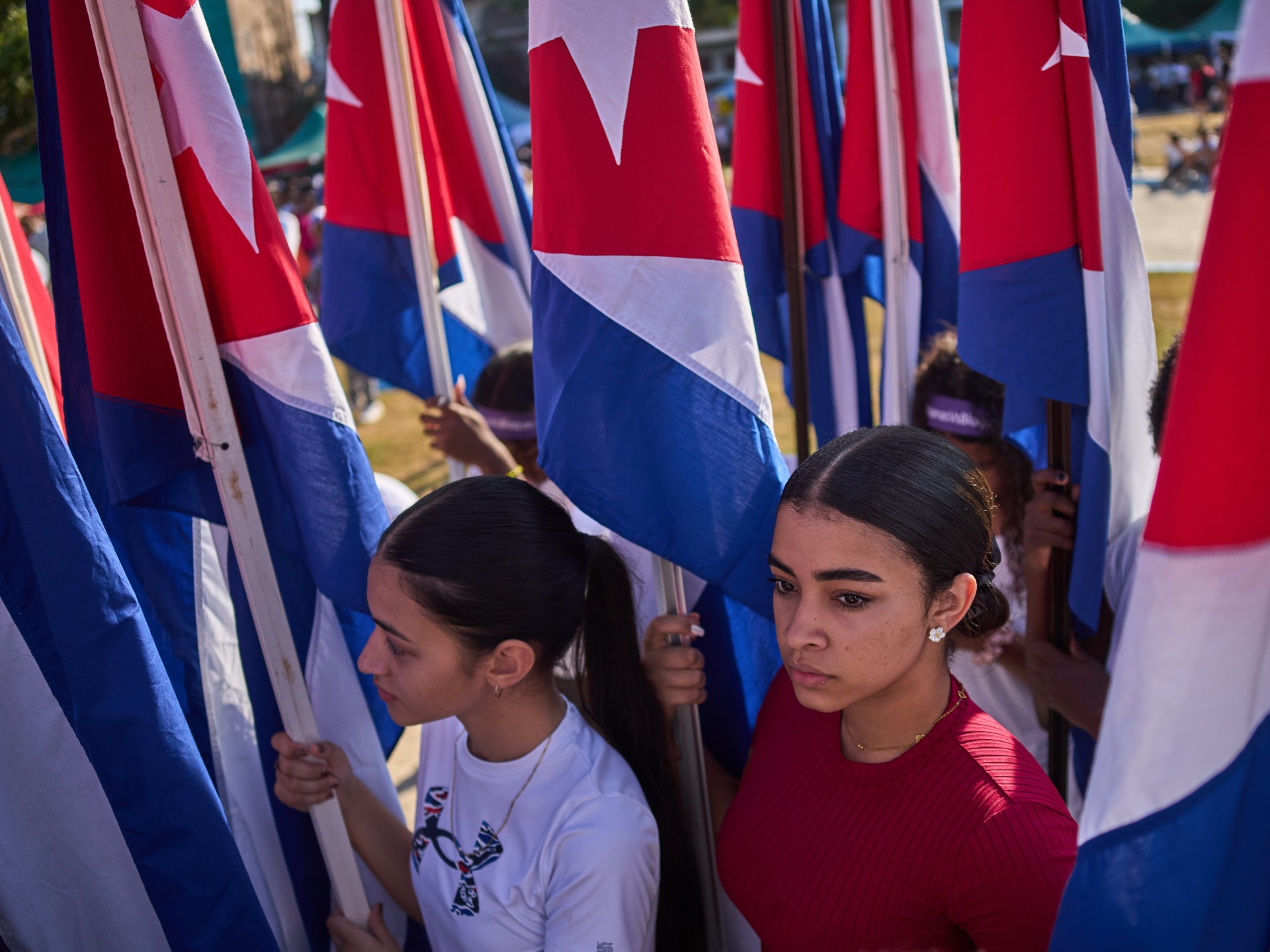
The Cuban government has led several protests in recent weeks to call on the US to allow oil to arrive to the island.Women in Havana attend a rally calling for the end of the US blockade against Cuba on April 7 [Ramon Espinosa/AP Photo]Published On 7 Apr 2026Hundreds of women marched in Cuba’s capital, Havana, to protest the de facto oil blockade and pressure campaign that the United States has imposed on the island.Banners and signs at Tuesday’s demonstration bore the slogan “Tumba el bloqueo” or “Tear down the blockade”. Many protesters waved Cuban flags, and some wore T-shirts with the hashtag #NoMasBloqueo or “No more blockade”.Recommended Stories list of 3 itemslist 1 of 3FBI agents from US arrive in Cuba to probe lethal speedboat shootinglist 2 of 3Russia sending second ship with oil to Cuba amid US blockadelist 3 of 3Cuba releases over 2,000 prisoners amid mounting US pressureend of listThe protest took place on what would have been the 96th birthday of the late Vilma Espin, a leader in the Cuban Revolution and a former first lady. She was the wife of Raul Castro and the sister-in-law of Fidel Castro, both presidents.Top officials in Cuba’s communist government led the demonstration, including Deputy Prime Minister Ines Maria Chapman and Deputy Foreign Minister Josefina Vidal.They denounced the US campaign against the Cuban government as a kind of collective punishment.“This policy of abuse has to stop,” Vidal told The Associated Press. “The Cuban people don’t deserve this. It’s the most comprehensive, all-encompassing, and longest-running system of coercive measures ever imposed against an entire country.”The women’s rally was held on the anniversary of former First Lady Vilma Espin’s birthday [Ramon Espinosa/AP Photo]A cap on foreign oilThe Cuban government has organised protests in recent weeks as a show of opposition to policies put in place under US President Donald Trump.Last Thursday, for instance, Cuban President Miguel Diaz-Canel joined demonstrators on bicycles and electric vehicles outside the US Embassy in Havana to denounce the US-led fuel shortage.Since January, the Trump administration has sought to cut Cuba off from its foreign oil imports, as part of a bid to destabilise its government.First, on January 11, Trump announced that Cuba would receive no more money or oil from its close regional ally Venezuela, following a US attack that culminated in the abduction and imprisonment of the South American country’s president, Nicolas Maduro.Then, on January 29, Trump issued an executive order announcing tariffs against any foreign government that attempted, whether directly or indirectly, to deliver oil to Cuba.Since then, Cuba’s foreign oil supply has effectively been severed. Only in the last couple of weeks has the blockade been eased slightly, when the Trump administration allowed the arrival of a Russian oil tanker in Havana’s harbour on March 30.According to the International Energy Agency, some 58 percent of Cuba’s energy production comes from oil, as of 2023. Another 23.6 percent comes from natural gas.While Cuba does produce some crude oil domestically, most of its oil supply comes from external sources. The International Energy Agency estimates that the country produces only 40.6 percent of its own oil supply, with 59.4 percent coming from abroad.With little foreign oil entering the country, Cuba has suffered at least two island-wide blackouts in the last month. Those outages come with deadly consequences, as hospitals and other critical infrastructure lose the power necessary for life-saving work.Russia has announced it plans to send a second oil tanker to Cuba, in defiance of the US blockade.Pressure on Cuba’s leadershipBut Trump has continued to apply pressure to the Cuban government, holding up the change in Venezuela’s leadership as an example he would like to replicate.Since Maduro’s abduction, Venezuela has been led by interim President Delcy Rodriguez, who has largely agreed to cooperate with US demands.Since February 28, the US has been embroiled in a war with Iran, but Trump has repeatedly warned that Cuba “is next” on his list of governments to confront. In March, Trump reiterated that stance on several occasions.“I do believe I’ll be the honour of — having the honour of taking of Cuba,” Trump told reporters from the Oval Office on March 16. “Whether I free it, take it, I think I can do anything I want with it, if you want to know the truth. They’re a very weakened nation right now.”Trump’s “maximum pressure” campaign began in his first term as president, from 2017 to 2021, and it includes heightened sanctions against the island.Already, since the 1960s, Cuba has faced a total trade embargo from the US over Cold War-era tensions.The US and Cuba have been in negotiations in recent weeks to lift the recent oil blockade, and Vidal addressed those talks in an interview during Tuesday’s march.“We are in a very preliminary, very initial phase, and there are still no structured negotiations between the two governments,” Vidal told the news agency AFP, adding that “Cuba has always believed in dialogue” over confrontation.Vidal had helped lead past negotiations that resulted in a brief detente under US President Barack Obama in 2015, shortly before Trump took office for his first term. In her remarks to AFP, Vidal contrasted the circumstances now with those previous negotiations.At the time, she said, “We worked to create a relationship that was not without differences, but that did not place those differences at the centre.”Tuesday’s demonstration comes a day after two progressive members of the US Congress, Pramila Jayapal of Washington state and Jonathan Jackson of Illinois, visited Cuba to meet President Diaz-Canel over the blockade.Upon receiving the US representatives, Diaz-Canel issued a statement saying he “denounced the criminal harm caused by the #blockade”, as well as the US’s “threats of even more aggressive actions”.For their part, Jayapal and Jackson issued a joint statement, calling on Trump, a Republican, to end the blockade, noting that the energy shortage has caused food to spoil, water pumps to stop working, and medical patients to go untreated.“We do not believe that the majority of Americans would want this kind of cruelty and inhumanity to continue in our name,” they wrote.
SRCAl Jazeera
LANGEN
LEANCenter
WORDS1 009
ENT12
TUE · 2026-04-07 · 20:44 GMTBRIEF NSR-2026-0407-57336
NSR-2026-0407-57336News Report·EN·Economic Impact
‘Policy of abuse’: Women march in Cuba against US energy blockade
On April 7, 2026, hundreds of women marched in Havana, Cuba, to protest the United States' oil blockade and pressure campaign against the island nation. The demonstration, led by Cuban government officials, coincided with the 96th birthday of Vilma Espin, a leader in the Cuban Revolution.
Al Jazeera StaffAl JazeeraFiled 2026-04-07 · 20:44 GMTLean · CenterRead · 5 min
Al JazeeraFIG 01
Reading time
5min
Word count
1 009words
Sources cited
3cited
Entities identified
12entities
Quality score
100%
§ 01
Briefing Summary
AI-generatedNEWSAR · AI
On April 7, 2026, hundreds of women marched in Havana, Cuba, to protest the United States' oil blockade and pressure campaign against the island nation. The demonstration, led by Cuban government officials, coincided with the 96th birthday of Vilma Espin, a leader in the Cuban Revolution. Protesters carried signs and banners denouncing the US policy, which they view as collective punishment. The Cuban government has organized several protests recently in response to the Trump administration's efforts since January to cut off Cuba's foreign oil imports, particularly from Venezuela, with the aim of destabilizing the Cuban government.
Confidence 0.90Sources 3Claims 5Entities 12
§ 02
Article analysis
Model · rule-basedFraming
Economic Impact
Political Strategy
Tone
Measured
AI-assessed
CalmNeutralAlarmist
Factuality
0.70 / 1.00
Factual
LowHigh
Sources cited
3
Well sourced
FewMany
§ 03
Key claims
5 extracted01
According to the International Energy Agency, some 58 percent of Cuba’s energy comes from foreign oil.
statisticInternational Energy Agency
Confidence
1.00
02
On January 29, Trump issued an executive order announcing tariffs against any foreign government that attempted to deliver oil to Cuba.
factual
Confidence
1.00
03
This policy of abuse has to stop. The Cuban people don’t deserve this.
quoteJosefina Vidal
Confidence
1.00
04
Hundreds of women marched in Havana to protest the de facto oil blockade and pressure campaign that the United States has imposed on the island.
factual
Confidence
1.00
05
Since January, the Trump administration has sought to cut Cuba off from its foreign oil imports, as part of a bid to destabilise its government.
factual
Confidence
0.90
§ 04
Full report
5 min read · 1 009 words§ 05
Entities
12 identifiedKey playerOppositionContext
C
Cuba location · Key Player
90
US
United States location · Opposition
80
H
Havana location · Context
60
DT
Donald Trump person · Opposition
60
VE
Vilma Espin person · Context
50
V
Venezuela location · Context
40
IM
Ines Maria Chapman person · Key Player
40
RC
Raul Castro person · Context
40
FC
Fidel Castro person · Context
40
NM
Nicolas Maduro (Maduro) person · Context
40
MD
Miguel Diaz-Canel person · Key Player
40
JV
Josefina Vidal person · Key Player
40
§ 06
Keywords & salience
9 termsus blockade
1.00
cuba
0.90
protest
0.80
oil blockade
0.70
women's march
0.60
us policy
0.60
foreign oil imports
0.50
fuel shortage
0.50
economic pressure
0.40
§ 07
Topic connections
Interactive graph Network visualization showing 51 related topics
View Full Graph Person Organization Location Event|Click node to navigate|Edge numbers = shared articles