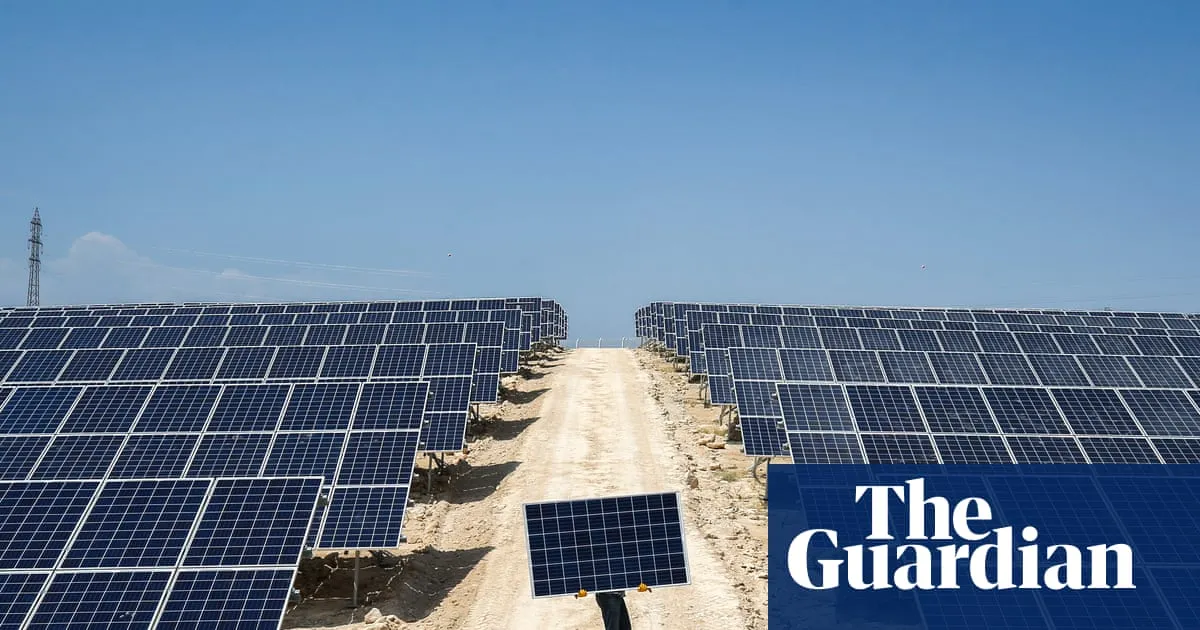
Turkey has given the green light to more batteries to buffer its electricity grid than any EU member state, a report has found, in a further sign of rich countries losing steam in the race to a clean economy.More than 33GW of battery capacity have been approved in Turkey since 2022, according to the climate thinktank Ember, while the total planned and operational capacity in European frontrunners that started deploying them earlier, such as Germany and Italy, is 12-13GW.The coal-hungry economy straddling Europe and Asia is among several developing countries witnessing a rapid boom in clean technology as prices fall and fossil fuels face further crises.The findings come as diplomats prepare to descend on the Mediterranean resort city of Antalya in November, when Turkey hosts the Cop31 climate summit.Ufuk Alparslan, an analyst at Ember and author of the report, said policy choices in Turkey had created a “massive investment signal” in battery storage that outstripped its European peers. “If delivered, Turkey’s battery pipeline will be the backbone of a new, clean regional energy hub.”Batteries amplify the benefits of weather-dependent renewable technologies, such as turbines that spin in the wind, and solar panels that absorb sunlight. By storing electricity to be released when needed, batteries reduce reliance on fossil fuels when the sun is not shining nor the wind blowing.European energy experts have called for greater investment in electricity grids and battery storage to cut pollution, bills and reliance on foreign autocrats. Their calls have gained in urgency since the Iran war prompted the latest fossil fuel crisis.Turkey’s large number of projects is the result of a 2022 mandate that gives preferential grid access to renewables that are paired with an equal amount of storage. Of 221GW of battery storage in submitted applications, Turkey has approved 33GW, equivalent to 83% of its current wind and solar capacity, according to the report. Romania is the only EU country with a greater ratio. The Turkish projects mostly use one-hour batteries, providing 37GWh.Greg Nemet, an energy researcher at the University of Wisconsin-Madison, who was not involved in the report, said the “dramatic” growth of solar and batteries in some countries, especially in the global south, had come as the cost of both had fallen by nearly 90% in the last decade.“Cheap solar and batteries create a tremendous opportunity for creating a cheap, clean and reliable energy system,” he said. “Countries like Turkey are taking advantage of that.”Turkey generates about a fifth of its power from wind and solar – well above any country in the Middle East or central Asia but below the European average – while continuing to back coal, which benefits from extensive subsidies and generated 34% of its electricity last year.The country is targeting 120GW of installed wind and solar capacity by 2035, up from 40GW today. The 6.5GW it added last year fell short of the 8GW needed to meet its target, the report found.An early draft of Turkey’s proposed “action agenda” for Cop31, which was leaked to the Guardian last month, omitted mention of the phaseout of fossil fuels that was discussed in depth at last year’s climate summit in Brazil.Alparslan said Turkey still faced “several hurdles” in realising the proposed battery projects, such as permit bottlenecks and reliance on spot electricity market prices. Turkey also had a less pressing need for big batteries than many European countries owing to large hydropower dams that provided clean base-load power.“The approach appears somewhat overcautious, rather than fully forward-looking,” said Alparslan. “Turkey has nonetheless sent a strong investment signal that surpasses those of its European counterparts.”
SRCThe Guardian - World News
LANGEN
LEANCenter-Left
WORDS594
ENT12
WED · 2026-04-08 · 04:00 GMTBRIEF NSR-2026-0408-57746
NSR-2026-0408-57746News Report·EN·Environmental
Turkey to race ahead of EU on battery storage amid fossil fuel crisis
A recent report reveals that Turkey has approved significantly more battery storage capacity (33GW) than any EU member state since 2022, signaling a rapid growth in clean technology adoption. This surge is driven by falling prices and ongoing fossil fuel crises, positioning Turkey as a potential regional energy hub.
Ajit Niranjan Europe environment correspondentThe Guardian - World NewsFiled 2026-04-08 · 04:00 GMTLean · Center-LeftRead · 3 min
The Guardian - World NewsFIG 01
Reading time
3min
Word count
594words
Sources cited
2cited
Entities identified
12entities
Quality score
100%
§ 01
Briefing Summary
AI-generatedNEWSAR · AI
A recent report reveals that Turkey has approved significantly more battery storage capacity (33GW) than any EU member state since 2022, signaling a rapid growth in clean technology adoption. This surge is driven by falling prices and ongoing fossil fuel crises, positioning Turkey as a potential regional energy hub. Turkey's policy of prioritizing grid access for renewables paired with equal storage has spurred investment, with approved battery capacity equivalent to 83% of its current wind and solar capacity. This development comes as Turkey prepares to host the Cop31 climate summit in Antalya in November. The increase in battery storage aims to reduce reliance on fossil fuels by storing and releasing renewable energy when needed.
Confidence 0.90Sources 2Claims 5Entities 12
§ 02
Article analysis
Model · rule-basedFraming
Environmental
Economic Impact
Tone
Measured
AI-assessed
CalmNeutralAlarmist
Factuality
0.70 / 1.00
Factual
LowHigh
Sources cited
2
Limited
FewMany
§ 03
Key claims
5 extracted01
Turkey is targeting 120GW of installed wind and solar capacity by 2035, up from 40GW today.
statisticArticle
Confidence
1.00
02
Cheap solar and batteries create a tremendous opportunity for creating a cheap, clean and reliable energy system.
quoteGreg Nemet, energy researcher at the University of Wisconsin-Madison
Confidence
1.00
03
Turkey generates about a fifth of its power from wind and solar.
statisticArticle
Confidence
1.00
04
Turkey's approved 33GW of battery storage is equivalent to 83% of its current wind and solar capacity.
statisticEmber
Confidence
1.00
05
Turkey has approved more battery capacity (33GW) than any EU member state since 2022.
statisticEmber
Confidence
1.00
§ 04
Full report
3 min read · 594 words§ 05
Entities
12 identifiedKey playerOppositionContextPositiveNeutralNegative
Organizations3
Locations6
Events1
§ 06
Keywords & salience
10 termsbattery storage
1.00
renewable energy
0.80
fossil fuels
0.70
clean energy
0.70
turkey
0.70
european union
0.60
climate summit
0.50
electricity grid
0.50
solar
0.40
wind
0.40
§ 07
Topic connections
Interactive graph Network visualization showing 51 related topics
View Full Graph Person Organization Location Event|Click node to navigate|Edge numbers = shared articles