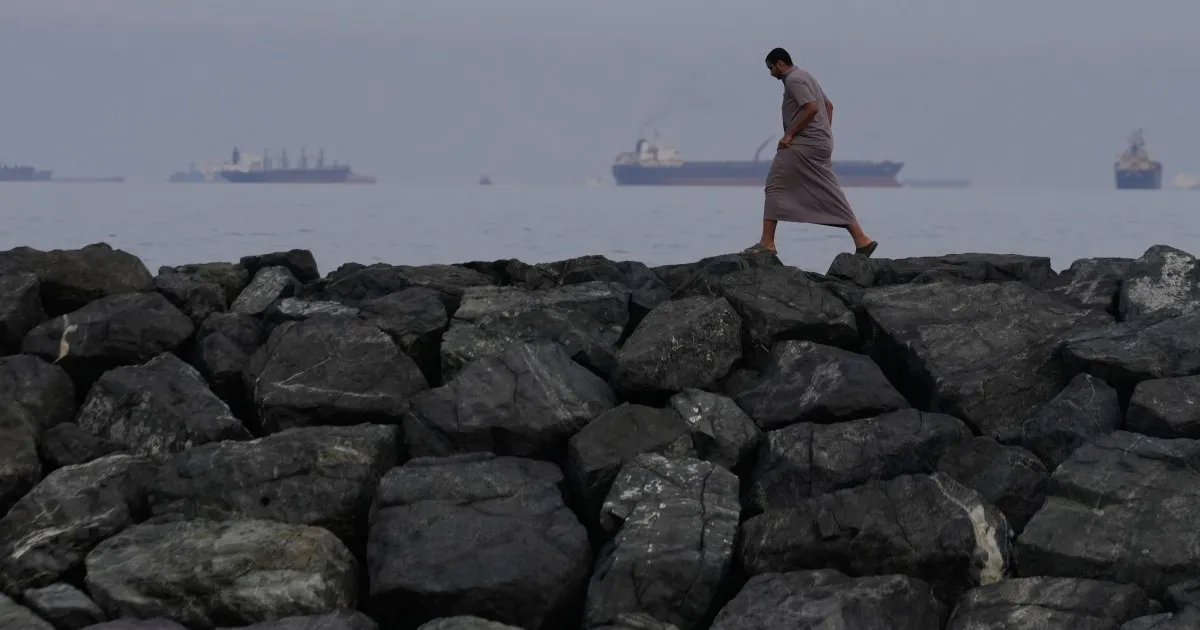
Tehran and Beijing both stand to gain from boosting status of the Chinese yuan.Oil tankers and cargo ships line up just outside the Strait of Hormuz, as seen from Khor Fakkan, United Arab Emirates, on March 11, 2026 [Altaf Qadri/AP]Published On 8 Apr 2026As the United States-Israel war on Iran — paused for two weeks on Wednesday amid fresh diplomatic talks — has roiled the global economy for more than a month, Iran and China have seized the opportunity to address a shared gripe about the global financial system.Their common cause: ending the hegemony of the US dollar.Recommended Stories list of 4 itemslist 1 of 4Israeli soldiers fire tear gas at Palestinian youth during raid in Hebronlist 2 of 4Why is Iran’s Bushehr nuclear power plant being attacked?list 3 of 4Protesters swarm US embassy in Tel Aviv, demanding end of warslist 4 of 4Trump says US could charge for Strait of Hormuz passage amid Iran warend of listFor years, they say, Washington has leveraged the dominance of the dollar in international trade to exert influence and inflict pain on enemies and competitors, Iran and China included.The supremacy of the dollar is especially apparent in the global oil market, where about 80 percent of transactions are settled in the currency, according to a 2023 estimate by JP Morgan Chase.In Iran’s control of the Strait of Hormuz, a conduit from the Gulf for about one-fifth of global oil and liquefied natural gas supplies, Tehran and Beijing have found a tool to boost the Chinese yuan as an alternative to the greenback.Under Iranian officials’ de facto toll booth regime, commercial vessels are being charged transit fees in yuan, according to multiple reports, the latest example of deepening Chinese-Iranian economic cooperation facilitated by China’s currency.While it is unclear how many vessels have made payments in yuan, at least two had done so as of March 25, according to Lloyd’s List.China’s Ministry of Commerce last week acknowledged the Lloyd’s List reporting in a social media post that appeared to confirm the use of yuan to settle payments.On Saturday, Iran’s embassy in Zimbabwe said in a social media post that it was time to add the “petroyuan” to the global oil market.Tehran, which on Wednesday said it would guarantee safe passage in the strait for two weeks under a ceasefire deal reached with the US, and Beijing did not respond to requests for comment.“At one level, Iran is aiming to poke its thumb in the United States’s eye, adding insult to injury,” Kenneth Rogoff, an economics professor at Harvard University and former chief economist at the International Monetary Fund (IMF), told Al Jazeera.“At another level, Iran is dead serious about preferring yuan to avoid US sanctions and to cultivate its ally, China, which has been moving steadily to redenominate its own trade, and that of the BRICS nations into yuan,” Rogoff said.US dollar and Chinese yuan banknotes pictured on September 12, 2025 [Dado Ruvic/Reuters]A ‘multipolar’ financial worldFor Tehran and Beijing, elevating the yuan is a win-win.The use of the currency allows China and Iran to skirt US sanctions imposed via the dollar-dominated financial system.It also simplifies and reduces the cost of trade between the sides, which has boomed under a 25-year “strategic partnership” signed in 2021.“Iran clearly understands the importance of this challenge to US financial dominance as well as the vital role of the dollar system and petrodollars,” Bulent Gokay, a professor of international relations at Keele University in the United Kingdom, told Al Jazeera.For China, Gokay said, the move aligns with Beijing’s aims of creating a “multipolar financial world where the US dollar’s central role is counterbalanced by the growing influence of emerging powers”.China buys more than 80 percent of Iran’s oil exports, enjoying discounted rates in purchases widely believed to be facilitated in yuan.Iran in turn imports large quantities of Chinese machinery, electronic equipment, chemicals and industrial components.The war has done little to disrupt oil flows between the two countries, which remain similar to pre-conflict levels, according to analyses by data and analytics firms.In the first two weeks of the conflict, Iran exported 12 million to 13.7 million barrels of crude, most of it to China, according to Kpler and TankerTrackers.China has long harboured ambitions of challenging the primacy of the dollar.In a speech to officials in 2024, Chinese President Xi Jinping expressed his hope that the yuan would become a common currency in international commerce and achieve “global reserve currency status”.A key policy for Chinese President Xi Jinping is the internationalisation of the yuan [File: Tingshu Wang/Reuters]A mountain to climbThe yuan has made steady inroads in recent years amid the growing influence of Global South economies, many of which have strained relations with Washington.But the Chinese currency still has a steep mountain to climb if it is to pose a serious challenge to the greenback.Unlike the dollar, the yuan is not freely convertible due to Beijing’s strict capital controls, meaning that businesses and institutions cannot exchange it for other currencies or move it across borders at will.The Chinese government’s control over financial institutions, including the central bank, has further hampered adoption as it cements perceptions that China’s markets lack transparency or a predictable regulatory footing.While the proportion of central banks’ foreign exchange reserves held in dollars has been in steady decline for decades, the US currency is still by far the dominant reserve currency globally.The dollar accounted for 57 percent of holdings worldwide last year, compared with about 20 percent for the euro and 2 percent for the yuan, according to the IMF.Meanwhile, only 3.7 percent of cross-border trade was settled in yuan in 2024, up from less than 1 percent in 2012, according to S&P Global.“This is not really what is going to ‘de-dollarise’ the world,” Alicia Garcia-Herrero, chief economist for the Asia Pacific at Natixis in Hong Kong, told Al Jazeera, adding that the use of yuan in the Strait of Hormuz only “adds incremental pressure and normalises alternatives in energy flows”.Far-reaching “de-dollarisation” would require the participation of Gulf states, Garcia-Herrero said, all of which have priced their oil in dollars since the 1970s when Saudi Arabia agreed to exclusively use the currency in exchange for US security guarantees.A cargo ship sits near the Strait of Hormuz, as seen from northern Ras al-Khaimah in the United Arab Emirates on March 11, 2026 [Reuters]‘Chipping away’ at dollar dominanceEven if China struggles to match the internationalisation of the dollar, it may not matter much to Tehran, said Hosuk Lee-Makiyama, director of the European Centre for International Political Economy in Brussels.“China purchases nearly all of Iran’s oil, and their trade is actually in balance since Iran can get all the machinery and industrial goods that it cannot get elsewhere,” Lee-Makiyama told Al Jazeera.Europe’s and Japan’s currencies could not displace the dollar in the past because neither power could supply oil-producing countries with all of their import needs, Lee-Makiyama said.But China, he said, is “perhaps the closest the world has seen to a manufacturing one-stop shop” as the biggest manufacturer globally by far.Dan Steinbock, the founder of the consultancy Difference Group, said that while the supremacy of the US dollar would not change in the short-term, the growing use of yuan could “chip away” at US dominance in specific sectors over time.“Overall, it is a question of gradual erosion rather than an abrupt substitution,” Steinbock told Al Jazeera.Rogoff, the Harvard economist, said much would depend on the endgame of the war and ensuing fallout in the coming years.“If Iran and China prevail, under most scenarios, it will encourage countries to diversify away from the dollar financial system so as to protect themselves from being held hostage to US financial sanctions,” said Rogoff, who has argued that the dominance of the dollar has already peaked.
SRCAl Jazeera
LANGEN
LEANCenter
WORDS1 290
ENT12
WED · 2026-04-08 · 06:21 GMTBRIEF NSR-2026-0408-57928
NSR-2026-0408-57928News Report·EN·Political Strategy
In Strait of Hormuz, Iran and China take aim at US dollar hegemony
Amidst a period of heightened tensions in the Middle East in early 2026, Iran and China are reportedly collaborating to challenge the dominance of the US dollar in global trade. Iran is allegedly charging transit fees in Chinese yuan to commercial vessels passing through the Strait of Hormuz, a critical waterway for global oil and gas supplies.
John PowerAl JazeeraFiled 2026-04-08 · 06:21 GMTLean · CenterRead · 6 min
Al JazeeraFIG 01
Reading time
6min
Word count
1 290words
Sources cited
2cited
Entities identified
12entities
Quality score
100%
§ 01
Briefing Summary
AI-generatedNEWSAR · AI
Amidst a period of heightened tensions in the Middle East in early 2026, Iran and China are reportedly collaborating to challenge the dominance of the US dollar in global trade. Iran is allegedly charging transit fees in Chinese yuan to commercial vessels passing through the Strait of Hormuz, a critical waterway for global oil and gas supplies. This move aims to undermine the dollar's hegemony, particularly in the oil market, where it is the primary currency for transactions. China's Ministry of Commerce has seemingly confirmed the use of yuan for these payments, and Iran has publicly advocated for the adoption of the "petroyuan" in the global oil market. The initiative reflects a shared desire by both nations to reduce their reliance on the US dollar and its influence in international finance.
Confidence 0.90Sources 2Claims 5Entities 12
§ 02
Article analysis
Model · rule-basedFraming
Political Strategy
Economic Impact
Tone
Mixed Tone
AI-assessed
CalmNeutralAlarmist
Factuality
0.70 / 1.00
Factual
LowHigh
Sources cited
2
Limited
FewMany
§ 03
Key claims
5 extracted01
About 80 percent of global oil transactions are settled in US dollars.
statisticJP Morgan Chase (2023 estimate)
Confidence
0.90
02
Iran and China are addressing a shared gripe about the global financial system: ending the hegemony of the US dollar.
factual
Confidence
0.90
03
Iran is aiming to poke its thumb in the United States’s eye.
quoteKenneth Rogoff, Harvard University
Confidence
0.80
04
At least two vessels had made payments in yuan as of March 25.
factualLloyd’s List
Confidence
0.80
05
Commercial vessels are being charged transit fees in yuan in the Strait of Hormuz.
factual
Confidence
0.70
§ 04
Full report
6 min read · 1 290 words§ 05
Entities
12 identifiedKey playerOppositionContextPositiveNeutralNegative
Organizations1
Locations11
I
Iran
CountryKey Player
10x
90
SO
Strait of Hormuz
Strategic
4x
85
C
China
CountryKey Player
6x
80
US
United States
CountryOpposition
4x
80
UD
US dollar
EconomicOpposition
3x
75
CY
Chinese yuan
EconomicKey Player
4x
70
B
Beijing
CityKey Player
2x
60
T
Tehran
CityKey Player
2x
60
I
Israel
Country
40
Z
Zimbabwe
Country
30
UA
United Arab Emirates
Country
30
§ 06
Keywords & salience
9 termsus dollar hegemony
1.00
chinese yuan
0.90
strait of hormuz
0.80
iran
0.70
china
0.70
oil market
0.60
economic cooperation
0.50
transit fees
0.40
international trade
0.40
§ 07
Topic connections
Interactive graph Network visualization showing 51 related topics
View Full Graph Person Organization Location Event|Click node to navigate|Edge numbers = shared articles