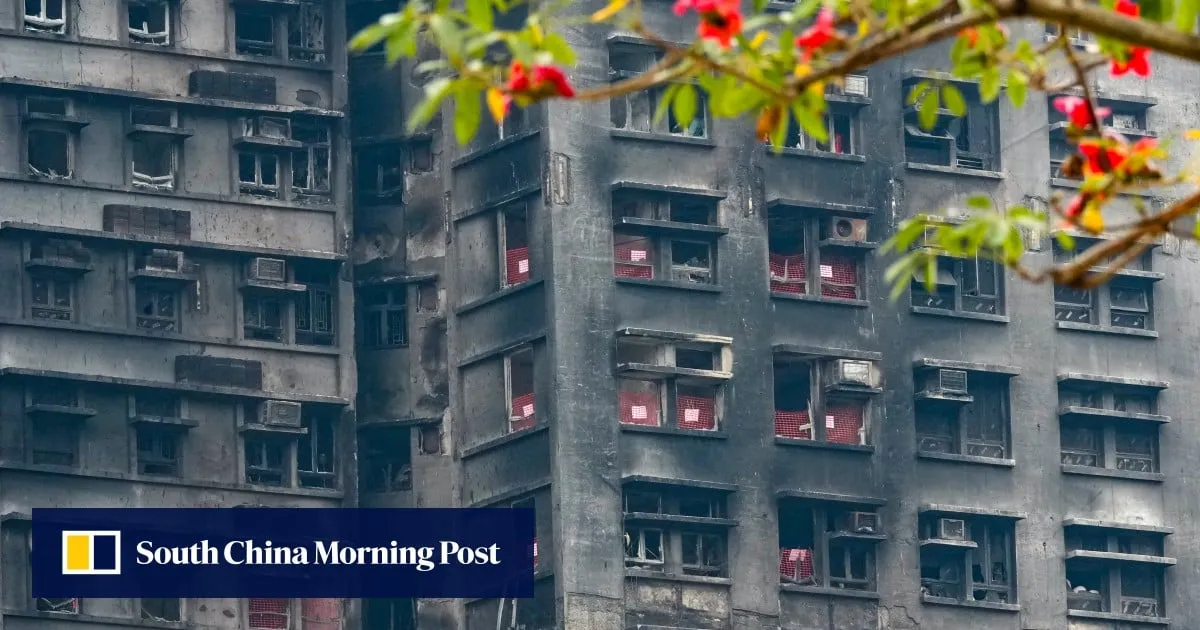
A redevelopment proposal representing the interests of more than 400 fire-displaced residents has been submitted to the Hong Kong Government, claiming that a partial redevelopment of Wang Fuk Court could generate a HK6.4 billion (US816.7 million) surplus.The 47-page proposal, alongside two letters, was sent to the Chief Executive John Lee Ka-chiu, Deputy Chief Secretary Warner Cheuk Wing-hing, Deputy Financial Secretary Michael Wong Wai-lun, housing minister Winnie Ho Wing-yin, and home affairs minister Alice Mak Mei-kuen on Wednesday.The group stressed that the proposal was not meant to replace the current rehousing plan, but rather to serve as a parallel option for residents.“We are fully aware of the length of redevelopment, and we have absolutely no wish to be a burden on the public coffers,” it said.“We have conducted two in-depth studies and found as many as 427 residents explicitly stated that they did not want compensation or to be rehoused, but only to return home.“Based on this solid foundation of public opinion, we urged the government to explore the feasibility of rebuilding three to four new blocks on the original site.”Drawing from the study results, some residents wrote the proposal and submitted it to the government. They said that they did not conduct an independent survey into each resident’s view for the proposal.The catastrophic blaze that tore through seven of the eight 31-storey blocks of the estate on November 26, killed 168 people and displaced nearly 5,000 residents.In the proposal, the residents suggested increasing the plot ratio from 3.8 times to 6.9 times, allowing the government to construct three to four new 40-storey blocks with about 2,600 to 3,000 flats.That would cost around HK$3.6 billion to HK$4.2 billion, taking into account other fees such as demolition and design.Assuming about 700 of the 1,984 households chose to return, the government would have around 2,300 extra flats to sell.Further ReadingIf the flats were 560 sq ft each and sold at a price of HK$7,000 per square foot, the government would generate HK$9.1 billion in revenue.Together with the estimated HK$1.5 billion insurance payout, the government would have HK$6.4 billion in surplus, according to the proposal.It proposed that residents who chose the in-situ redevelopment plan pass their insurance payout to the government, which would also receive the sum from those who want to sell their titles to the administration.With the help of modular integrated construction technology, the construction time would be shortened to about five to six years, allowing residents to return by 2031. The government earlier estimated that in-situ redevelopment of the entire estate could take 10 years.A building’s plot ratio regulates its development density. A higher plot ratio will allow developers to build more densely and taller, thereby providing potentially more residential flats on the plot.The residents said that while the government had provided them with emergency relief and temporary shelter, their sense of loss remains deep and painful.“We sincerely and humbly plead with the government: please bring us back to our home, back to our roots. Let us return to those corridors where we grew up together, to where our tears once fell, where we can push open the doors and say ‘I’m home’.”Chinachem representatives at the Lands Tribunal building in January after a hearing to replace the management committee of Wang Fuk Court’s owners’ corporation. Photo: Jonathan WongSeparately, the administrator of Wang Fuk Court has stated it will hold a briefing for residents in early May, but turned down an earlier request from more than 300 owners to convene a general meeting, citing a lack of information that complied with legal requirements.According to an email seen by the South China Morning Post on Wednesday, Hop On Management did not elaborate on what additional information was needed, nor did it specify what the “legal requirements” were.The Chinachem Group subsidiary was appointed by the government as the Tai Po housing estate’s interim administrator following the deadly fire last November.“We have conducted a detailed review and consultation with legal advisers and find that the email you sent on March 15, saying you had collected owners’ concerns through an online form, did not provide other information,” the email in Cantonese, addressed to a resident representative and dated April 7, read.“Regarding [another] email on March 22, as the information you provided does not comply with the relevant statutory requirements, we will not be arranging an owners’ meeting at this stage.”Residents signed an online petition in mid-March, demanding that Hop On convene an owners’ meeting to address multiple issues, such as the use of remaining renovation funds and the progress and distribution of insurance payouts after the fire that destroyed all but one of the estate’s eight buildings last November.According to the Building Management Ordinance, “the chairman of the management committee shall convene a general meeting of the corporation at the written request of not less than 5 per cent of the owners for the purposes specified by such owners within 14 days of receiving such request, and hold the general meeting within 45 days of receiving such request”.
SRCSouth China Morning Post
LANGEN
LEANCenter-Right
WORDS832
ENT9
WED · 2026-04-08 · 08:32 GMTBRIEF NSR-2026-0408-58255
NSR-2026-0408-58255News Report·EN·Economic Impact
Wang Fuk Court administrator rejects request to hold owners’ meeting, email shows
Following a devastating fire at Wang Fuk Court in Hong Kong that displaced nearly 5,000 residents, a group representing over 400 residents submitted a redevelopment proposal to the government. The proposal suggests a partial redevelopment of the site, constructing three to four new blocks, which they estimate could generate a HK$6.4 billion surplus.
Edith LinSouth China Morning PostFiled 2026-04-08 · 08:32 GMTLean · Center-RightRead · 4 min
South China Morning PostFIG 01
Reading time
4min
Word count
832words
Sources cited
0cited
Entities identified
9entities
Quality score
100%
§ 01
Briefing Summary
AI-generatedNEWSAR · AI
Following a devastating fire at Wang Fuk Court in Hong Kong that displaced nearly 5,000 residents, a group representing over 400 residents submitted a redevelopment proposal to the government. The proposal suggests a partial redevelopment of the site, constructing three to four new blocks, which they estimate could generate a HK$6.4 billion surplus. Residents are urging the government to consider this option, where they would return to new flats on the original site, as an alternative to the current rehousing plan. The proposal outlines increasing the plot ratio and selling extra flats to generate revenue, with residents who choose to return passing their insurance payouts to the government. The residents claim that many displaced residents want to return home and are not seeking compensation or rehousing.
Confidence 0.90Claims 5Entities 9
§ 02
Article analysis
Model · rule-basedFraming
Economic Impact
Human Interest
Tone
Measured
AI-assessed
CalmNeutralAlarmist
Factuality
0.80 / 1.00
Factual
LowHigh
Sources cited
0
No named sources
FewMany
§ 03
Key claims
5 extracted01
The residents suggested increasing the plot ratio from 3.8 times to 6.9 times.
factualResidents' proposal
Confidence
1.00
02
The catastrophic blaze on November 26 killed 168 people and displaced nearly 5,000 residents.
factualArticle (reporting event)
Confidence
1.00
03
A redevelopment proposal suggests a partial redevelopment of Wang Fuk Court could generate a HK6.4 billion surplus.
statisticResidents' proposal
Confidence
0.90
04
427 residents explicitly stated that they did not want compensation or to be rehoused, but only to return home.
statisticResidents' proposal (study results)
Confidence
0.70
05
Construction time would be shortened to about five to six years, allowing residents to return by 2031.
predictionResidents' proposal
Confidence
0.60
§ 04
Full report
4 min read · 832 words§ 05
Entities
9 identifiedKey playerOppositionContextPositiveNeutralNegative
People5
Organizations1
§ 06
Keywords & salience
9 termsredevelopment proposal
0.90
wang fuk court
0.80
fire-displaced residents
0.70
fatal fire
0.70
insurance payout
0.60
rehousing plan
0.60
government surplus
0.60
plot ratio
0.50
housing
0.40
§ 07
Topic connections
Interactive graph Network visualization showing 18 related topics
View Full Graph Person Organization Location Event|Click node to navigate|Edge numbers = shared articles