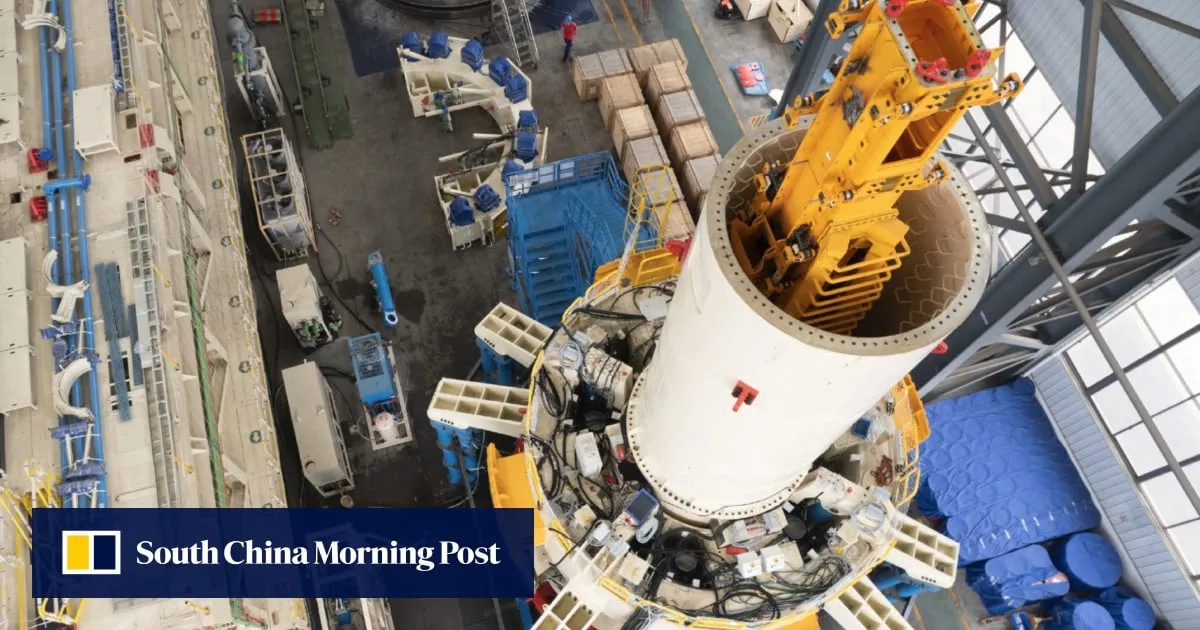
The fearsome-sounding “Gangtie Jiliang” is designed to do what no machine has ever done before: delve straight down, kilometre after kilometre, into the heart of the Earth.Translated to English as “steel backbone”, Gangtie Jiliang is billed as the world’s first boring machine capable of excavating full-face shafts to depths exceeding 1,000 metres (3,280 feet) in hard rock.Weighing about 500 tonnes and measuring 8.1 metres wide, the machine looks less like mining equipment and more like an “underground aircraft carrier”, according to the state-owned Science and Technology Daily on Tuesday.Developed by the China Railway Construction Corporation (CRCC), the industrial leviathan has transitioned from its record-breaking assembly to full-scale operations and has been deployed to an iron ore project in northeastern Liaoning province.Its mission is to unlock a hidden world of wealth buried beneath the Earth’s crust.The boring machine has been deployed to an iron ore project in China’s northeastern Liaoning province. Photo: CRCCChina’s deep-Earth mineral deposits are vast. Experts estimate there is twice as much mineral wealth deep underground than what has already been proved near the surface.
SRCSouth China Morning Post
LANGEN
LEANCenter-Right
WORDS177
ENT5
THU · 2026-04-09 · 01:00 GMTBRIEF NSR-2026-0409-59428
NSR-2026-0409-59428News Report·EN·Technology
Mining revolution: China’s 500-tonne ‘underground carrier’ tunnels a kilometre to mine ore
China has deployed the "Gangtie Jiliang," the world's first boring machine capable of excavating full-face shafts over 1,000 meters deep in hard rock, to an iron ore project in Liaoning province. Developed by the China Railway Construction Corporation (CRCC), the 500-tonne, 8.1-meter-wide machine is designed to directly tunnel deep into the Earth to access previously unreachable mineral deposits.
Dannie PengSouth China Morning PostFiled 2026-04-09 · 01:00 GMTLean · Center-RightRead · 1 min
South China Morning PostFIG 01
Reading time
1min
Word count
177words
Sources cited
1cited
Entities identified
5entities
Quality score
100%
§ 01
Briefing Summary
AI-generatedNEWSAR · AI
China has deployed the "Gangtie Jiliang," the world's first boring machine capable of excavating full-face shafts over 1,000 meters deep in hard rock, to an iron ore project in Liaoning province. Developed by the China Railway Construction Corporation (CRCC), the 500-tonne, 8.1-meter-wide machine is designed to directly tunnel deep into the Earth to access previously unreachable mineral deposits. The machine, nicknamed "steel backbone," aims to tap into China's vast deep-Earth mineral resources, estimated to be twice the amount already discovered near the surface. This new technology represents a significant advancement in mining capabilities, potentially unlocking substantial mineral wealth.
Confidence 0.90Sources 1Claims 5Entities 5
§ 02
Article analysis
Model · rule-basedFraming
Technology
Economic Impact
Tone
Mixed Tone
AI-assessed
CalmNeutralAlarmist
Factuality
0.80 / 1.00
Factual
LowHigh
Sources cited
1
Limited
FewMany
§ 03
Key claims
5 extracted01
The machine looks like an “underground aircraft carrier”.
quoteScience and Technology Daily
Confidence
1.00
02
The boring machine has been deployed to an iron ore project in northeastern Liaoning province.
factualnull
Confidence
1.00
03
The machine weighs about 500 tonnes and measures 8.1 metres wide.
factualnull
Confidence
1.00
04
Gangtie Jiliang is the world’s first boring machine capable of excavating full-face shafts to depths exceeding 1,000 metres in hard rock.
factualnull
Confidence
0.90
05
Experts estimate there is twice as much mineral wealth deep underground than what has already been proved near the surface.
statisticExperts
Confidence
0.80
§ 04
Full report
1 min read · 177 words§ 05
Entities
5 identifiedKey playerOppositionContextPositiveNeutralNegative
Organizations3
§ 06
Keywords & salience
9 termsmining
0.90
underground mining
0.80
boring machine
0.80
deep-earth mineral deposits
0.70
iron ore
0.70
gangtie jiliang
0.60
china
0.60
mineral wealth
0.50
excavation
0.50
§ 07
Topic connections
Interactive graph Network visualization showing 51 related topics
View Full Graph Person Organization Location Event|Click node to navigate|Edge numbers = shared articles