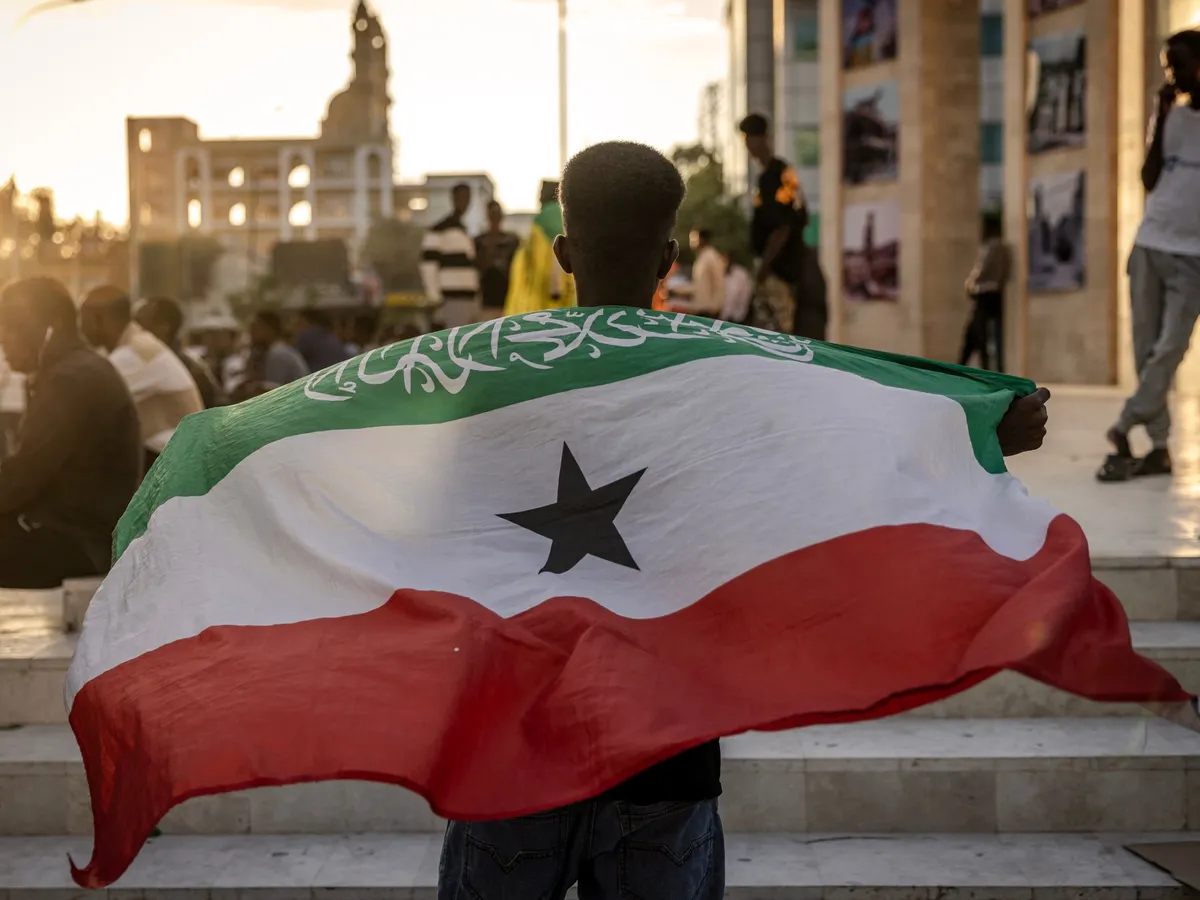
Gideon Saar has become the first Israeli foreign minister to visit the breakaway region since Israel recognised its independence.A man holds a flag of Somaliland in front of the Hargeisa War Memorial monument in Hargeisa [File: AFP]Published On 6 Jan 2026Israel’s foreign minister has arrived in Somaliland for the first high-level diplomatic visit since the country became the first in the world to recognise the breakaway region’s independence over a week and a half ago, triggering condemnation and concerns that Palestinians may be forcibly expelled by Israel there.Gideon Saar landed in the capital Hargeisa on Tuesday and was received by government officials at the airport, according to a statement from Somaliland’s presidency.Recommended Stories list of 3 itemslist 1 of 3Somaliland denies agreeing to host Israeli bases, resettle Palestinianslist 2 of 3Somali president: Israel deal with Somaliland tied to hosting Palestinianslist 3 of 3The Take: What does Israel’s recognition of Somaliland mean for the region?end of listHe was scheduled to meet President Abdirahman Mohamed Abdullahi, with footage circulating online showing the two together.Somalia’s foreign ministry condemned Saar’s visit as an “unauthorized incursion” into its sovereign territory. The ministry said any official presence or engagement in Somali territory without Mogadishu’s consent was “illegal, null, and void”.The Israeli visit comes as regional opposition to Israel’s recognition intensifies, with the African Union convening an emergency ministerial session on Tuesday to address the move.The session, which was not part of the AU Peace and Security Council’s original January agenda, was specially convened following requests from member states.Egypt’s Foreign Minister Badr Abdelaty told the session that Israel’s recognition represented “a blatant violation” of Somalia’s sovereignty and set a dangerous precedent.In the meantime, Ismail Shirwac, a Somaliland diplomat, described the Saar visit as marking “a defining moment in the deepening relations between two democratic nations operating in a strategically critical region”.He said the diplomatic partnership was “not only significant, it is irreversible”.Israel formally recognised Somaliland as an independent state on December 26, marking its second major breakthrough following the establishment of ties with Taiwan in 2020.Somaliland’s president, in a New Year’s Eve message, said he expected more countries to follow.Ted Cruz, the staunchly pro-Israel US senator from Texas, and a prominent supporter of Somaliland, has urged President Donald Trump to recognise it, calling it a matter of strategy that “aligns with America’s security interests”.However, Trump appeared uninterested when asked about the issue in a recent interview with the New York Post, only saying the matter was being studied.Self-declared independenceSomaliland broke away from Somalia unilaterally in 1991 as the country collapsed into civil war.While Somalia only began emerging from the chaos in the early 2000s, Somaliland had stabilised by the late 1990s, establishing its own constitution, parliament and currency.Somalia swiftly condemned Israel’s move as the “gravest attack” on its sovereignty and has mobilised diplomatic support across the region and beyond.More than 50 countries have criticised Israel’s decision, while tens of thousands of Somalis took to the streets in late December demanding national unity.President Hassan Sheikh Mohamud alleged in an interview with Al Jazeera that Somaliland accepted three Israeli conditions in exchange for recognition: resettling Palestinians from Gaza, effectively facilitating ethnic cleansing; hosting an Israeli military base; and joining Trump’s Abraham Accords, which a handful of nations have joined and normalised relations with Israel.Somaliland has denied agreeing to resettle Palestinians or host military facilities, insisting its engagement with Israel is “purely diplomatic” and conducted “in full respect of international law”.However, Bashir Goth, Somaliland’s representative to the United States, told the Middle East Forum that “as two independent countries which recognise each other, with diplomatic relations, there is nothing that can stop us from having a security cooperation or a security pact.”The timing of Saar’s visit also occurs amid a backdrop of growing tensions across the Red Sea region.Saudi Arabia’s foreign minister held talks in Cairo with Egyptian President Abdel Fattah el-Sisi on Monday, with both countries affirming their commitment to preserving Somalia’s territorial integrity and sovereignty.Days earlier, Turkish President Recep Tayyip Erdogan held separate phone calls with both Saudi Crown Prince Mohammed bin Salman and UAE President Mohammed bin Zayed, emphasising that Turkiye “supports the territorial integrity and unity” of both Somalia and Yemen.The coordination reflects broader regional realignments, with Saudi Arabia and Turkiye increasingly allied against the United Arab Emirates’ influence across the Red Sea region, including in Yemen, where Saudi forces recently clashed with UAE-supported separatists, prompting UAE troops to withdraw.The leader of Yemen’s Houthi rebels has also warned that any Israeli presence in Somaliland would be considered a “military target”.“We consider any Israeli presence in Somaliland a military target for our armed forces, as it constitutes aggression against Somalia and Yemen, and a threat to the security of the region,” said the group’s chief, Abdel-Malik al-Houthi, according to a statement published by rebel media online in late December.
SRCAl Jazeera
LANGEN
LEANCenter
WORDS802
ENT11
TUE · 2026-01-06 · 14:26 GMTBRIEF NSR-2026-0106-5963
NSR-2026-0106-5963News Report·EN·Diplomatic
Israeli FM visits Somaliland after world-first recognition storm
Israeli Foreign Minister Gideon Saar visited Somaliland on Tuesday, marking the first high-level diplomatic visit since Israel recognized the breakaway region's independence on December 26, 2025. The visit, condemned by Somalia as an "unauthorized incursion," involved meetings with Somaliland's President Abdirahman Mohamed Abdullahi.
Faisal AliAl JazeeraFiled 2026-01-06 · 14:26 GMTLean · CenterRead · 4 min
Al JazeeraFIG 01
Reading time
4min
Word count
802words
Sources cited
5cited
Entities identified
11entities
Quality score
100%
§ 01
Briefing Summary
AI-generatedNEWSAR · AI
Israeli Foreign Minister Gideon Saar visited Somaliland on Tuesday, marking the first high-level diplomatic visit since Israel recognized the breakaway region's independence on December 26, 2025. The visit, condemned by Somalia as an "unauthorized incursion," involved meetings with Somaliland's President Abdirahman Mohamed Abdullahi. The African Union convened an emergency session to address Israel's recognition of Somaliland, with Egypt's Foreign Minister denouncing it as a violation of Somalia's sovereignty. Somaliland views the diplomatic partnership with Israel as significant and irreversible, while regional opposition to the recognition intensifies. This marks Israel's second major diplomatic breakthrough since establishing ties with Taiwan in 2020.
Confidence 0.90Sources 5Claims 5Entities 11
§ 02
Article analysis
Model · rule-basedFraming
Diplomatic
Conflict
Tone
Measured
AI-assessed
CalmNeutralAlarmist
Factuality
0.80 / 1.00
Factual
LowHigh
Sources cited
5
Well sourced
FewMany
§ 03
Key claims
5 extracted01
Egypt’s Foreign Minister Badr Abdelaty told the session that Israel’s recognition represented “a blatant violation” of Somalia’s sovereignty.
quoteEgypt’s Foreign Minister Badr Abdelaty
Confidence
1.00
02
Ismail Shirwac described the Saar visit as marking “a defining moment in the deepening relations between two democratic nations”.
quoteIsmail Shirwac, a Somaliland diplomat
Confidence
1.00
03
Somalia’s foreign ministry condemned Saar’s visit as an “unauthorized incursion” into its sovereign territory.
quoteSomalia’s foreign ministry
Confidence
1.00
04
Israel formally recognised Somaliland as an independent state on December 26.
factualArticle
Confidence
1.00
05
Gideon Saar has become the first Israeli foreign minister to visit Somaliland since Israel recognised its independence.
factualArticle
Confidence
1.00
§ 04
Full report
4 min read · 802 words§ 05
Entities
11 identifiedKey playerOppositionContextPositiveNeutralNegative
People4
Organizations1
§ 06
Keywords & salience
9 termsisraeli foreign minister visit
0.90
somaliland recognition
0.90
israeli-somaliland relations
0.80
independence
0.70
sovereignty
0.60
diplomatic visit
0.60
regional opposition
0.50
breakaway region
0.50
african union
0.50
§ 07
Topic connections
Interactive graph Network visualization showing 51 related topics
View Full Graph Person Organization Location Event|Click node to navigate|Edge numbers = shared articles