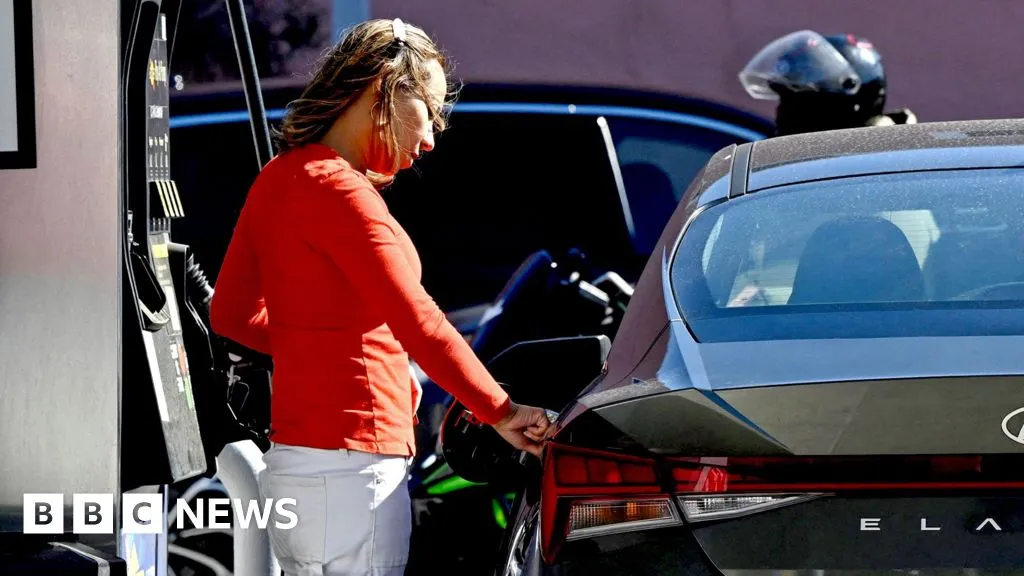
53 minutes agoOsmond ChiaandNick Edser,Business reportersShutterstockThe cost of petrol and diesel has continued to rise as motorists wait to see if the US-Iran ceasefire leads to cheaper prices at the pump.Oil prices had plunged initially after an agreement to pause the conflict was announced, but rose on Thursday due to concerns over whether the ceasefire would hold.The price of oil remains much higher than pre-war levels and drivers have been warned not to expect a significant drop in costs soon.However, one motoring group has said fuel prices could start to fall over the next couple of weeks as long as the ceasefire is maintained.Doubts over the durability of the US-Iran ceasefire emerged after after Israel launched a wave of strikes on Lebanon.This led Tehran to warn of a "regret‑inducing response" if they continue, while US President Donald Trump has said the country's forces will remain in the region until Iran complies with the "real" ceasefire agreement.One of the conditions of the ceasefire agreement was that ships would be able to safely use the Strait of Hormuz - a key shipping route for global oil and gas supplies. But reports that Iran will keep the crucial shipping route closed because of the Israeli strikes has renewed fears of a lengthy disruption to energy supplies, which would keep fuel prices high.The price of a barrel of Brent crude rose 3.2% to $97.94 on Thursday as pressure mounted on what US Vice President JD Vance described as a "fragile truce".Since the war began on 28 February, wholesale oil prices have jumped by 35%. Crude oil is a key ingredient in petrol and diesel, so its price has a big influence on the cost of filling up a car.According to data from UK motoring group the RAC, the average petrol price was 158.03p a litre on Thursday while diesel was 191.11p – both slightly higher than the previous day.A tank of petrol is now £13.86 more expensive than it was at the beginning of the conflict at £86.92, the RAC said.A full tank of diesel now costs £26.80 more at £105.11.The RAC has said drivers should not expect a big fall in pump prices soon, although rival group the AA said wholesale fuel costs were now lower than they were at the start of the week."Based on the fuel industry's rule of thumb of a 10 to 14-day lag between wholesale cost movements and those at the pump, drivers should expect prices on forecourts to level by next weekend and then fall – providing the ceasefire holds," said Luke Bosdet, the AA's spokesman on pump prices.Stock markets reversed some of the major gains they made on Wednesday. Japan's Nikkei 225 index closed down 0.5%, while in Europe the UK's FTSE 100 slipped 0.4%, Germany's Dax index was 1.3% lower and France's Cac was down 0.9%."I think there's a little bit of nervousness in global markets," said Victoria Scholar, head of investment at Interactive Investor."Markets are giving back some gains… and I think that reflects a lot of uncertainty over whether the Strait of Hormuz is actually open."Ships in the Gulf have received a warning from Iran's navy that any vessels seeking to cross the strait without permission "will be targeted and destroyed", shipping brokerage firm SSY has confirmed to BBC Verify.However, he said the reopening would only happen "after the United States actually withdraw this aggression", seemingly referring to Israel's attacks on Lebanon.There is disagreement over whether Lebanon is included in the ceasefire. Vance is due to take part in negotiations with Iran in Pakistan on Saturday.Only a handful of ships have passed through the Strait of Hormuz since the deal was announced - well below the rate of some 130 vessels that transited daily before the war.It will take a minimum of 10 days to clear the existing backlog of vessels, even if the strait resumes its usual volume of shipping, according to maritime tracking firm Pole Star Global.Shipping through the Strait of Hormuz has been "unchanged in risk profile and numbers transiting" since the announcement of the ceasefire, according to maritime intelligence firm Windward.The company added that even under a best-case scenario, "weeks are required to move stranded gas and oil cargoes, and months for global trade to approach pre-crisis levels".Nils Haupt from container shipping firm Hapag-Lloyd, which still has six ships in the Persian Gulf, told the BBC's Today programme that it was "very difficult to plan because every day you get very different news".Haupt said they were still waiting for official information on whether there will be fees to pass through the Strait of Hormuz, but warned that if there were it could have a major impact."If this means that for the coming years there will be a fee for the Strait of Hormuz of millions which is double, triple the price of crossing the Panama Canal or the Suez Canal it would be quite ridiculous for the entire industry."
SRCBBC News - World
LANGEN
LEANCenter
WORDS820
ENT10
THU · 2026-04-09 · 11:07 GMTBRIEF NSR-2026-0409-60234
NSR-2026-0409-60234News Report·EN·Economic Impact
Petrol and diesel prices rise again as concerns grow over ceasefire
Petrol and diesel prices have risen again due to concerns about the US-Iran ceasefire's stability. Initial drops in oil prices after the ceasefire announcement were reversed on Thursday amid doubts fueled by Israeli strikes on Lebanon and Iranian warnings.
BBC News - WorldFiled 2026-04-09 · 11:07 GMTLean · CenterRead · 4 min
BBC News - WorldFIG 01
Reading time
4min
Word count
820words
Sources cited
6cited
Entities identified
10entities
Quality score
100%
§ 01
Briefing Summary
AI-generatedNEWSAR · AI
Petrol and diesel prices have risen again due to concerns about the US-Iran ceasefire's stability. Initial drops in oil prices after the ceasefire announcement were reversed on Thursday amid doubts fueled by Israeli strikes on Lebanon and Iranian warnings. The Strait of Hormuz, a key oil shipping route, remains a point of contention, further impacting prices. Brent crude rose 3.2% to $97.94 a barrel, reflecting market anxiety. Since the war began on February 28th, wholesale oil prices have increased by 35%, leading to higher costs at the pump, with average petrol prices at 158.03p a litre and diesel at 191.11p on Thursday in the UK. While one motoring group anticipates price drops if the ceasefire holds, another warns against expecting significant reductions soon.
Confidence 0.90Sources 6Claims 5Entities 10
§ 02
Article analysis
Model · rule-basedFraming
Economic Impact
Conflict
Tone
Measured
AI-assessed
CalmNeutralAlarmist
Factuality
0.80 / 1.00
Factual
LowHigh
Sources cited
6
Well sourced
FewMany
§ 03
Key claims
5 extracted01
The average petrol price was 158.03p a litre on Thursday while diesel was 191.11p.
statisticthe RAC
Confidence
1.00
02
Since the war began on 28 February, wholesale oil prices have jumped by 35%.
statistic
Confidence
1.00
03
The price of a barrel of Brent crude rose 3.2% to $97.94 on Thursday.
statistic
Confidence
1.00
04
Reports that Iran will keep the crucial shipping route closed because of the Israeli strikes has renewed fears of a lengthy disruption to energy supplies
factual
Confidence
0.90
05
Drivers should expect prices on forecourts to level by next weekend and then fall – providing the ceasefire holds.
predictionLuke Bosdet, the AA's spokesman on pump prices
Confidence
0.70
§ 04
Full report
4 min read · 820 words§ 05
Entities
10 identifiedKey playerOppositionContextPositiveNeutralNegative
Organizations2
§ 06
Keywords & salience
9 termsfuel prices
1.00
ceasefire
0.90
oil prices
0.80
petrol
0.70
diesel
0.70
strait of hormuz
0.60
wholesale oil prices
0.50
energy supplies
0.50
us-iran
0.40
§ 07
Topic connections
Interactive graph Network visualization showing 51 related topics
View Full Graph Person Organization Location Event|Click node to navigate|Edge numbers = shared articles