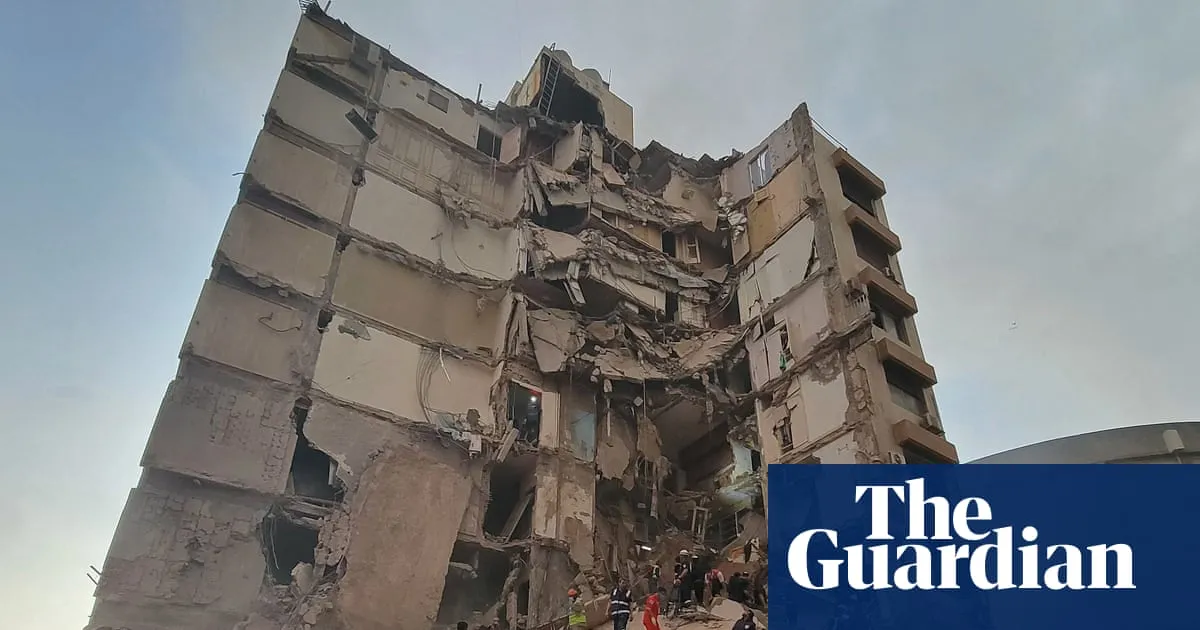
First responders and residents gather at the site of an Israeli airstrike in Beirut's Tallet al-Khayyat neighbourhood. Photograph: Fadel Itani/AFP/Getty ImagesIt took Israel only 10 minutes to carry out one of the worst mass-killings in Lebanon since the end of the country’s civil war in 1990.Omar Rakha heard the war planes but did not feel the explosions; it was only when he woke up face down on the street, bleeding, that he understood what had happened: the building next to his in the Barbour neighbourhood of central Beirut had been destroyed by two Israeli bombs. He then ran through the flaming wreckage to find his sister, screaming.Israeli airstrikes hit Beirut on Wednesday. Photograph: Hassan Ammar/APShaden Fakih, a 24-year-old calisthenics trainer, also ran towards the impact site; his friend Mahmoud was inside the struck building. He could only get so close; the multistorey building was a pile of burning rubble. Fakih began to pull people out of the apartments in front of the site, carrying in his arms an old woman who could not walk. There was no sign of Mahmoud and the neighbourhood – once thought to be safe from Israeli bombs – felt like a war zone.Dr Ghassan Abu-Sittah was in the emergency room when the casualties began to arrive. Among the wounded were children pulled from under the rubble; many arrived alone, without parents, their identities unknown. “The youngest was an 11-month-old. I had to operate on him just to relieve some pressure in the head,” said Abu-Sittah, who works as a surgeon at the American University of Beirut Medical College (AUBMC).Rescue workers search the rubble for survivors and casualties in Beirut. Photograph: Daniel Carde/Getty ImagesThe flood of wounded came after Israel bombed more than 100 targets across Lebanon in those 10 minutes on Wednesday, killing more than 300 people and wounding 1,165, according to an initial count by Lebanon’s civil defence. The death toll, which was expected to rise as more bodies were found, was higher than Beirut’s 2020 port explosion – one of the largest non-nuclear explosions in human history.The Israeli military said it had hit Hezbollah “command and control centres” in the bombing campaign, which it dubbed “Operation Eternal Darkness”.Deadly Israeli strikes hit Beirut – videoBut residents and Lebanese officials said the strikes, which used 1,000lb bombs in densely packed residential areas of Beirut, mainly killed civilians. Lebanon’s prime minister, Nawaf Salam, accused Israel in a statement of targeting “densely populated residential neighbourhoods” and killing unarmed civilians in breach of international law.Abu-Sittah said most of the people were wounded in a very short period of time, which was “intentional to flood the health system”, and he compared the aftermath to the mass casualty events he saw while working in Gaza.The AUBMC received about 70 wounded people all at once; many critically injured, according to Dr Firass Abiad, a surgeon and Lebanon’s former health minister. Crush injuries, lots of elderly people, a woman who had to have both her legs amputated – Abiad rattled off the toll of the day in a tired voice.Destroyed buildings and burned vehicles in the Corniche al-Mazraa area of Beirut. Photograph: Houssam Shbaro/Anadolu/Getty Images“There was a 90-year-old who I just left a bit ago. He passed away from his wounds … There was nothing we could do,” Abiad said. “These are civilians who, without any warning, their whole apartment building was flattened. So you can imagine the severity of injuries that we’re getting.”First responders in Barbour worked to find people trapped under the rubble. Firefighters sprayed water on the smouldering remains of the building while forklifts lifted crumpled cars to clear the road for ambulances. An emergency worker on the scene said they had not yet found any survivors, only pieces of people.A man FaceTimed his son, showing him a crumpled car. “You said it was a Volkswagen?” he said, haplessly looking at the crowd around him as he inspected the car. Its badge had been blown off the bumper and the twisted metal left the car unrecognisable.Rakha watched as the civil defence worked. “I really didn’t think something like this would happen here. Nothing like this happened in the last war [and] because of that all of the refugees came here for safety,” the 38-year-old supermarket owner said, his head wrapped in a blood-stained bandage.A man carries pieces of clothing at the site of an Israeli strike in Ain al-Mraiseh, Beirut. Photograph: Mohamed Azakir/ReutersBarbour, like many of the areas in Beirut that Israel struck on Wednesday, is a mixed neighbourhood where Hezbollah enjoys little support. As more than 1.1 million people were displaced by Israeli bombing over the last month, schools in Barbour opened their doors to shelter the fleeing families.The neighbourhood had not previously been considered within the scope of Israel’s war in Lebanon. But Israel’s military suggested on Wednesday that such areas had now become targets, claiming they had been infiltrated by Hezbollah fighters.Israel’s Arabic language spokesperson Avichay Adraee said on Wednesday: “Recently, the IDF [Israel Defense Forces] observed the terrorist group Hezbollah began leaving the Shiite strongholds in the suburbs and repositioning itself towards northern Beirut and the mixed areas of the city.” He vowed that Israel would “continue to pursue” Hezbollah fighters wherever they might be located.The Israeli military’s statements and bombing erased any hope that the ceasefire with Iran might also halt the war in Lebanon. The war, which started after Hezbollah launched rockets at Israel on 2 March prompting an Israeli bombing campaign and invasion of Lebanon, has left around 1,800 people dead and 5,873 wounded in Lebanon.Barbour’s residents rejected Israel’s explanation of its attacks, saying the strikes were driving even Hezbollah’s critics towards the group.The funeral of Mohammed Zain Al-Abidin Shehab, who was killed in an Israeli strike on Wednesday. Photograph: Mohamed Azakir/ReutersFakih said: “It’s getting ridiculous. There’s no Hezbollah here, the Israelis are just getting happy when they bomb people, it’s not about Hezbollah.“Just stop bombing us. If you want to kill Hezbollah, go for it, but don’t kill civilians, because you’re creating anger in us against Israel and we will have to act like Hezbollah just to defend our country. But I don’t want to do that, I just want to live in peace.”As night fell, people began to take stock of the dizzying, bloody day. Pictures of dust-covered babies pulled out from under rubble circulated on WhatsApp groups as people searched for their relatives.People shared a selfie of a smiling elderly couple, Mohammed and Khatoun Karshat, desperately asking if anyone had seen them after they went missing in one of the strikes. Their bodies were found under the rubble late in the night, and people kept sharing their selfie, now in memoriam.Fakih lingered by the impact site in Barbour as rescuers worked. It had been hours and he had not heard from his friend Mahmoud; his calls went to voicemail.“It’s been the worst day since the war started,” Fakih said. “And what I’m most sad about is that my pretty Lebanon, our beautiful Lebanon, soon it will all be brought down to the ground.”9:39
SRCThe Guardian - World News
LANGEN
LEANCenter-Left
WORDS1 174
ENT11
THU · 2026-04-09 · 13:00 GMTBRIEF NSR-2026-0409-60386
NSR-2026-0409-60386News Report·EN·Human Rights
‘There’s no Hezbollah here’: the Lebanese reaction to Israeli strikes that killed hundreds
Israeli airstrikes on Wednesday targeted over 100 locations in Lebanon, resulting in over 300 deaths and 1,165 injuries in just 10 minutes. The strikes, which Israel claims targeted Hezbollah command centers as part of "Operation Eternal Darkness," hit densely populated residential areas of Beirut.
William Christou in BeirutThe Guardian - World NewsFiled 2026-04-09 · 13:00 GMTLean · Center-LeftRead · 5 min
The Guardian - World NewsFIG 01
Reading time
5min
Word count
1 174words
Sources cited
5cited
Entities identified
11entities
Quality score
100%
§ 01
Briefing Summary
AI-generatedNEWSAR · AI
Israeli airstrikes on Wednesday targeted over 100 locations in Lebanon, resulting in over 300 deaths and 1,165 injuries in just 10 minutes. The strikes, which Israel claims targeted Hezbollah command centers as part of "Operation Eternal Darkness," hit densely populated residential areas of Beirut. First responders and residents described scenes of devastation, with many civilians, including children, among the casualties. The strikes used 1,000lb bombs. Lebanese officials, including Prime Minister Nawaf Salam, condemned the attacks, asserting that they primarily killed civilians. The death toll surpassed that of the 2020 Beirut port explosion, and is expected to rise as rescue efforts continue.
Confidence 0.90Sources 5Claims 5Entities 11
§ 02
Article analysis
Model · rule-basedFraming
Human Rights
Conflict
Tone
Mixed Tone
AI-assessed
CalmNeutralAlarmist
Factuality
0.70 / 1.00
Factual
LowHigh
Sources cited
5
Well sourced
FewMany
§ 03
Key claims
5 extracted01
Lebanon’s prime minister accused Israel of targeting “densely populated residential neighbourhoods”.
quoteNawaf Salam
Confidence
1.00
02
The Israeli military said it had hit Hezbollah “command and control centres”.
quoteIsraeli military
Confidence
1.00
03
Israel bombed more than 100 targets across Lebanon in 10 minutes.
factual
Confidence
0.90
04
The death toll was higher than Beirut’s 2020 port explosion.
factual
Confidence
0.90
05
Israeli airstrikes killed more than 300 people and wounded 1,165 in Lebanon on Wednesday.
statisticLebanon’s civil defence
Confidence
0.90
§ 04
Full report
5 min read · 1 174 words§ 05
Entities
11 identifiedKey playerOppositionContextPositiveNeutralNegative
People5
Organizations2
§ 06
Keywords & salience
8 termsisraeli airstrikes
1.00
lebanon
0.90
beirut
0.80
civilian casualties
0.70
bombing
0.60
hezbollah
0.50
war zone
0.40
rescue workers
0.40
§ 07
Topic connections
Interactive graph Network visualization showing 51 related topics
View Full Graph Person Organization Location Event|Click node to navigate|Edge numbers = shared articles