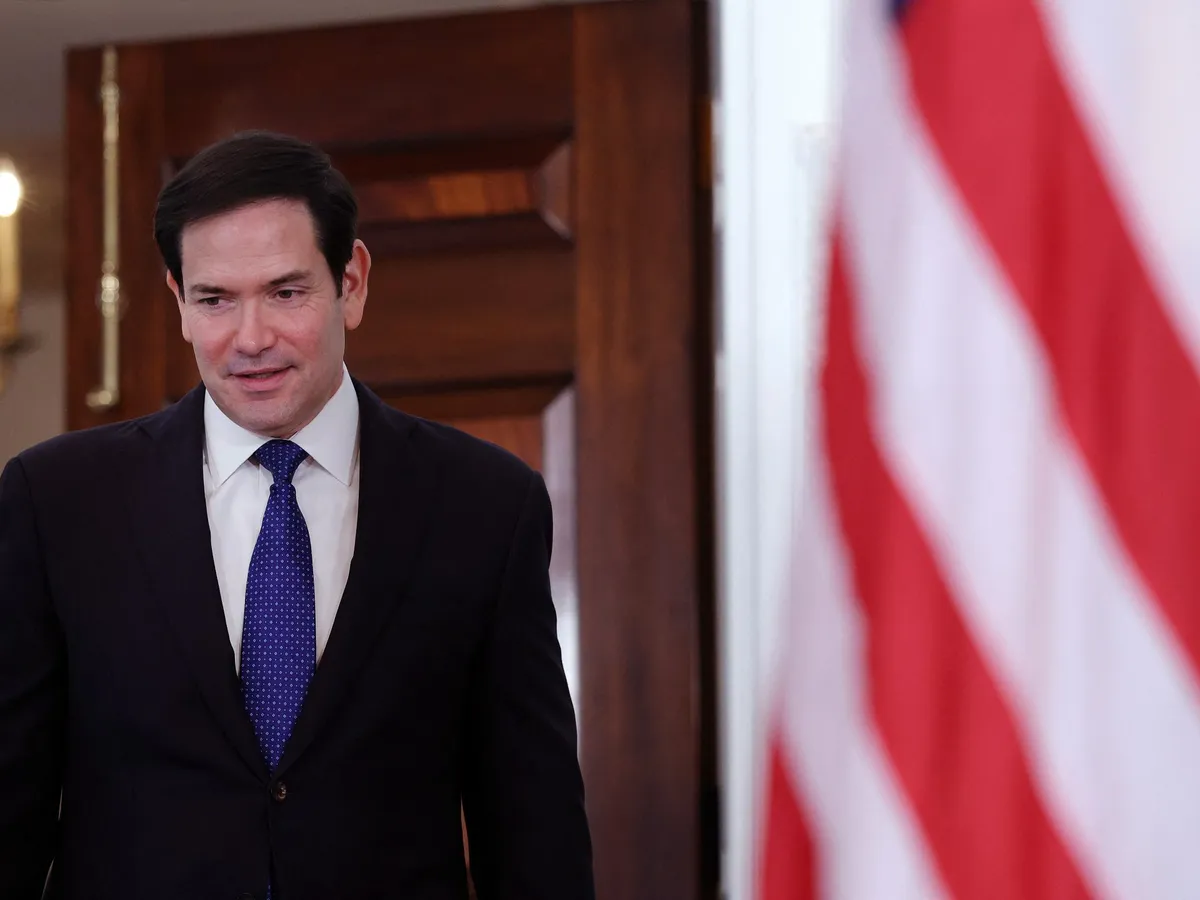
Top diplomat has long pushed toppling of Maduro, with eye towards Cuba, but remains constrained by competing ambitions.US Secretary of State Marco Rubio is seen at the State Department in Washington, DC, the United States [Kevin Dietsch/Getty AFP]Published On 6 Jan 2026Washington, DC – United States Secretary of State Marco Rubio has not been shy about his desire to see the toppling of Venezuelan President Nicolas Maduro.Infamously, the former Florida senator even posted a series of photos of slain deposed leaders, including a bloodied former Libyan leader Muammar Gaddafi, as tensions with the US and Maduro’s government spiked in 2019.Recommended Stories list of 3 itemslist 1 of 3How US statements on Venezuela shifted, from drugs to oillist 2 of 3The ‘terrorist’ labelled leaders who warned of US oil aggressionlist 3 of 3What to know about Delcy Rodriguez, Venezuela’s interim presidentend of listBut it was not until the second administration of US President Donald Trump that Rubio’s vision of a hardline approach to Latin America and his longtime pressure campaign against leftist leaders was realised – culminating on Saturday with the illegal abduction of longtime Venezuelan leader Maduro.Experts say Rubio has relied on an ability to capitalise on the overlapping interests of competing actors within the Trump administration to achieve this, even as his broader ideological goals, including the ousting of Cuba’s communist government, will likely remain constrained by the administration’s competing ambitions.“It took a tremendous amount of political skill on his part to marginalise other voices in the administration and elsewhere who were saying: ‘This is not our conflict. This is not what we stand for. This is going to upset our base,'” Alejandro Velasco, an associate professor of history at New York University, told Al Jazeera.Those agendas included Trump’s preoccupation with opening Venezuela’s nationalised oil industry, US Secretary of Defense Pete Hegseth’s desire for a more pugilistic military approach abroad, and adviser Stephen Miller’s fixation on migration and mass deportation.“So that’s the way that Rubio was able to bring into line not quite competing, but really divergent agendas, all of them to focus on Venezuela as a way to advance a particular end,” Velasco said.US Secretary of State Marco Rubio whispers in the ear of President Donald Trump during a roundtable discussion about antifa in the State Dining Room of the White House in Washington, DC, on October 8, 2025 [File: Jim Watson/AFP]A hawk in ‘America First’A traditionalist hawk who has regularly supported US military intervention in the name of spreading Western democracy and human rights abroad, Rubio initially appeared to be an awkward fit to be Trump’s top diplomat in his second term.His selection followed a campaign season defined by Trump’s vow to end foreign wars, eschew US-backed regime change, and pursue a wider “America First” pivot.But the actual shape of Trump’s foreign policy has borne little resemblance to that vision, with the administration adopting a so-called “Peace Through Strength” doctrine that observers say has resulted in more room for military adventurism. That has, to date, seen the Trump administration launch bombing campaigns against Yemen and Iran, strike armed groups in Nigeria and Somalia, and attack alleged drug smuggling boats in the Caribbean.The approach of Trump 2.0 has more closely aligned with Rubio’s vision of Washington’s role abroad, which has long supported maximum-pressure sanctions campaigns and various forms of US intervention to topple governments.The US secretary of state’s personal ideology traces to his South Florida roots, where his family settled in the 1960s after leaving Cuba three years before the rise of Fidel Castro, in what Velasco described as an “acerbically anti-communist” political environment.“I think for him, it started as a question of finally making real the hopes and dreams of Cubans in Florida and elsewhere to return to their homeland under a capitalist government,” Velasco explained.“It went from that to what this could represent, if we think about it more hemispherically – a bigger shift that would not only increase, but in fact ensure, US hegemony in the region for the 21st century.”‘Vacuum was his to fill’After tangling with Trump in the 2016 presidential election, in which the future president deridingly dubbed his opponent “Little Marco” while Rubio decried him as a “con man”, the pair forged a pragmatic working relationship.Rubio eventually endorsed Trump ahead of the 2016 vote, helping to deliver Florida. In Trump’s first term, Rubio came to be seen as the president’s “shadow secretary” on Latin America, an atypical role that saw the lawmaker influence Trump’s eventual recognition of Juan Guaido as interim president in opposition to Maduro.Analysts note Rubio’s approach to Venezuela has always been directly aimed at undermining the economic support it provides to Cuba, with the end goal of toppling the island’s 67-year-old Communist government. Following Maduro’s abduction on Saturday, Rubio quickly pivoted to the island nation, telling reporters: “If I lived in Havana and I was in the government, I’d be concerned”.Still, in the early months of Trump’s second term, Rubio appeared largely sidelined, with the president instead favouring close friends and family members to spearhead marquee negotiations on ceasefires in Gaza and Ukraine.During this time, Rubio was slowly amassing a sizeable portfolio. Beyond serving as secretary of state, Rubio became the acting administrator of the Trump-dismantled US Agency for International Development (USAID) and the acting archivist of the US National Archives. Most notably, he became the acting director of National Security, making him the first top US diplomat to also occupy the impactful White House role since Henry Kissinger.A Venezuelan in Miami holds a picture of US Secretary of State Marco Rubio during a rally in response to US military strikes in Venezuela; in Miami, Florida, the US, January 3, 2026 [Cristobal Herrera-Ulashkevich/EPA]Rubio eventually found himself in a White House power vacuum, according to Adam Isacson, the director of defence oversight at the Washington Office on Latin America (WOLA).“Rubio’s somebody who understands Washington better than the Grenells and Witkoffs of the world,” Isacson told Al Jazeera, referring to Trump’s special envoys Richard Grenell and Steve Witkoff.“At the same time, other powerful figures inside the White House, like Stephen Miller and [Director of the Office of Management and Budget] Russ Vought haven’t cared as much about foreign policy,” he said, “so the vacuum was his to fill.”Meanwhile, Rubio showed his ability to be an “ideological weather vane”, pivoting regularly to stay in Trump’s good graces, Isacson said. The National Security Strategy released by the White House in December exemplified that approach.The document, which is drafted by the National Security adviser with final approval from the president, offered little in tough language towards Russia, despite Rubio’s previous hard lines on the war in Ukraine. It supported the gutting of US foreign aid, despite Rubio’s years-long support for the system. It offered little of the human-rights language with which Rubio had earlier in his career styled himself as a champion.It did, however, include a “Trump corollary” to the Monroe Doctrine, which dovetailed with Rubio’s worldview by calling for the restoration of US “preeminence” over the Western Hemisphere.A pyrrhic victory?To be sure, the toppling of Maduro has so far proved a partial, if not pyrrhic victory for Rubio, far short of the comprehensive change he has long supported.In a news conference immediately following Maduro’s abduction, Trump doused support for exiled opposition leader Maria Corina Machado, who has hewed close to Rubio’s vision for a future Venezuela. Several news agencies have since reported that US intelligence assessed that installing an opposition figure would lead to widespread chaos in the country.
SRCAl Jazeera
LANGEN
LEANCenter
WORDS1 246
ENT10
TUE · 2026-01-06 · 20:40 GMTBRIEF NSR-2026-0106-6057
NSR-2026-0106-6057Analysis·EN·Political Strategy
Maduro abduction shows influence, limits of US Secretary of State Rubio
In 2026, US Secretary of State Marco Rubio's long-standing hardline stance against leftist leaders in Latin America culminated in the abduction of Venezuelan President Nicolas Maduro. Rubio, known for his strong desire to oust Maduro and previously expressing aggressive sentiments, capitalized on the Trump administration's various interests to achieve this.
Joseph StepanskyAl JazeeraFiled 2026-01-06 · 20:40 GMTLean · CenterRead · 5 min
Al JazeeraFIG 01
Reading time
5min
Word count
1 246words
Sources cited
1cited
Entities identified
10entities
Quality score
100%
§ 01
Briefing Summary
AI-generatedNEWSAR · AI
In 2026, US Secretary of State Marco Rubio's long-standing hardline stance against leftist leaders in Latin America culminated in the abduction of Venezuelan President Nicolas Maduro. Rubio, known for his strong desire to oust Maduro and previously expressing aggressive sentiments, capitalized on the Trump administration's various interests to achieve this. These included President Trump's focus on Venezuelan oil, Secretary of Defense Hegseth's preference for military action, and advisor Miller's immigration policies. Experts note that Rubio skillfully aligned these divergent agendas to focus on Venezuela. However, it is expected that Rubio's broader goals, such as removing Cuba's communist government, will be limited by the administration's other priorities.
Confidence 0.90Sources 1Claims 5Entities 10
§ 02
Article analysis
Model · rule-basedFraming
Political Strategy
National Security
Tone
Mixed Tone
AI-assessed
CalmNeutralAlarmist
Factuality
0.60 / 1.00
Mixed
LowHigh
Sources cited
1
Limited
FewMany
§ 03
Key claims
5 extracted01
Rubio posted photos of slain deposed leaders, including Muammar Gaddafi, in 2019.
factualArticle
Confidence
1.00
02
It took political skill to marginalise voices saying 'This is not our conflict'.
quoteAlejandro Velasco
Confidence
0.90
03
Marco Rubio has long pushed for the toppling of Venezuelan President Nicolas Maduro.
factualArticle
Confidence
0.90
04
Rubio's vision of a hardline approach to Latin America was realised with the illegal abduction of Maduro.
factualArticle
Confidence
0.80
05
Trump was preoccupied with opening Venezuela’s nationalised oil industry.
factualArticle
Confidence
0.70
§ 04
Full report
5 min read · 1 246 words§ 05
Entities
10 identifiedKey playerOppositionContextPositiveNeutralNegative
People6
Organizations1
§ 06
Keywords & salience
9 termsmarco rubio
1.00
venezuela
0.90
nicolas maduro
0.80
us foreign policy
0.70
trump administration
0.60
latin america
0.60
political influence
0.50
cuba
0.40
abduction
0.40
§ 07
Topic connections
Interactive graph Network visualization showing 51 related topics
View Full Graph Person Organization Location Event|Click node to navigate|Edge numbers = shared articles