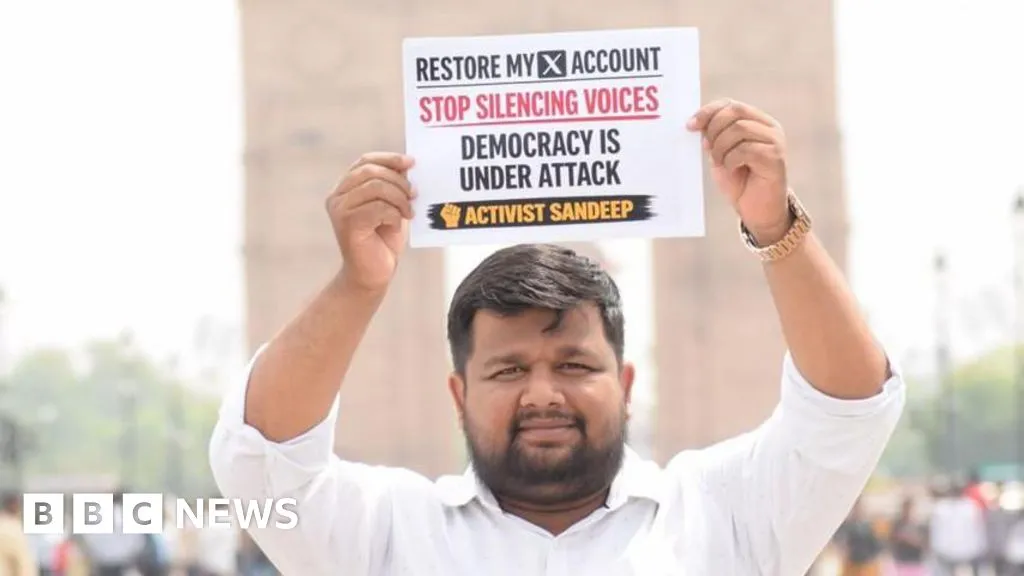
"Interestingly, despite the many laws regulating online content, hate speech and fake news haven't reduced in the country. Meanwhile, posts that are critical of the government - even if they're satirical - are increasingly being blocked or removed," Banerjee says. The authorities reject the charge. Getty ImagesInternet rights activists worry the new rules will be misused by the government to clamp down on dissentBut last month, X blocked about a dozen accounts, many known for satirical posts about the government, acting on orders issued under Section 69A of India's IT Act.Kumar Nayan, whose X account @Nehr_who? has about 242,000 followers, told the BBC he received neither prior notice nor an explanation for the block.Nayan said his account was restored this week by a court order, but 10 posts remain blocked in India pending review by a government-appointed panel. The BBC has seen the posts, all of which either mock Prime Minister Narendra Modi or criticise his Bharatiya Janata Party (BJP) government."No reasonable person will say that these posts threaten the nation's security or disturb communal harmony. They are just funny posts, so why does the government want them taken down? Nayan asks.He added that by challenging the order in court, his identity is now public, raising concerns about his safety."I have lost the anonymity offered by social media, which is a double-edged sword but also shields whistleblowers and critics from threats and harassment," he says.Nayan has moved home since his identity became public.The BBC has shared a list of questions with MeitY.Meanwhile, a recent US government report noted that since 2021, US social media firms had been subjected to an "increasing number of takedown requests for content and user accounts related to issues that appear politically motivated".Nikhil Pahwa, a digital rights activist, says the proposed amendments to the IT rules only strengthen the government's existing "infrastructure for mass censorship".In an article co-authored with Apar Gupta, founder of the Internet Freedom Foundation, in the Times of India newspaper, Pahwa traces how successive amendments to the IT rules - introduced in 2021 - have expanded the government's control over online content and diminished users' rights.A 2021 amendment brought digital news outlets under government oversight, while a 2025 change strengthened the federal home ministry's Sahyog portal - a centralised platform that allows a number of agencies to issue takedown notices to social media companies with limited transparency and fewer safeguards, say the authors.Getty ImagesThe government has said that there needs to be a "common framework" to govern news content as such content is no longer only shared by news publishers.This portal functions as a parallel mechanism for removing content, distinct from the blocking powers granted to the federal government under Section 69A of the IT Act.The IT rules were amended yet again in early 2026, where the window for social media firms to comply with government blocking orders was reduced from 36 to three hours, severely reducing the scope for legal review."Keen to preserve market access in India, platforms comply. Citizens whose speech is restricted receive no notice, no hearings, no reasons, and neither government nor platforms can be held to account by a legal system being outpaced by regulatory agility," Pahwa writes. MeitY Secretary S Krishnan has defended the IT rules and the recently proposed changes saying that guidelines issued by his ministry are in keeping with the law and the Constitution. He told the BBC that there "needed to be a common policy or common framework" to govern news and current affairs' content as such content is no longer shared only by news publishers but also ordinary citizens.Sandeep Singh, whose X account @ActivistSandeep (with 100,000+ followers) was among those blocked in March, says he began posting critical views after feeling mainstream media was "biased" in favour of the BJP.Singh's X account remained blocked in India at the time of writing this article."I stand for the truth and blocking my accounts or posts will not stop me from continuing speaking truth to power," Singh told the BBC. Nayan says that while he has the means to challenge the blocking orders in court, not every person will be willing to go to such lengths to have their content restored.
SRCBBC News - World
LANGEN
LEANCenter
WORDS696
ENT11
FRI · 2026-04-10 · 00:23 GMTBRIEF NSR-2026-0410-61141
NSR-2026-0410-61141News Report·EN·Political Strategy
India proposes new rules to regulate news and political posts on social media
India is proposing new rules to regulate news and political content on social media platforms, raising concerns about potential government censorship. The proposal follows instances of the government ordering social media platforms like X to block accounts, particularly those known for satirical posts critical of the government.
BBC News - WorldFiled 2026-04-10 · 00:23 GMTLean · CenterRead · 3 min
BBC News - WorldFIG 01
Reading time
3min
Word count
696words
Sources cited
4cited
Entities identified
11entities
Quality score
100%
§ 01
Briefing Summary
AI-generatedNEWSAR · AI
India is proposing new rules to regulate news and political content on social media platforms, raising concerns about potential government censorship. The proposal follows instances of the government ordering social media platforms like X to block accounts, particularly those known for satirical posts critical of the government. Critics argue that these actions, often justified under Section 69A of India's IT Act, are politically motivated and suppress dissent. A recent US government report also noted an increase in takedown requests from India targeting politically sensitive content. Digital rights activists fear the proposed rules will further expand the government's control over online content and diminish user rights, potentially impacting anonymity and safety for critics.
Confidence 0.90Sources 4Claims 5Entities 11
§ 02
Article analysis
Model · rule-basedFraming
Political Strategy
Human Rights
Tone
Measured
AI-assessed
CalmNeutralAlarmist
Factuality
0.70 / 1.00
Factual
LowHigh
Sources cited
4
Well sourced
FewMany
§ 03
Key claims
5 extracted01
Kumar Nayan's X account @Nehr_who? has about 242,000 followers.
factualBBC
Confidence
1.00
02
A US government report noted an increasing number of takedown requests for content and user accounts related to politically motivated issues since 2021.
factualBBC
Confidence
0.90
03
X blocked about a dozen accounts known for satirical posts about the government, acting on orders issued under Section 69A of India's IT Act.
factualBBC
Confidence
0.90
04
Posts critical of the government, even satirical ones, are increasingly being blocked or removed.
quoteBanerjee
Confidence
0.80
05
Amendments to the IT rules strengthen the government's existing infrastructure for mass censorship.
quoteNikhil Pahwa
Confidence
0.70
§ 04
Full report
3 min read · 696 words§ 05
Entities
11 identifiedKey playerOppositionContextPositiveNeutralNegative
People4
Organizations5
§ 06
Keywords & salience
10 termssocial media regulation
0.90
government censorship
0.80
online content regulation
0.80
it rules
0.70
freedom of speech
0.70
political posts
0.60
takedown requests
0.60
digital rights
0.50
satirical posts
0.50
dissent
0.40
§ 07
Topic connections
Interactive graph Network visualization showing 51 related topics
View Full Graph Person Organization Location Event|Click node to navigate|Edge numbers = shared articles