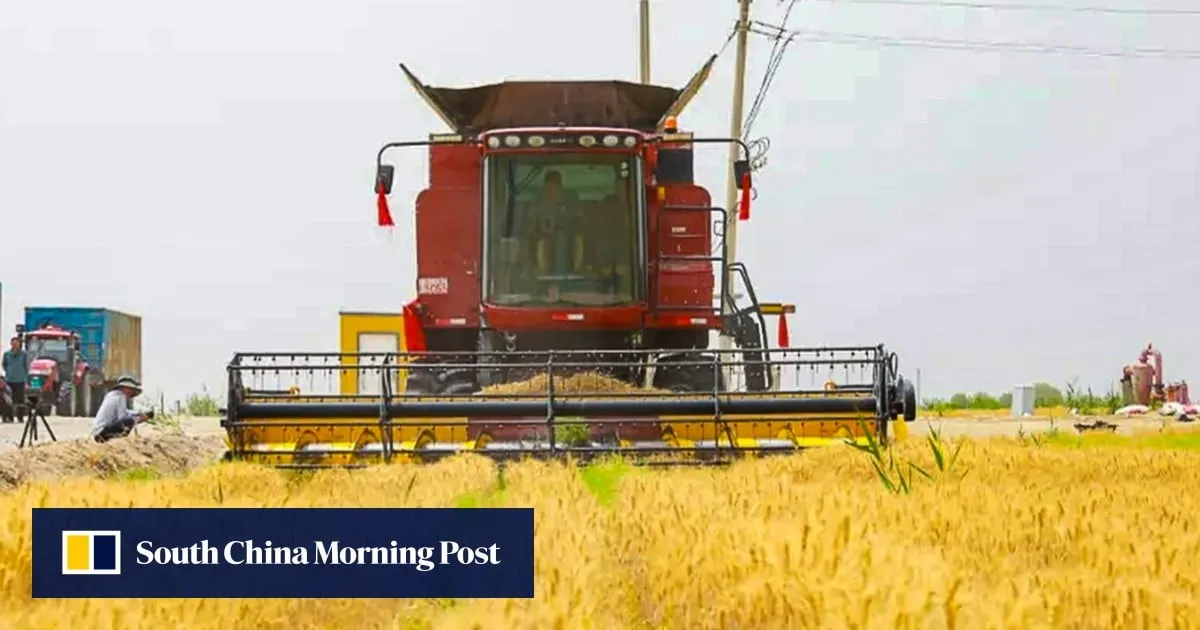
China’s “desert wheat farms” have survived repeated sandstorms and continue to grow following an initial trial in the country’s largest desert, as part of an ongoing effort to combat desertification and unlock the land’s potential for strengthening national food security.Two years ago, on the fringes of the Taklamakan Desert in the Xinjiang Uygur Autonomous Region, China launched an unprecedented project to plant wheat in sand.The first harvest, covering 400 hectares (988 acres) on the desert’s southwestern edge, proved a landmark achievement. Since then, sustained efforts across various desert locations have enabled crops to withstand harsh conditions, while reducing the labour required as the planting area expands.In Kunyu, a county-level city on the southern edge of the Taklamakan, the latest wheat crop – planted across more than 8,200 mu, or about 547 hectares – has maintained a greening and seedling-survival rate of over 90 per cent, according to a People’s Daily report in early April.Farm managers in the region have implemented highly automated irrigation technology known as a “pivot sprinkler system”, featuring multiple suspended showerhead-like nozzles.Once the settings are calibrated and fertiliser is supplied, the system requires minimal human oversight. “Where 30 people were once required, now only four are needed,” Cui Gangchuang, the field manager, was quoted as saying.The project has had its challenges. When Cui’s agricultural company took over the land in 2024, the site consisted of little more than rolling sand dunes.
SRCSouth China Morning Post
LANGEN
LEANCenter-Right
WORDS234
ENT6
FRI · 2026-04-10 · 05:09 GMTBRIEF NSR-2026-0410-61341
NSR-2026-0410-61341News Report·EN·Environmental
2 years on: China proves its ‘desert wheat farms’ are not a hoax
China's "desert wheat farms," initiated two years ago on the fringes of the Taklamakan Desert in Xinjiang, have proven successful in combating desertification and bolstering food security. The project, which began with a 400-hectare trial, has expanded to multiple desert locations, with the latest crop covering 547 hectares in Kunyu.
Dannie PengSouth China Morning PostFiled 2026-04-10 · 05:09 GMTLean · Center-RightRead · 1 min
South China Morning PostFIG 01
Reading time
1min
Word count
234words
Sources cited
2cited
Entities identified
6entities
Quality score
100%
§ 01
Briefing Summary
AI-generatedNEWSAR · AI
China's "desert wheat farms," initiated two years ago on the fringes of the Taklamakan Desert in Xinjiang, have proven successful in combating desertification and bolstering food security. The project, which began with a 400-hectare trial, has expanded to multiple desert locations, with the latest crop covering 547 hectares in Kunyu. Automated irrigation technology, specifically a pivot sprinkler system, has been implemented to reduce labor requirements and maintain a high seedling-survival rate. Despite initial challenges of planting in rolling sand dunes, the project demonstrates China's commitment to unlocking the agricultural potential of desert land. The ongoing effort aims to address national food security concerns by cultivating wheat in previously unusable areas.
Confidence 0.90Sources 2Claims 5Entities 6
§ 02
Article analysis
Model · rule-basedFraming
Environmental
Economic Impact
Tone
Measured
AI-assessed
CalmNeutralAlarmist
Factuality
0.80 / 1.00
Factual
LowHigh
Sources cited
2
Limited
FewMany
§ 03
Key claims
5 extracted01
The planting area is expanding.
factual
Confidence
1.00
02
Where 30 people were once required, now only four are needed.
quoteCui Gangchuang, the field manager
Confidence
1.00
03
The latest wheat crop has maintained a greening and seedling-survival rate of over 90 per cent.
statisticPeople’s Daily report
Confidence
1.00
04
The first harvest covered 400 hectares on the desert’s southwestern edge.
factual
Confidence
1.00
05
China launched a project to plant wheat in sand on the fringes of the Taklamakan Desert two years ago.
factual
Confidence
1.00
§ 04
Full report
1 min read · 234 words§ 05
Entities
6 identifiedKey playerOppositionContextPositiveNeutralNegative
Organizations1
§ 06
Keywords & salience
9 termsdesert wheat farms
1.00
desertification
0.80
food security
0.70
taklamakan desert
0.70
pivot sprinkler system
0.60
irrigation technology
0.60
china
0.50
crop yield
0.40
automated irrigation
0.40
§ 07
Topic connections
Interactive graph Network visualization showing 51 related topics
View Full Graph Person Organization Location Event|Click node to navigate|Edge numbers = shared articles