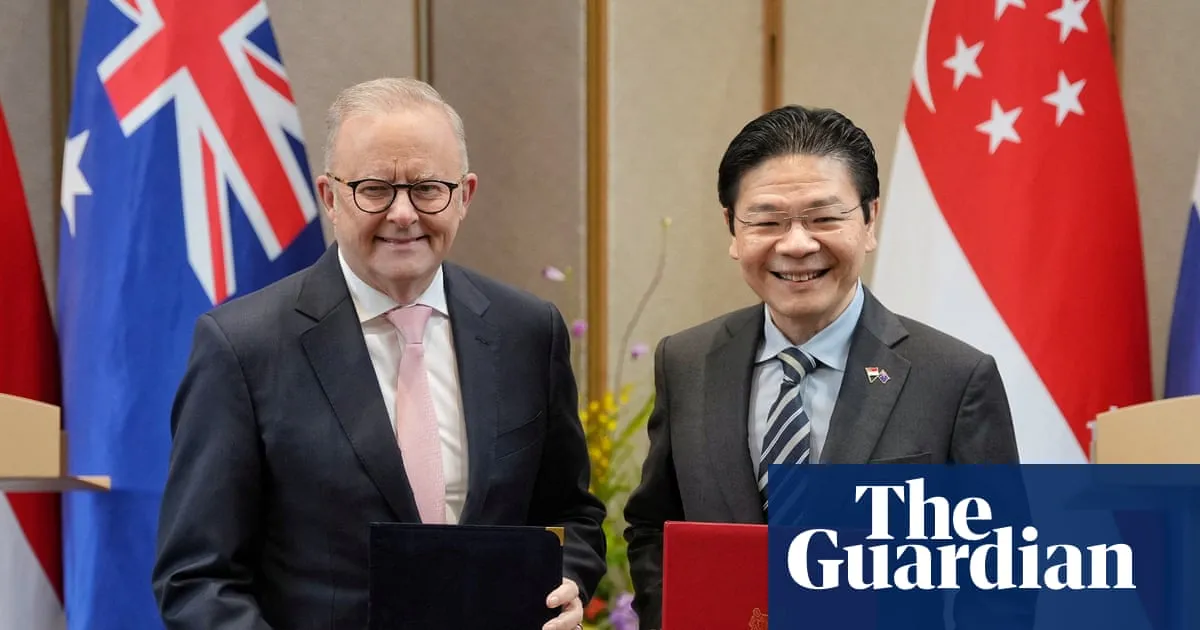
Australian PM Anthony Albanese met with Singapore’s prime minister, Lawrence Wong. The two countries have agreed to keep sending one another fuel and liquefied natural gas amid the ongoing energy crisis caused by the war in the Middle East. Photograph: Chia Ti Yan/Reuters View image in fullscreen Australian PM Anthony Albanese met with Singapore’s prime minister, Lawrence Wong. The two countries have agreed to keep sending one another fuel and liquefied natural gas amid the ongoing energy crisis caused by the war in the Middle East. Photograph: Chia Ti Yan/Reuters Cutting fuel to Australia ‘won’t happen’, says Singapore PM, as Albanese secures pledge from our largest petrol source Australia and Singapore will ‘make maximum efforts to meet each other’s energy security needs’ in refined fuels and LNG, according to new agreement Get our breaking news email, free app or daily news podcast Australia’s largest petrol source has pledged not to cut supplies, with Singapore’s prime minister telling Anthony Albanese that fuel will keep flowing despite the international crisis. Albanese’s whistle-stop visit with his Singaporean counterpart, Lawrence Wong, culminated in a new agreement that the two countries would keep sending one another fuel and liquefied natural gas, amid the “acute energy crisis” caused by the war in the Middle East. Australia and Singapore will also add a legally binding addendum to their free trade agreement on essential supplies like energy. While the visit to Singapore didn’t lead to any immediate announcements of extra fuel supplies coming to Australia – a fact quickly seized on by the Coalition opposition – the government said the visit would help secure fuel supplies. “We do not plan to restrict exports. We didn’t have to do so even in the darkest days of Covid, and we will not do so during this energy crisis,” Wong said when asked if Australia would get priority treatment if Singapore was forced to cut production. Singapore is Australia’s largest trade partner in south-east Asia, and considered one of Canberra’s closest strategic and economic partners. Australia is Singapore’s second biggest supplier of LNG, while Singapore is Australia’s largest supplier of petrol. Singapore makes up more than a quarter of Australia’s total refined fuel imports, including 55% of our petrol, 22% of jet fuel and 15% of diesel worth more than $10bn. Australia supplies 32% of Singapore’s LNG, worth about $5bn. Albanese’s short trip to Singapore, with only one full day on the ground, was not anticipated to immediately lock in any new fuel supplies. But amid global supply shocks from the Middle East war, and ongoing interruptions to shipping through the strait of Hormuz – further complicated by Israel’s ongoing bombing campaign in Lebanon – there is concern that major exporters of fuel may see their supplies interrupted. Albanese and his government have mounted a major diplomatic offensive to ensure Australian fuel imports keep arriving, including using our own exports of gas and coal as leverage. “These are difficult times, not just for Australia and Singapore, but for countries everywhere,” Wong said. “That is why in times like these, we must work closely, move faster, and stand together. Not just to manage the risk, but to protect the wellbeing of our people.” The joint statement agreed by Albanese and Wong said Australia and Singapore would “make maximum efforts to meet each other’s energy security needs” in refined fuels and LNG. “We reaffirmed our commitment to support the flow of essential goods including petroleum oils, such as diesel, and LNG and agreed to intensify cooperation to facilitate the timely movement of goods and essential supplies through enhanced coordination, efficient border and port processes, transparency, and early consultation,” the statement read. “We agreed on the need to coordinate our response to this global crisis so that both our economies are stronger and more resilient into the future.” “We recognised the importance of the role of our countries in each other’s energy security – Singapore is one of Australia’s top suppliers of refined petroleum products, and Australia is one of Singapore’s top suppliers of liquefied natural gas.” While Albanese did not secure any additional fuel supplies during the visit, both sides said the agreement would lock in future ongoing supplies. “This is not just about managing today’s crisis. It’s about building trusted supply lines for a more uncertain future,” Wong said. Albanese spoke favourably of giving Singapore more access to additional Australian LNG. Wong said a new Singaporean government body, which centralises imports of gas, would “look to Australia to assess more gas on a commercial basis, and hopefully more long term gas as well.” However Albanese appeared to downplay the prospects of his government instituting a new tax on gas exports, as has been championed by progressive campaigners, members of his own Labor backbench, and even the Coalition’s shadow minister Andrew Hastie. Asked if there would be such a measure in the May federal budget, Albanese largely sidestepped the question but did not express support for the change. “We have three priorities when it comes to energy, both now and certainly in the immediate period, they are supply, supply and supply … if there’s a fourth, below supply is price,” he said. Wong said Singapore would focus on diversifying its supply of LNG, with a major concern being price competitiveness, but added: “we hope to have more sources from Australia.” Explore more on these topics Petrol prices Singapore Asia Pacific Australian politics US-Israel war on Iran Anthony Albanese Energy news Share Reuse this content
SRCThe Guardian - World News
LANGEN
LeanCenter-Left
WORDS911
ENT8
FRI · 2026-04-10 · 08:16 GMTBRIEF NSR-2026-0410-61643
NSR-2026-0410-61643News Report·EN·National Security
Cutting fuel to Australia ‘won’t happen’, says Singapore PM, as Albanese secures pledge from our largest petrol source
Australian Prime Minister Anthony Albanese met with Singaporean Prime Minister Lawrence Wong to secure continued fuel supplies amidst the ongoing energy crisis. Singapore, Australia's largest petrol source, pledged not to cut fuel exports to Australia.
Josh ButlerThe Guardian - World NewsFiled 2026-04-10 · 08:16 GMTLean · Center-LeftRead · 4 min
The Guardian - World NewsFIG 01
Reading time
4min
Word count
911words
Sources cited
2cited
Entities identified
8entities
NEWSAR · AI
Australian Prime Minister Anthony Albanese met with Singaporean Prime Minister Lawrence Wong to secure continued fuel supplies amidst the ongoing energy crisis. Singapore, Australia's largest petrol source, pledged not to cut fuel exports to Australia. The two countries agreed to continue supplying each other with fuel and liquefied natural gas (LNG) and will add a legally binding addendum to their free trade agreement regarding essential supplies. Singapore is Australia's largest supplier of petrol, accounting for over a quarter of Australia's refined fuel imports, while Australia is Singapore's second-biggest supplier of LNG. The agreement aims to ensure energy security for both nations during the current global instability.
Confidence 0.90Sources 2Claims 5Entities 8
Framing
National Security
Economic Impact
Tone
Measured
AI-assessed
CalmNeutralAlarmist
Factuality
0.80 / 1.00
Factual
LowHigh
Sources cited
2
Limited
FewMany
01
Australia supplies 32% of Singapore’s LNG.
statistic
Confidence
1.00
02
Singapore makes up more than a quarter of Australia’s total refined fuel imports.
statistic
Confidence
1.00
03
Cutting fuel to Australia ‘won’t happen’.
quoteSingapore PM Lawrence Wong
Confidence
1.00
04
Singapore is Australia’s largest supplier of petrol.
factual
Confidence
1.00
05
Australia and Singapore will ‘make maximum efforts to meet each other’s energy security needs’ in refined fuels and LNG.
factualnew agreement
Confidence
0.90
§ 04
Full report
4 min read · 911 wordsKey playerOppositionContextPositiveNeutralNegative
Organizations1
Locations4
Topics1
fuel supply
0.90
australia
0.90
singapore
0.90
energy security
0.80
lng
0.70
energy crisis
0.70
petrol
0.70
refined fuels
0.60
trade agreement
0.60
exports
0.50
§ 07
Connections
Who appears together in the newsIn this articleWider coverageLine weight = articles in common
Laying out network…
Strongest ties articles in common
- 409
- 133
- 121
- 101
- 65
- 55
Recurring context not named in this article
- LChinalinks 8
- LIranlinks 8
- LIsraellinks 8
- LUnited Stateslinks 8
- LStrait of Hormuzlinks 8
- TArtificial Intelligencelinks 8
- PDonald Trumplinks 7
- LJapanlinks 7