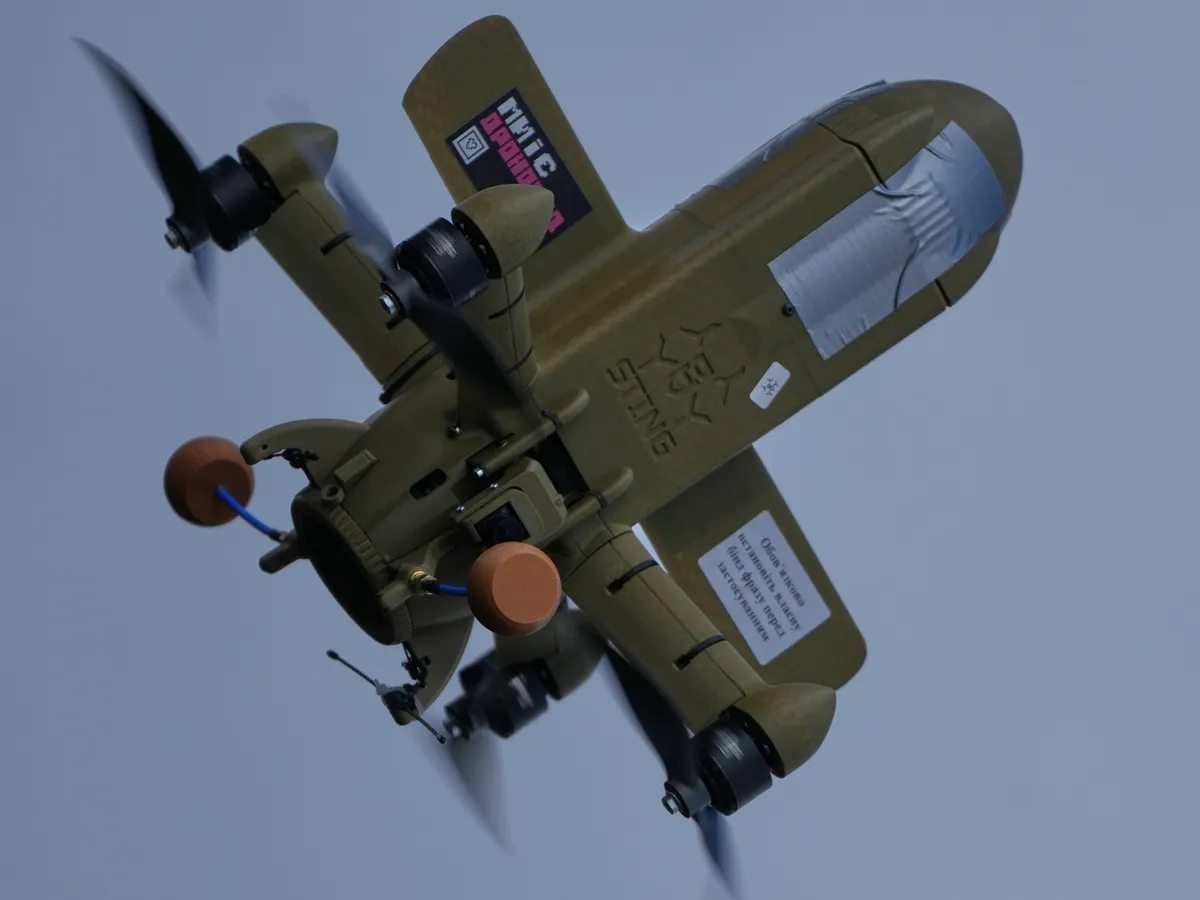
Russian casualties are mounting, its recruitment is falling and its territorial acquisitions are dwindling, recently released figures suggest.A Sting interceptor drone flies during drills at the Yatagan School for Unmanned Aerial Systems in the Kyiv region, Ukraine, on March 19, 2026 [Efrem Lukatsky/ AP Photo]Published On 10 Apr 2026The casualty rate for Russian soldiers in Ukraine increased to a new monthly high in March, according to Ukraine’s armed forces. They say drone production enabled a record number of strikes.Ukraine tallied Russian casualties at 35,351 last month, with drones causing 96 per cent of them while artillery and small arms fire accounted for the rest. That casualty rate was a 29 per cent increase on February, said Ukraine’s commander in chief.“These are clearly confirmed losses: we have video footage of each such strike in our system,” said Ukrainian Defence Minister Mykhailo Fedorov.The losses are slightly above a previous record set in December, and appear to confirm Ukraine’s claim that Russian casualty rates are rising inexorably this year. Ukrainian Presidential Office Deputy Head Colonel Pavlo Palisa told RBC-Ukraine that Russia had suffered 316 casualties for every square kilometre it captured in the first three months of 2026, compared with 120 casualties per square kilometre last year.Ukraine’s defence ministry said Russia has been unable to replace all of the losses since December. Russia aimed to recruit 409,000 contract soldiers this year, Ukraine’s armed forces said in January.That means a daily average recruitment rate of 1,120. But Ukraine’s “I Want to Live” initiative, which provides communication channels for Russian soldiers wishing to surrender, said Russia recruited 940 troops a day in the first quarter.If sustained, that meant Russian recruitment was on track for a 65,000-man shortfall this year. Ukraine now sees manpower shortages as a Russian strategic weakness it can exploit. President Volodymyr Zelenskyy, set a goal of 50,000 Russian casualties a month in January, which he called the “optimal level” to ensure Russian forces weaken irrecoverably.“We are confidently moving towards our strategic goal – 50,000+ eliminated occupiers per month,” said the Ukrainian Defence Ministry.The territory Russia is capturing for its mounting losses is also in long-term decline, according to estimates by the Institute for the Study of War, a Washington-based think tank. Russian forces captured an average of 5.5sq km a day this year, compared to 10.66sq km a day in the middle of last year and 14.9sq km a day at the end of 2024, said the ISW.Zelenskyy said the stark reality of manpower weakness lay behind Russian President Vladimir Putin’s ceasefire demand that Ukraine hand over the heavily fortified quarter of the eastern Donetsk region it held last August.“They believe that if we retreat, they won’t lose hundreds of thousands of people,” Zelenskyy told the Associated Press in an interview this week.Drones are the keyUkrainian officials credit drone production and training for their armed forces’ growing lethality. Commander-in-Chief Oleksandr Syrskii said the armed forces struck 151,207 targets in March using drones, a 50 per cent increase on February. That’s the result of 11,000 drone sorties a day.“This is all a historical maximum,” Syrskii said.Palisa said that’s because Ukraine’s drone manufacturing had managed to outpace Russia’s to achieve a 1.3:1 overall ratio in First Person View drones on the frontlines.Other reports suggested Ukraine was raising drone production. Fedorov said Ukrainian interceptor drones shot down a record 33,000 Russian UAVs of various types in March – twice as many as in the previous month.His deputy, Serhii “Flash” Beskrestnov said he was working with interceptor drone manufacturers to develop the next generation of interceptors capable of flying at 400-550km/h to counter the jet-powered Shahed drones to which Russia was gradually converting.Fire Point, Ukraine’s biggest manufacturer of long-range drones used in the majority of strikes deep inside Russia, told Reuters that it had designed two ballistic missiles of 300km and 850km range, which were approaching the deployment stage.The longer-range type is capable of reaching Moscow.Ukraine gains defensive ‘strategic initiative’Syrskii thinks that Ukraine’s forces, although still ceding small amounts of territory, have now gained “the strategic initiative” because they “do not allow Russian troops to resume a large-scale offensive.”He said an increase in mid-range strikes against logistics, warehouses, command posts and oil depots 30-120 km into the Russian rear had been particularly effective in hamstringing Russian assaults – one of the top operational priorities.Syrskii said on April 5 that fighting was most intense in Dnipropetrovsk, where Ukraine’s forces have recaptured eight settlements and 480sq km of territory.Ukraine’s leadership has long believed that Russia harbours territorial ambitions to seize the Odesa and Mykolaiv regions to control Ukraine’s entire Black Sea coastline, and to carve out a buffer zone across northern Ukraine.Palisa told RBK-Ukraine on April 8 that Russia also planned to create a southern buffer zone in Ukraine’s southwestern Vinnytsia region next to Moldova’s Russian-speaking territory of Transnistria.That was the first time a Ukrainian official has suggested such an ambition. “I am 100 per cent convinced that the Russians want to completely occupy us,” Zelenskyy told the AP.
SRCAl Jazeera
LANGEN
LEANCenter
WORDS831
ENT9
FRI · 2026-04-10 · 13:19 GMTBRIEF NSR-2026-0410-62013
NSR-2026-0410-62013News Report·EN·Conflict
Russia suffers ‘record’ soldier casualties as Ukraine ups drone production
According to Ukraine's armed forces, Russian soldier casualties reached a record high in March 2026, totaling 35,351, largely due to increased Ukrainian drone production and strikes. This casualty rate represents a 29% increase compared to February.
John T PsaropoulosAl JazeeraFiled 2026-04-10 · 13:19 GMTLean · CenterRead · 4 min
Al JazeeraFIG 01
Reading time
4min
Word count
831words
Sources cited
5cited
Entities identified
9entities
Quality score
100%
§ 01
Briefing Summary
AI-generatedNEWSAR · AI
According to Ukraine's armed forces, Russian soldier casualties reached a record high in March 2026, totaling 35,351, largely due to increased Ukrainian drone production and strikes. This casualty rate represents a 29% increase compared to February. Ukraine's defense ministry reports that Russia is struggling to replace these losses, with recruitment efforts falling short of their target of 409,000 contract soldiers this year. The "I Want to Live" initiative indicates Russia is recruiting fewer soldiers per day than needed to meet this goal. The Institute for the Study of War estimates that the amount of territory Russia captures daily is also decreasing. Ukraine aims to further weaken Russian forces by inflicting 50,000 casualties monthly.
Confidence 0.90Sources 5Claims 5Entities 9
§ 02
Article analysis
Model · rule-basedFraming
Conflict
Political Strategy
Tone
Mixed Tone
AI-assessed
CalmNeutralAlarmist
Factuality
0.70 / 1.00
Factual
LowHigh
Sources cited
5
Well sourced
FewMany
§ 03
Key claims
5 extracted01
These are clearly confirmed losses: we have video footage of each such strike in our system.
quoteUkrainian Defence Minister Mykhailo Fedorov
Confidence
0.90
02
Ukraine tallied Russian casualties at 35,351 last month, with drones causing 96 per cent of them.
statisticUkraine’s armed forces
Confidence
0.90
03
Russia aimed to recruit 409,000 contract soldiers this year.
factualUkraine’s armed forces
Confidence
0.80
04
Russian forces captured an average of 5.5sq km a day this year.
statisticthe Institute for the Study of War
Confidence
0.80
05
Russia recruited 940 troops a day in the first quarter.
statisticUkraine’s “I Want to Live” initiative
Confidence
0.70
§ 04
Full report
4 min read · 831 words§ 05
Entities
9 identifiedKey playerOppositionContextPositiveNeutralNegative
Organizations3
§ 06
Keywords & salience
9 termsrussian casualties
1.00
ukraine
0.90
drone production
0.80
military recruitment
0.70
manpower shortages
0.60
territorial acquisitions
0.60
armed conflict
0.50
strategic weakness
0.50
military losses
0.40
§ 07
Topic connections
Interactive graph Network visualization showing 51 related topics
View Full Graph Person Organization Location Event|Click node to navigate|Edge numbers = shared articles